27 dead as bombs target Sunday Mass in Philippine cathedral
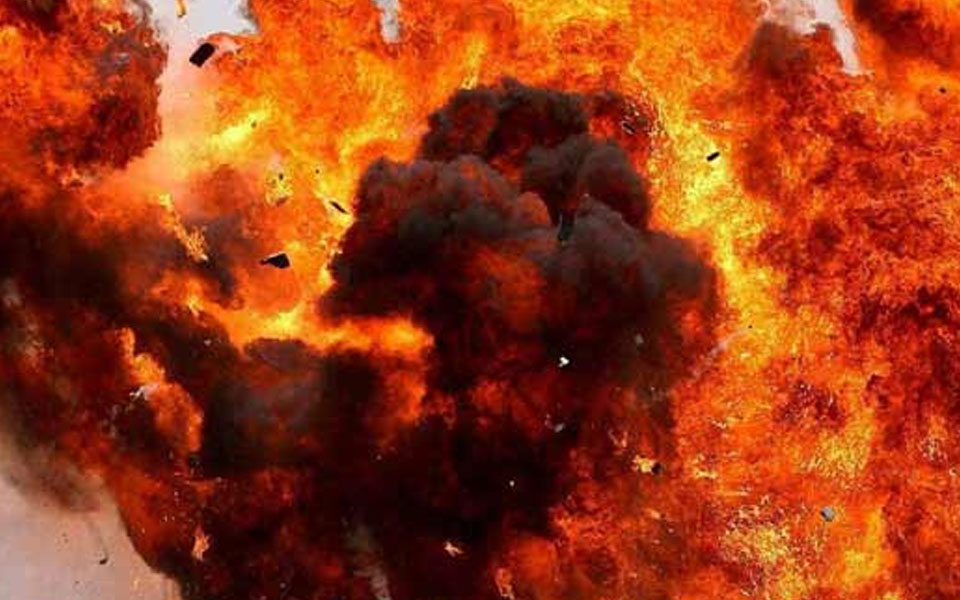
Jolo(Philippines), Jan 27 : Two bombs minutes apart tore through a Roman Catholic cathedral on a southern Philippine island where Muslim militants are active, killing at least 27 people and wounding 77 others during a Sunday Mass, officials said.
Witnesses said the first blast inside the Jolo cathedral in the provincial capital sent churchgoers, some of them wounded, to stampede out of the main door.
Army troops and police posted outside were rushing in when the second bomb went off about one minute later near the main entrance, causing more deaths and injuries. The military was checking a report that the second explosive device may have been attached to a parked motorcycle.
The initial explosion scattered the wooden pews inside the main hall and blasted window glass panels, and the second bomb hurled human remains and debris across a town square fronting the Cathedral of Our Lady of Mount Carmel, witnesses said.
Cellphone signal was cut off in the first hours after the attack. The witnesses who spoke to The Associated Press refused to give their names or were busy at the scene of the blasts.
Police said at least 27 people died and 77 were wounded. The fatalities included 20 civilians and seven troops. Among the wounded were 14 troops, two police and 61 civilians.
Troops in armoured carriers sealed off the main road leading to the church while vehicles transported the dead and wounded to the town hospital. Some casualties were evacuated by air to nearby Zamboanga city.
"I have directed our troops to heighten their alert level, secure all places of worships and public places at once, and initiate pro-active security measures to thwart hostile plans," said Defense Secretary Delfin Lorenzana in a statement.
"We will pursue to the ends of the earth the ruthless perpetrators behind this dastardly crime until every killer is brought to justice and put behind bars. The law will give them no mercy," the office of President Rodrigo Duterte said in Manila.
It said that "the enemies of the state boldly challenged the government's capability to secure the safety of citizens in that region. The (Armed Forces of the Philippines) will rise to the challenge and crush these godless criminals."
Jolo island has long been troubled by the presence of Abu Sayyaf militants, who are blacklisted by the United States and the Philippines as a terrorist organization because of years of bombings, kidnappings and beheadings. A Catholic bishop, Benjamin de Jesus, was gunned down by suspected militants outside the cathedral in 1997.
No one has immediately claimed responsibility for the latest attack.
It came nearly a week after minority Muslims in the predominantly Roman Catholic nation endorsed a new autonomous region in the southern Philippines in hopes of ending nearly five decades of a separatist rebellion that has left 150,000 people dead.
Although most of the Muslim areas approved the autonomy deal, voters in Sulu province, where Jolo is located, rejected it. The province is home to a rival rebel faction that's opposed to the deal as well as smaller militant cells that not part of any peace process.
Western governments have welcomed the autonomy pact. They worry that small numbers of Islamic State-linked militants from the Middle East and Southeast Asia could forge an alliance with Filipino insurgents and turn the south into a breeding ground for extremists.
"This bomb attack was done in a place of peace and worship, and it comes at a time when we are preparing for another stage of the peace process in Mindanao," said Gov. Mujiv Hataman of the Autonomous Region in Muslim Mindanao.
"Human lives are irreplaceable," he added, calling on Jolo residents to cooperate with authorities to find the perpetrators of this "atrocity."
Security officials were looking "at different threat groups and they still can't say if this has something to do with the just concluded plebiscite," Oscar Albayalde, the national police chief, told ABS-CBN TV network.
Hermogenes Esperon, the national security adviser, said that the new autonomous region, called Bangsamoro, "signifies the end of war for secession. It stands for peace in Mindanao."
Aside from the small but brutal Abu Sayyaf group, other militant groups in Sulu include a small band of young jihadis aligned with the Islamic State group, which has also carried out assaults, including ransom kidnappings and beheadings.
Abu Sayyaf militants are still holding at least five hostages a Dutch national, two Malaysians, an Indonesian and a Filipino in their jungle bases mostly near Sulu's Patikul town, not far from Jolo.
Government forces have pressed on sporadic offensives to crush the militants, including those in Jolo, a poverty-wracked island of more than 700,000 people. A few thousand Catholics live mostly in the capital of Jolo.
There have been speculations that the bombings may be a diversionary move by Muslim militants after troops recently carried out an offensive that killed a number of IS-linked extremists in an encampment in the hinterlands of Lanao del Sur province, also in the south.
The area is near Marawi, a Muslim city that was besieged for five months by hundreds of IS-aligned militants, including foreign fighters, in 2017. Troops quelled the insurrection, which left more 1,100 mostly militants dead and the heartland of the mosque-studded city in ruins.
Duterte declared martial law in the entire southern third of the country to deal with the Marawi siege, his worst security crisis. His martial law declaration has been extended to allow troops to finish off radical Muslim groups and other insurgents but bombings and other attacks have continued.
Let the Truth be known. If you read VB and like VB, please be a VB Supporter and Help us deliver the Truth to one and all.
10 held for sale of prohibited narcotic substances in Bengaluru

Bengaluru (PTI): In a major crackdown, the Bengaluru police on Thursday announced the arrest of 10 people allegedly involved in the sale of prohibited narcotic substances in parts of the city.
Among them are three foreign nationals, including two women, they said.
With their arrests, police claimed to have seized 5 kg of MDMA (crystal), 1 kg of cocaine, 21 kg ganja, and 19 gms ecstasy pills and a two-wheeler used in the commission of crime.
The seized drugs are worth Rs 11.81 crore, with an estimated market value of Rs 23.63 crore, they added.
According to police, based on credible information received on various dates, officers and staff came to know that prohibited narcotic substances such as MDMA (crystal), cocaine, ganja, and ecstasy pills were being sold within the limits of Yelahanka New Town, D J Halli, Koramangala, Bommanahalli, and Pulakeshinagar Police Stations.
Acting on this information, cases were registered under the NDPS (Narcotic Drugs and Psychotropic Substances) Act at the respective police stations, and raids were conducted at the identified locations, a senior police officer said.
During these operations, a total of 10 accused persons were apprehended on different dates, he said.
During interrogation, the accused confessed that, with the intention of making quick money, they were procuring narcotic substances such as MDMA (crystal), cocaine, ganja, and ecstasy pills from foreign, interstate, and local unidentified suppliers at lower prices, and selling them to the public, including college students, the officer said.
Efforts are on to trace the foreign and interstate suppliers involved in supplying these narcotic substances. Investigation in the cases is in progress, police said.
All 10 accused were produced before the Court on different dates and have been remanded to judicial custody, they added.