26 Gaza aid-seekers killed as Netanyahu faces growing criticism over expanding war
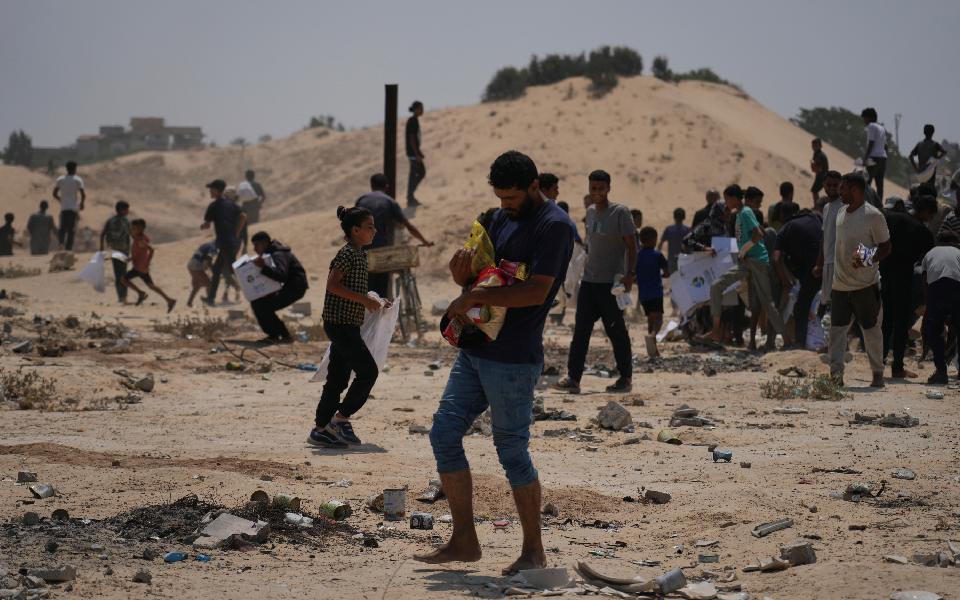
Deir al-Balah (Gaza Strip), Aug 10 (AP): At least 26 Palestinians were killed while seeking aid in the Gaza Strip, hospitals and witnesses said, as families of Israeli hostages called for a general strike to protest Prime Minister Benjamin Netanyahu's plans to expand military operations in the territory.
Netanyahu is scheduled to give a press conference for foreign and local media later Sunday amid international condemnation of his plans. His address will come just before the United Nations Security Council holds an emergency meeting on Israel's plan to take control of Gaza City.
Hospital officials said they received bodies from areas where Palestinians were seeking aid — either along food convoy routes or near privately run aid distribution points across Gaza.
The dead include 10 who were killed while waiting for aid trucks close to the newly built Morag corridor which separates the southern cities of Rafah and Khan Younis, said Nasser hospital.
A further six people were killed while waiting for aid in northern Gaza near the Zikim crossing, according to the Gaza Health Ministry and the Shifa hospital in Gaza City which received the casualties.
In central Gaza, witnesses said they first heard warning shots before the fire was aimed toward crowds of aid seekers trying to reach a food distribution site operated by Gaza Humanitarian Foundation. AP cannot independently confirm who fired the shots. The Awda hospital in the nearby Nuseirat refugee camp said four people were killed by Israeli gunfire.
“First, it was in the air, then they started to fire at the people,” said Sayed Awda, who waited hundreds of meters (yards) from the GHF site in the area.
Six other aid seekers were killed while trying to reach GHF sites in Khan Younis and Rafah, Nasser hospital said.
The US and Israel backed the foundation months ago as an alternative to the UN-run aid system, but its early operations have been marred by deaths and chaos, with aid-seekers coming under gunfire near the routes leading to the sites.
Responding to Associated Press inquiries, the GHF media office said: “There were no incidents at or near our sites today and these incidents appear to be linked to crowds trying to loot aid convoy.”
Israel's military also said there were no incidents involving Israeli troops near central Gaza aid sites.
Seven people were killed in airstrikes, local hospitals reported — three people near the fishermen's port in Gaza City and four people, two of them children, in a strike that hit a tent in Khan Younis. The Israeli military did not immediately comment on the strikes, but has accused Hamas of operating from civilian areas.
Hunger deaths mount, toll among children hits 100
Israel's air and ground offensive has displaced most of the population and pushed the territory toward famine. Two more Palestinian children died of malnutrition-related causes on Saturday, bringing the death toll among children in Gaza to 100 since the war began.
A total of 117 adults have died of malnutrition-related causes since late June when the ministry started to count this age category, it said.
The toll from hunger isn't included in the ministry's death toll of 61,400 Palestinians in the war. The ministry, part of the Hamas-run government and staffed by medical professionals, doesn't distinguish between fighters or civilians, but says around half of the dead have been women and children.
The UN and independent experts consider it the most reliable source on war casualties.
Labour strike urged in Israel over looming Gaza City offensive
The prospect of expanding the war has sparked outrage both internationally and within Israel, where bereaved families and relatives of hostages still held in Gaza urged companies to declare a general strike next week.
Tens of thousands of Israelis rallied in Tel Aviv on Saturday night in what local media called one of the largest anti-government protests in recent months.
The families and their supporters hope to pressure the government to reverse its decision to take over Gaza City, warning that expanding the war will endanger their loved ones.
Of the 251 people abducted when Hamas-led group attacked southern Israel on Oct 7, 2023, killing about 1,200, around 50 remain in Gaza, with 20 Israel believed to be alive.
Lishay Miran-Lavi, whose husband Omri is among the hostages, also appealed to US President Donald Trump and special envoy Steve Witkoff to halt the war.
“The decision to send the army deeper into Gaza is a danger to my husband, Omri. But we can still stop this disaster,” she said.
Also Sunday, Israeli Defense Minister Israel Katz toured the northern part of the Israeli-occupied West Bank. He said Israel's military would remain in the area's refugee camps at least until the end of the year.
Approximately 40,000 Palestinians have been driven from their homes this year in the West Bank's largest displacement since Israel captured the territory in 1967. Israel says the operations are needed to stamp out militancy, as violence by all sides has surged since Hamas' Oct 7, 2023, attack ignited war in Gaza.
Katz on Sunday said the number of warnings about attacks against Israelis in the West Bank had decreased by 80% since the operation began in January.
Let the Truth be known. If you read VB and like VB, please be a VB Supporter and Help us deliver the Truth to one and all.
Raghuvanshi, spinners fire KKR to seven-wicket win over SRH

Hyderabad (PTI): The promising Angkrish Raghuvanshi (59) made a well-paced fifty as Kolkata Knight Riders defeated Sunrisers Hyderabad by seven wickets in their IPL match here on Sunday.
Skipper Ajinkya Rahane (43) and Raghuvanshi added 84 runs for the second wicket as KKR overhauled SRH’s under-par 165 all out with ease.
Finn Allen made an aggressive 29 off 13 balls upfront to give KKR a brisk start.
Earlier, Travis Head made a belligerent 61 off 28 balls but KKR's spinners bowled well to restrict SRH to 165.
Mystery spinners Varun Chakravarthy (3/36) and Sunil Narine (2/31) wrecked SRH middle-order with controlled spells.
Along the way of his two-wicket burst in his fourth-over, Narine also completed 200 IPL wickets.
The spinner was the third bowler to achieve the feat after Yuzvendra Chahal and Bhuvneshwar Kumar.
Ishan Kishan made 42 off 29 balls.
Brief Scores:
Sunrisers Hyderabad: 165 all out in 19 overs (Travis Head 61, Ishan Kishan 42; Varun Chakravarthy 3/36, Sunil Narine 2/31).
Kolkata Knight Riders: 169/3 in 18.2 overs (Angkrish Raghuvanshi 59, Ajinkya Rahane 43).