35 people killed in suicide blast at political party's meeting in Pak's Khyber Pakhtunkhwa province
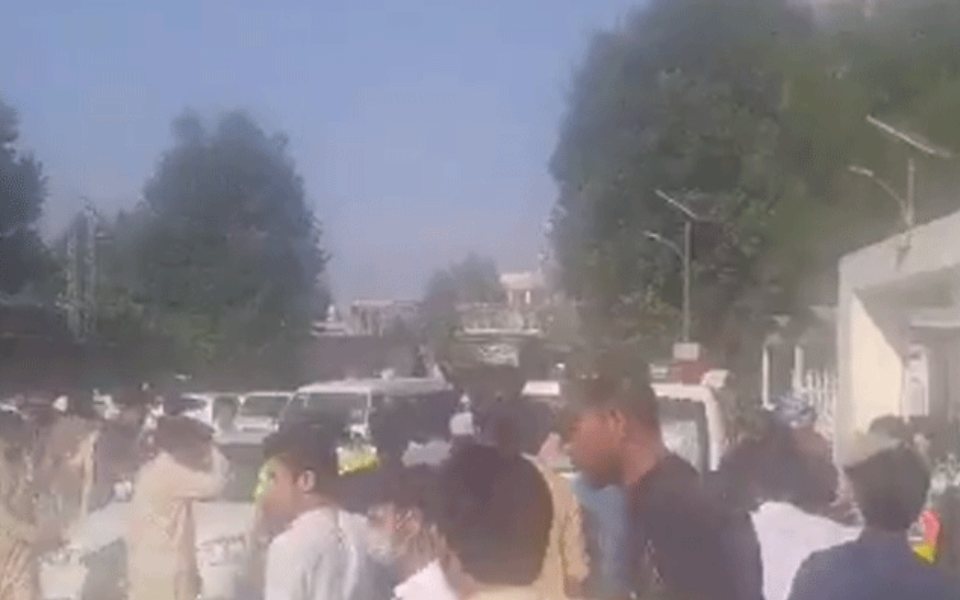
Peshawar, Jul 30: At least 35 people were killed and over 200 others injured on Sunday when a suicide bomber triggered a powerful blast at a hardline Islamic political party's meeting in a restive tribal district of Pakistan's Khyber Pakhtunkhwa province bordering Afghanistan.
The explosion took place at 4 pm at the Jamiat Ulema-e-Islam-Fazl (JUI-F) workers' convention in Khar, the capital of Bajaur tribal district.
At least 35 people were killed and over 200 injured in the blast, police and emergency sources said.
Television footage showed panic-stricken people gathering at the site following the blast as ambulances arrived to move the injured to hospitals. Over 500 people were attending the convention when the blast occurred.
DIG police Malakand Range Nasir Mehmud Satti said the initial investigation revealed it was a suicide blast. However, evidence is being collected to determine the nature of the blast.
The area was sealed and a search operation has been initiated, he said.
No group has yet claimed responsibility for the attack.
The JUI-F chief Maulana Fazlur Rehman demanded Prime Minister Shehbaz Sharif and the province's caretaker Chief Minister Azam Khan to investigate the incident.
He also urged the party workers to reach the hospital and donate blood.
"JUI workers should remain peaceful and federal and provincial governments should provide the best treatment to the injured," said Fazl.
Chief Minister Khan condemned the blast and sought a report from the district administration.
Police said that the injured have been shifted to a nearby hospital.
The condition of the majority of the injured people was stated to be critical.
Rescue 1122 spokesperson Bilal Faizi told the Dawn newspaper that five ambulances had reached the site.
JUI-F leader Hafiz Hamdullah said he was supposed to attend the convention today but could not because of some personal commitments.
"I strongly condemn the blast and want to give a message to the people behind it that this is not jihad but terrorism," the JUI-F leader said, adding that it was an attack on humanity and Bajaur.
He demanded that the blast should be probed, recalling that this was not the first that the JUI-F had been targeted.
"This has happened before...our workers have been targeted. We raised our voice over this in the Parliament but no action was taken."
Hamdullah also extended his condolences to grieving families and urged the provincial government to provide the best medical facilities to the injured.
Caretaker Information minister of the province Jamal Feroze Shah said an emergency was declared in hospitals of Peshawar and dir district.
Pakistan has witnessed a surge in terrorist attacks following the Afghan Taliban's return to power in August 2021 and called upon the interim rulers to take decisive actions against terrorists including the Tehrik-e Taliban Pakistan (TTP) responsible for cross-border attacks.
In November last year, the TTP called off an indefinite ceasefire agreed with the federal government and ordered its militants to carry out attacks on Pakistan's security forces.
On January 30, a Pakistan Taliban suicide bomber blew himself up during the afternoon prayers in a mosque in Peshawar, killing 101 people and injuring more than 200 others.
In February, heavily-armed TTP militants stormed the Karachi Police chief's office in Pakistan's most populous city, sparking gunfire that killed three rebels and four others, including two police constables.
The TTP was set up as an umbrella group of several militant outfits in 2007.
The outfit, which is believed to be close to Al-Qaeda, has been blamed for several deadly attacks across Pakistan, including an attack on army headquarters in 2009, assaults on military bases, and the 2008 bombing of the Marriott Hotel in Islamabad.
The TTP has also orchestrated the heinous Army Public School attack in Peshawar in 2014, in which over 130 students were killed.
Let the Truth be known. If you read VB and like VB, please be a VB Supporter and Help us deliver the Truth to one and all.
Ram Temple built due to commitment of those in power; India already a Hindu Rashtra: Bhagwat
Nagpur (PTI): The Ram Temple in Ayodhya was built due to the commitment of those in power and the support of everyone in the country, RSS chief Mohan Bhagwat has said, emphasising that there is no need to declare India a Hindu Rashtra as it already is.
He was addressing a programme on Monday to felicitate individuals under whose leadership and guidance the Ram temple was constructed. The programme was organised by Dr Hedgewar Smarak Samiti in Reshimbagh here, according to a release issued by RSS.
Bhagwat said the temple was built by Lord Ram’s own will. Comparing it to the lifting of Govardhan (the mountain by Lord Krishna), he said such a feat does not happen unless everyone contributes.
"It rests on the Lord’s fingertip, but that fingertip does not move until people contribute their wood. The temple was built in the same way," he said.
Bhagwat further said that for the resurgence of Sanatan Dharma, the resurgence of Bharat is essential—an idea expressed 150 years ago by Yogi Aurobindo. As each contribution is made, he said, divine power continues to guide the fulfilment of this resolve.
The process of resurgence began in 1857, he pointed out.
Referring to the 2014 Lok Sabha elections, Bhagwat said that when the new government under Prime Minister Narendra Modi took oath, The Guardian in London published an article stating, "On this day, Indians have finally said goodbye to the British."
"Technically, we said goodbye on August 15, 1947, but we were not fully certain," he added.
Bhagwat questioned whether the Ram Temple would have been built without committed leadership.
If those in power were not committed, would the temple have been built? he asked.
"Bharat must rise. But what is Bharat? What kind of resurgence? What is Bharat-India? We were lost in this dilemma, and time was also lost.
"But our country chose a path. If there hadn't been such a massive movement (Ramjanmabhoomi Andolan), would the temple have been built? The movement happened on such a scale. But if those in power weren't committed to building the Ram temple, would it have been built?" he asked.
The RSS chief reiterated that the temple was built with the support of every individual in the country.
"The decision to build the temple was made, but without a strong foundation, how would it stand? Every person in Bharatvarsh contributed. Then Lord Ram’s fingertip performed its miracle, and this process will continue," he said.
Bhagwat also noted that the idea of Hindustan as a Hindu Rashtra was once mocked.
"Hindustan is a Hindu Rashtra. Until the Ram Temple was built, people laughed at this claim. Today, the same people say Hindustan is the land of Hindus," he said.
Many people ask the RSS to declare India a Hindu Rashtra, "but we say there is no need to declare what's already true, Bhagwat stressed.
"The Sun rises in the east—do we need to declare it? Similarly, Bharat is a Hindu Rashtra; it is already a reality, and everyone accepts it. But back then? Everyone mocked it. Those early inexperienced workers had faith in their hearts, belief in (RSS founder) Dr Hedgewar's words, so despite all this, they kept working," he said.
Bhagwat said the felicitation event was a way to express gratitude to all those who contributed to building the temple.
"They have done their work; now we must do ours. They were given the specific task of building the temple, and they excelled beyond expectations, making it more grand and beautiful than imagined, and it will be even more beautiful," he added.
Future plans are underway, Bhagwat said and called on people to contribute towards making the nation stronger and more prosperous.
"We must work to make it greater, more grand, and more beautiful than imagined, so that Dharma is established in the world,” he said.
He said the world's need can only be fulfilled by Bharat, and Bharat's resurgence will be done by Bharat's children, and that no other country will save Bharat.
"Bharat will rise great and save the whole world. This is written fate. If we contribute to fulfilling it, it will happen sooner, with minimal loss," he added.