40 dead, many feared buried in mud after Brazil dam collapse
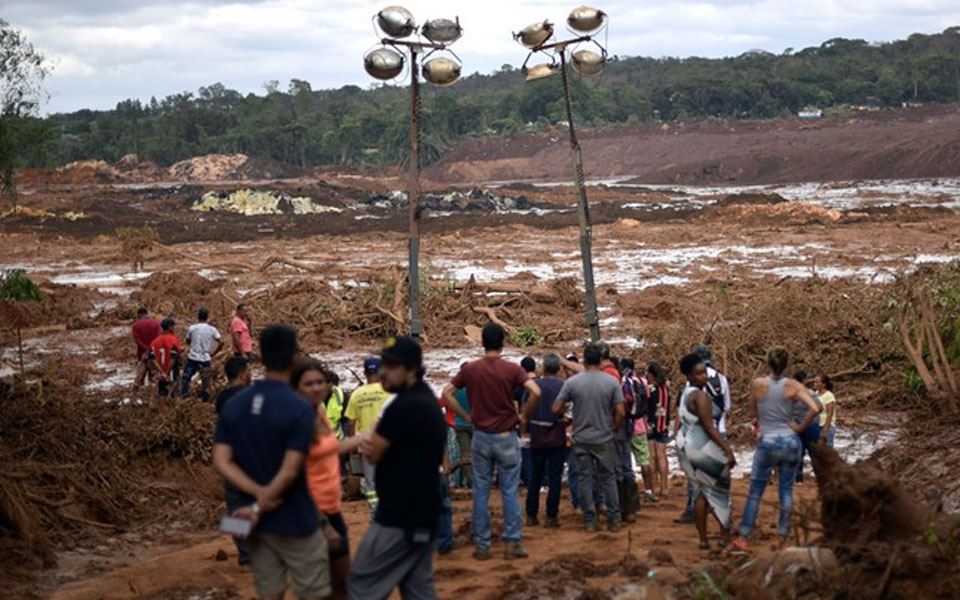
Brumadinho (Brazil), Jan 27 : The death toll from the collapse of a dam holding back mine waste in southeastern Brazil rose to 40 on Saturday as searchers flying in helicopters and rescuers labouring in deep mud uncovered more bodies.
An estimated 300 people were still missing and authorities expected the death toll to increase during a search made more challenging by intermittent rains.
Scores of families in the city desperately awaited word on their loved ones, and Romeu Zema, governor of Minas Gerais state, promised that those responsible "would be punished".
Employees of the mining complex owned and operated by Brazilian mining company Vale were eating lunch Friday afternoon when the dam gave way, unleashing a sea of reddish-brown mud that knocked over and buried several structures of the company and surrounding areas.
The level of devastation quickly led President Jair Bolsonaro and other officials to describe it as a "tragedy".
The flow of waste reached the nearby community of Vila Ferteco and an occupied Vale administrative office. On Saturday, rooftops poked above an extensive field of the mud, which also cut off roads. After the dam collapse, some were evacuated from Brumadinho. Other residents of the affected areas barely escaped with their lives.
"I saw all the mud coming down the hill, snapping the trees as it descended. It was a tremendous noise," said a tearful Simone Pedrosa, from the neighbourhood of Parque Cachoeira, about 8 kilometres from where the dam collapsed.
Pedrosa, 45, and her parents dashed to their car and drove to the highest point in the neighbourhood. "If we had gone down the other direction, we would have died," Pedrosa said, adding that she had a feeling "that this was the end of my life".
"I cannot get that noise out of my head," she said. "It's a trauma ... I'll never forget."
In addition to the 40 bodies recovered as of Saturday afternoon, 23 people were hospitalised, said authorities with the Minas Gerais fire department. There had been some signs of hope earlier Saturday when authorities found 43 more people alive. Company officials also had said that 100 workers were accounted for.
But the company said in a statement Saturday afternoon that more than 200 workers were still missing, while fire officials at one point estimated the total number at close to 300. Vale CEO Fabio Schvartsman said he did not know what caused the collapse. About 300 employees were working when it happened.
Emergency workers suspended their search shortly after nightfall. They planned to resume at first light Sunday morning.
For many, hope was fading to anguish. "I don't think he is alive," said Joao Bosco, speaking of his cousin, Jorge Luis Ferreira, who worked for Vale.
"Right now I can only hope for a miracle of God." Vanilza Sueli Oliveira described the wait for news of her nephew as "distressing, maddening." "Time is passing," she said. "It's been 24 hours already. ... I just don't want to think that he is under the mud."
The rivers of mining waste also raised fears of widespread contamination. According to Vale's website, the waste, often called tailings, is composed mostly of sand and is non-toxic. However, a UN report found that the waste from a similar disaster in 2015 "contained high levels of toxic heavy metals".
On Friday, Minas Gerais state court blocked USD 260 million from Vale for state emergency services and told the company to present a report about how they would help victims. On Saturday, the state's justice ministry ordered an additional USD 1.3 billion blocked.
Brazil's Attorney General, Raquel Dodge, promised to investigate, saying "someone is definitely at fault". Dodge noted there are 600 mines in the state of Minas Gerais alone that are classified as being at risk of rupture.
Another dam administered by Vale and Australian mining company BHP Billiton collapsed in 2015 in the city of Mariana in Minas Gerais state, resulting in 19 deaths and forcing hundreds from their homes.
Considered the worst environmental disaster in Brazilian history, it left 250,000 people without drinking water and killed thousands of fish. An estimated 60 million cubic metres of waste flooded rivers and eventually flowed into the Atlantic Ocean.
Schvartsman said what happened Friday was "a human tragedy much larger than the tragedy of Mariana, but probably the environmental damage will be less".
Sueli de Oliveira Costa, who hadn't heard from her husband since Friday, had harsh words for the mining company. "Vale destroyed Mariana and now they've destroyed Brumadinho," she said.
Daily Folha de S.Paulo reported Saturday that the dam's mining complex was issued an expedited license to expand in December due to "decreased risk". Preservation groups in the area alleged that the approval was unlawful.
On Twitter, President Bolsonaro said his government would do everything it could to "prevent more tragedies" like Mariana and now Brumadinho. The far-right leader campaigned on promises to jump-start Brazil's economy, in part by deregulating mining and other industries.
Environmental groups and activists said the latest spill underscored a lack of regulation, and many promised to fight any further deregulation by Bolsonaro in Latin America's largest nation.
"History repeats itself," tweeted Marina Silva, a former environmental minister and three-time presidential candidate. "It's unacceptable that government and mining companies haven't learned anything."
Let the Truth be known. If you read VB and like VB, please be a VB Supporter and Help us deliver the Truth to one and all.
Online fraud: Hotel chef from Udupi cheated of over Rs 1 lakh by WhatsApp contact

Udupi: Udupi City Police have registered a case of online fraud after a 62-year-old hotel chef was allegedly cheated of Rs 1.13 lakh by a woman who befriended him on WhatsApp, claiming to be based in London.
The victim, identified as Pandu Kariappa Poojary, a resident of Kuthpadi in Udupi, was working at a hotel in Mangaluru.
He reportedly came into contact with a woman identifying herself as Emilda William on WhatsApp. During their interactions, she told Poojary that she planned to start a cosmetics and hotel business in India and would meet him during a visit to Mangaluru.
On April 7, Emilda sent Poojary a flight ticket from London to Delhi via WhatsApp. The following day, Poojary received a phone call from a woman who informed him that Emilda had arrived at Delhi airport carrying a demand draft worth Rs 5 crore along with other items. The caller allegedly asked him to pay Rs 70,000.
Subsequently, Poojary also received a call from Emilda, who was reportedly crying and spoke about the situation. Believing the claims, he transferred a total of Rs 1,13,300 in phases using a scanner. He later realised that he had been cheated.