43-year-old Ethiopian PM Abiy Ahmed collects Nobel Peace Prize, urges unity against hatred
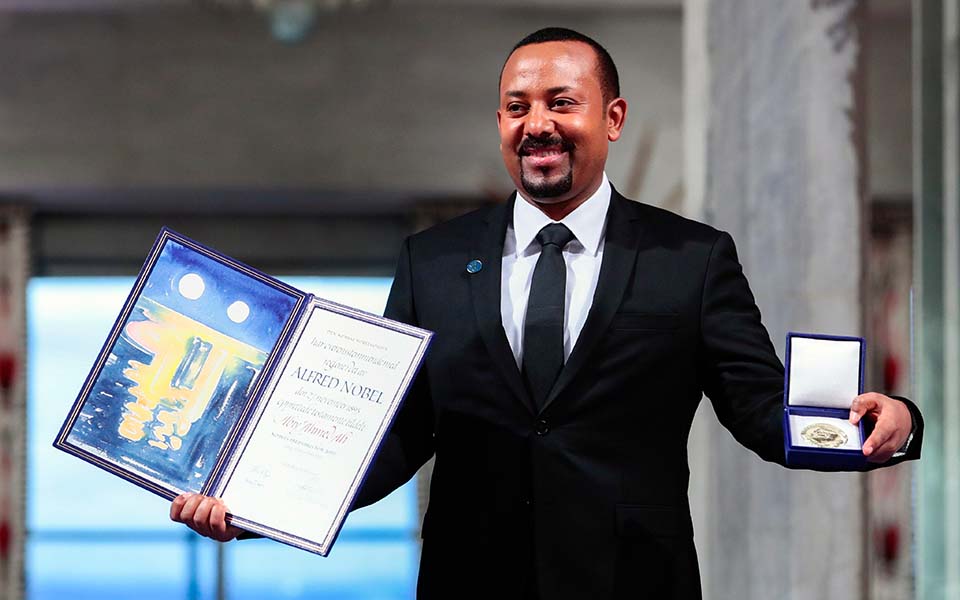
Oslo, Dec 10: Ethiopian Prime Minister Abiy Ahmed collected the Nobel Peace Prize in Oslo on Tuesday, appealing for unity as ethnic violence flares in his country and reconciliation efforts with neighbouring former foe Eritrea have stalled.
Abiy, 43, won the Nobel for his efforts to resolve the long-running conflict with Eritrea. Announced back in October, the prize also honoured his mediation efforts in eastern Africa and the democratic reforms he has undertaken in his country, long ruled by authoritarian leaders.
Ethiopia saw spectacular progress in the months after he took power in April 2018, but the winds have since shifted: in addition to the stalled peace process with Eritrea, his reforms aimed at opening up Ethiopia have paradoxically given rise to a flare-up of ethnic tensions.
Faced with these challenges, Africa's youngest leader called for unity as he picked up his award at Oslo's flower-bedecked City Hall, in a formal ceremony attended by the Norwegian royal family and dignitaries.
"There is no 'Us and Them'," he said. "There is only 'Us', for 'We' are all bound by a shared destiny of love, forgiveness and reconciliation." On July 9, 2018, following a historic meeting in Eritrea's capital Asmara, Abiy and Eritrean President Isaias Afwerki formally ended a 20-year-old stalemate between their countries in the wake of the 1998-2000 border conflict.
That was just three months after Abiy took office.
On Tuesday, Abiy was quick to praise the role of his Eritrean "partner and comrade-in-peace" -- the only leader Eritrea has known since it gained independence in 1993 -- in his Nobel Prize.
"We understood our nations are not enemies. Instead, we were victims of the common enemy called poverty," he said.
A former soldier himself, Abiy also testified to the ravages of war, recalling how his entire unit had been wiped out in an Eritrean artillery attack but he had survived after briefly leaving a foxhole to get better antenna reception.
"War is the epitome of hell for all involved," he said.
During the lightning-fast rapprochement that followed the peace deal with Asmara, embassies reopened, flights resumed and meetings were held across the region.
But the "Abiymania" hype has faded and he is now facing major challenges.
The land border between the two nations is once again closed, and the question of border demarcations remains unresolved.
"At present, this work seems to be at a standstill," said the head of the Norwegian Nobel Committee, Berit Reiss-Andersen.
"It is the hope of the Norwegian Nobel Committee that your previous achievements, coupled with added encouragement of the Peace Prize, will spur the parties to further implementation of the peace treaties," she added.
Abiy has vowed to hold the first "free, fair and democratic" elections since 2005 in May, and experts fear the Ethiopian leader may have to shift his attention away from the peace process to focus on the vote.
In stark contrast to his authoritarian predecessors, Abiy has lifted the state of emergency, released dissidents from jail, apologised for state brutality and welcomed home exiled armed groups.
He also established a national reconciliation committee and lifted a ban on some political parties.
But less than two weeks after the Nobel announcement in October, anti-Abiy protests left 86 people dead.
In his Nobel speech, he denounced the "evangelists of hate and division" who are "wreaking havoc in our society using social media".
Meanwhile, the Nobel festivities have been tainted by Abiy's refusal to field questions from the media, as the ex-intelligence chief has considerably shortened the traditional Nobel programme and cut out all news conferences.
The head of the Nobel Institute, Olav Njolstad, called the decision "highly problematic", noting that a "free press and freedom of expression are essential conditions for a lasting peace in a democracy." Abiy's entourage responded that it was "quite challenging" for a sitting leader to spend several days at such an event, especially when "domestic issues are pressing and warrant attention".
They also said Abiy's "humble disposition" contrasted with "the very public nature of the Nobel award".
The Nobel Peace Prize consists of a diploma, a gold medal and a cheque for nine million Swedish kronor (850,000 euros, 9,45,000).
The other Nobel prizes for literature, physics, chemistry, medicine and economics will also be handed over on Tuesday, but in Stockholm.
Let the Truth be known. If you read VB and like VB, please be a VB Supporter and Help us deliver the Truth to one and all.
AIITA welcomes Karnataka’s ban on obscene songs in school events
Bhatkal: The Karnataka unit of the All India Ideal Teachers Association (AIITA) has welcomed the Karnataka government’s decision to strictly ban school children from dancing to obscene songs during educational and cultural programmes in government, aided, and private schools across the state.
AIITA Karnataka State President M. R. Manvi congratulated the government for taking what he termed an important step to preserve the sanctity of education.
“Such decisions to safeguard the dignity of school children and uphold the values of education are the need of the hour. This rule should not be limited to government schools alone but must be strictly implemented in all private educational institutions as well,” he said.
He further urged the government to address other concerns within school programmes.
“The government should not only prohibit obscene dances in the name of school anniversaries, but also ensure that plays and dialogues that incite religious hatred are avoided. Schools should be centres of harmony, not platforms for spreading hatred,” he added.
According to a recent circular issued by the Department of School Education and Literacy, obscene dances are adversely affecting the mental health and moral values of students.
In this regard, schools have been advised to use songs that promote nationalism, positive thinking, the greatness of Kannada culture, and value-based traditions instead of inappropriate content during programmes.
The circular also emphasises that students should be dressed in decent attire.
AIITA also backed the department’s warning that disciplinary action would be taken against head teachers if such guidelines are violated. The association has further demanded that district Deputy Directors of Public Instruction strictly monitor the implementation of these rules.