50 Indian diplomats, security personnel evacuated from Afghanistan's Kandahar as Taliban advances
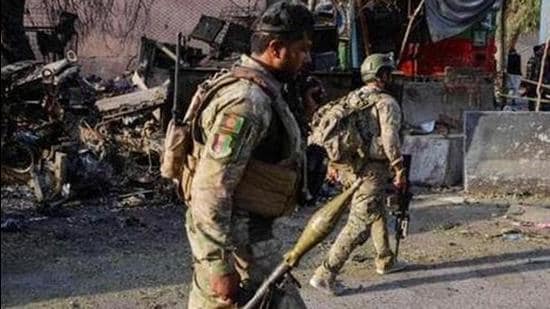
New Delhi, Jul 11: India has pulled out around 50 diplomats and security personnel from its consulate in Kandahar in Afghanistan in view of the deteriorating security situation and the Taliban gaining control of new areas around the southern Afghan city, people familiar with the development said on Sunday.
A special aircraft of the Indian Air Force was sent on Saturday to bring back the Indian diplomats, officials and other staff members including a group of Indo-Tibetan Border Police personnel, they said.
India's move to temporarily shut the consulate in Kandahar came in view of Taliban fighters rapidly seizing control of a number of key areas in the region as well as in western Afghanistan triggering huge security concerns.
On Tuesday, the Indian embassy in Kabul said there was no plan to close the embassy and the consulates in Kandahar and Mazar-e-Sharif.
Two days back, the Ministry of External said India was carefully monitoring the deteriorating security situation in Afghanistan and its implications on the safety and security of Indian nationals.
"Our response will be calibrated accordingly," External Affairs Ministry Spokesperson Arindam Bagchi said at a media briefing on Thursday.
Afghanistan witnessed a series of terror attacks in the last few weeks as the US looked to complete the withdrawal of its forces from Afghanistan by August-end, ending a nearly two-decade of its military presence in the war-ravaged country.
There were reports that at least two foreign missions in Mazar-e-Sharif, the capital of northern Balkh province, have closed their operation in view of escalating violence in the region.
Amid growing concerns in India over the deteriorating situation in Afghanistan, Afghan Ambassador Farid Mamundzay on Tuesday briefed Foreign Secretary Harsh Vardhan Shringla on the situation in Afghanistan.
The Indian embassy last week asked all Indians visiting, staying and working in Afghanistan to exercise the utmost caution with regard to their security and avoid all types of non-essential travel in view of rising incidents of violence in various parts of the country.
In an advisory, the embassy said the security situation in Afghanistan remains "dangerous" and that terror groups have carried out a series of complex attacks including targeting civilians, adding Indian nationals additionally face a "serious threat" of kidnapping.
India has been a major stakeholder in the peace and stability of Afghanistan. It has already invested nearly USD three billion in aid and reconstruction activities in the country.
India has been supporting a national peace and reconciliation process which is Afghan-led, Afghan-owned and Afghan-controlled.
In March, Afghan Foreign Minister Mohammad Haneef Atmar visited India during which Jaishankar conveyed to him India's long-term commitment towards a peaceful, sovereign and stable Afghanistan.
Let the Truth be known. If you read VB and like VB, please be a VB Supporter and Help us deliver the Truth to one and all.
Two injuries, one DNF, a DQ as India end messy World Relays campaign

Gaborone (Botswana) (PTI): Amoj Jacob and Ragul Kumar got injured during the men's 4x400m and 4x100 races respectively as India ended their World Athletics Relays campaign in disappointment on the second day of competitions here on Sunday.
The Indian camp had high hopes of making the 2027 World Championships in the men's 4x400m relay but the team did not finish (DNF) the race as Jacob suffered cramps and pulled out of the race after taking the baton from the first leg runner Dharamveer Choudhary. Rajesh Ramesh and Vishal TK were to run in the third and fourth legs.
Those teams which could not qualify for the 2027 Beijing World Championships by reaching the final round of each of the six relay events on Saturday were given another chance in the second qualification round on Sunday.
The top two teams in each of the two heats (in all six relay events) booked the Beijing ticket on Sunday.
India will now have to try and qualify for the World Championships through the Top Lists of the World Athletics, which is a long and tedious process.
In the men's 4x100m race, third leg runner Ragul Kumar fell down the track after failing to hand over the baton inside the exchange zone to fourth leg runner Gurindervir Singh, which clearly showed the lack of coordination among the runners.
Harsh Santosh Raut and Animesh Kujur ran the first two legs.
The Indian quartet was disqualified and Kumar was seen being taken away from the Field of Play with the help of the volunteers.
It was a comedy of errors in the case of the women's 4x100m race, which saw the baton being dropped during an exchange between first leg runner Tamanna and second runner Nithya Gandhe, though the Indians finished the race in 53.09 seconds.
Gandhe started running quite a distance, but after realising that the baton was not in her hand, she turned and ran back to pick it up.
The only silver-lining for the Indian contingent was the national record time in the mixed 4x100m relay race, though the quartet of Ragul Kumar, Nithya Gandhe, Animesh Kujur and Sneha SS finished sixth in heat number two with a time of 41.35 seconds, bettering the previous national mark of 42.30 seconds set in March in Chandigarh.
The mixed 4x400m relay quartet of Theerthesh P Shetty, Kumari Saloni, Nihal William and Rashdeep Kaur ended at fifth in heat number one with a time of 3 minutes and 19.40 seconds.
On Saturday, all the five Indian relay teams had failed to make it to the respective final rounds and thus missed out on the 2027 World Championships berths.