Powerful quake kills at least 568 people in Turkey, Syria
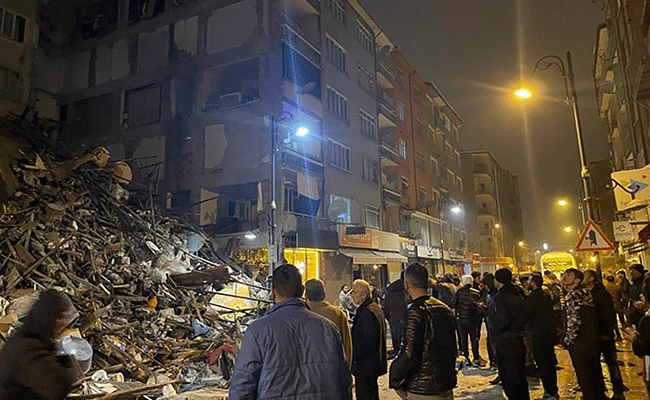
Ankara (AP): A Turkish official says the death toll from a powerful earthquake that struck southeast Turkey on Monday is now at 284.
That brings the overall death toll in Turkey and Syria to 568
Turkish Vice President Fuat Oktay says at least 2,300 people were injured across 10 provinces affected by the quake and 1,700 buildings collapsed.
A powerful 7.8 magnitude earthquake hit southern Turkey and northern Syria early Monday, toppling buildings and killing at least 360 people. With hundreds injured, the toll was expected to rise as rescue workers searched the rubble in cities and towns across the area.
On both sides of the border, residents jolted out of sleep by the pre-dawn quake rushed outside on a cold, rainy and snowy winter night, as buildings were flattened and strong aftershocks continued.
Rescue workers and residents in multiple cities searched for survivors, working through tangles of metal and giant piles of concrete.
In the Turkish city of Adana, one resident said three buildings near his home collapsed.
"I don't have the strength anymore," one survivor could be heard calling out from beneath the rubble as rescue workers tried to reach him, said the resident, journalism student Muhammet Fatih Yavus. Further east in Diyarbakir, cranes and rescue teams rushed people on stretchers out of a mountain of pancaked concrete floors that was once an apartment building.
On the Syrian side of the border, the quake smashed opposition-held regions that are packed with some 4 million people displaced from other parts of Syria by the country's long civil war. Many of them live in decrepit conditions with little health care. Rescue workers said hospitals in the area were quickly filled with the injured.
"We fear that the deaths are in the hundreds," Muheeb Qaddour, a doctor, said by phone from the town of Atmeh, referring to the entire rebel-held area.
Raed Salah, the head of the White Helmets, the emergency organization in opposition areas, said whole neighbourhoods were collapsed in some areas.
The quake, felt as far away as Cairo, struck a region that has been shaped by more than a decade of civil war in Syria.
Millions of Syrian refugees live in Turkey.
The swath of Syria affected by the quake is divided between government-held territory and the country's last opposition-held enclave, which is surrounded by Russian-backed government forces.
The quake was centered about 90 kilometers (60 miles) from the Syrian border outside the city of Gaziantep, a major Turkish provincial capital.
At least 20 aftershocks followed, some hours later during daylight, the strongest measuring 6.6, Turkish authorities said.
Turkish President Recep Tayyip Erdogan said on Twitter that "search and rescue teams were immediately dispatched" to the areas hit by the quake.
"We hope that we will get through this disaster together as soon as possible and with the least damage," he wrote.
Turkey's Disaster and Emergency Management agency said at least 76 people in seven Turkish provinces.
The agency said 440 people were injured. The death toll in government-held areas of Syria climbed to 237 with more than 630 injured, according to Syrian state media.
At least 47 people were reported killed in rebel-held areas.
Buildings were reported collapsed in a cross-border swath extending from Syria's cities of Aleppo and Hama to Turkey's Diyarbakir, more than 330 kilometers (200 miles) to the northeast.
In Turkey, people trying to leave the quake-stricken regions caused traffic jams, hampering efforts of emergency teams trying to reach the affected areas.
Authorities urged residents not to take to the roads. Mosques around the region were being opened up as a shelter for people unable to return to damaged homes amid temperatures that hovered around freezing.
The quake heavily damaged Gaziantep's most famed landmark, its historic castle perched atop a hill in the centre of the city. Parts of the fortresses' walls and watch towers were levelled and other parts heavily damaged, images from the city showed.
In Diyarbakir, rescue teams called for silence as they tried to listen for survivors under the wreckage of an 11-story building.
Rescue workers pulled out one man, carrying him on a stretcher through a dense crowd of hundreds of people anxiously watching the rescue efforts.
A gray-haired woman wailed before being escorted away by a man, while a rescue worker wearing a white helmet tried to calm a crying girl, who was also being cuddled by two friends.
In northwest Syria, the quake added new woes to the opposition-held enclave centered on the province of Idlib, which has been under siege for years, with frequent Russian and government airstrikes.
The territory depends on a flow of aid from nearby Syria for everything from food to medical supplies.
The opposition's Syrian Civil Defense described the situation there as "disastrous" adding that entire buildings have collapsed and people are trapped under the rubble.
In the small Syrian rebel-held town of Azmarin in the mountains by the Turkish border, the bodies of several dead children, wrapped in blankets, were brought to a hospital.
The U.S. Geological Survey said the quake was centered about 33 kilometers (20 miles) from Gaziantep.
It was centered 18 kilometers (11 miles) deep.
In Damascus, buildings shook and many people went down to the streets in fear. The quake jolted residents in Lebanon from beds, shaking buildings for about 40 seconds. Many residents of Beirut left their homes and took to the streets or drove in their cars away from buildings.
Turkey sits on top of major fault lines and is frequently shaken by earthquakes. Some 18,000 were killed in powerful earthquakes that hit northwest Turkey in 1999. (AP)
Let the Truth be known. If you read VB and like VB, please be a VB Supporter and Help us deliver the Truth to one and all.
Man jumps to death from 22nd floor of posh Noida society; depression suspected

Noida (PTI): A 37-year-old man allegedly died by suicide after jumping from the 22nd floor of a posh residential society in Sector 107 here, police said on Monday.
The incident took place on Sunday in Prateek Edifice Society under the jurisdiction of the Sector-39 police station. The deceased has been identified as Sajjal Mehrotra, a company director who lived in the society with his family.
"On Sunday afternoon, he jumped from the balcony of his flat on the 22nd floor," a police official said.
Family members and security guards rushed him to a nearby hospital, where doctors declared him dead, police said, adding that no suicide note has been found.
Prima facie, the deceased was suffering from depression, officials said, adding that other aspects of the case are being investigated.
The body has been sent for post-mortem and further legal formalities are underway.
Police said the man got married about 10 years ago and is survived by his wife and two children. No complaint has been received from the family in connection with the incident.
(Assistance for overcoming suicidal thoughts is available on the state’s health helpline 104, Tele-MANAS 14416.)