Gunmen kill at least 11 people at Jewish event at Sydney's Bondi Beach
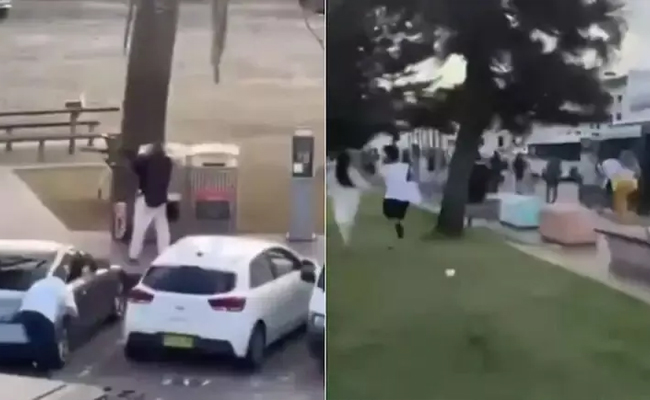
Sydney (AP): Two gunmen shot dead at least 11 people on Sunday at a Jewish event being held at Sydney's Bondi Beach, Australian authorities said, declaring it a terrorist attack. One gunman was fatally shot by police, and the second was arrested.
The suspect was in critical condition, authorities said. A massive emergency response was underway, with injured people loaded into ambulances.
At least 29 people were confirmed wounded, said Mal Lanyon, the police commissioner for New South Wales state, where Sydney is located. Two of those hurt were police officers.
“This attack was designed to target Sydney's Jewish community,” the state's Premier Chris Minns said. The massacre was declared a terrorist attack due to the event targeted and the weapons used, Lanyon said.
Hundreds had gathered for an event at Bondi Beach called Chanukah by the Sea, which was celebrating the start of the Hanukkah Jewish festival.
Dramatic footage apparently filmed by a member of the public and broadcast on Australian television channels showed someone appearing to tackle and disarm one of the gunmen, before pointing the man's weapon at him.
ALSO READ: Fight for Indian democracy: Priyanka Gandhi Vadra tells gathering at mega rally against ‘vote theft’
Lachlan Moran, 32, from Melbourne, was waiting for his family nearby when he heard shots, he told The Associated Press. He dropped the beer he was carrying for his brother and ran.
“You heard a few pops, and I freaked out and ran away. ... I started sprinting. I just had that intuition. I sprinted as quickly as I could," Moran said. He said he heard shooting off and on for about five minutes.
“Everyone just dropped all their possessions and everything and were running, and people were crying, and it was just horrible," Moran said.
Police said their operation was “ongoing" and that a “number of suspicious items located in the vicinity” were being examined by specialist officers, including an improvised explosive device found in one of the suspect's cars. Emergency services were called to Campbell Parade about 6.45 pm, responding to reports of shots being fired.
Local news outlets spoke to distressed and bloody bystanders. Lanyon said the death toll from the shooting was “fluid” and that injured people were still arriving at hospitals.
“Our heart bleeds for Australia's Jewish community tonight,” Minns told reporters in Sydney. “I can only imagine the pain that they're feeling right now to see their loved ones killed as they celebrate this ancient holiday.”
Prime Minister Anthony Albanese said in a statement that his thoughts were with all those affected.
“The scenes in Bondi are shocking and distressing,” he said. “Police and emergency responders are on the ground working to save lives.”
Mass shooting deaths in Australia are extremely rare. A 1996 massacre in the Tasmanian town of Port Arthur, where a lone gunman killed 35 people, prompted the government to drastically tighten gun laws and made it much more difficult for Australians to acquire firearms.
Significant mass shootings this century included two murder-suicides with death tolls of five people in 2014 and seven in 2018, in which gunmen killed their own families and themselves.
In 2022, two police officers were shot and killed by Christian extremists at a rural property in Queensland state. The three shooters in that incident, conspiracy theorists who hated the police, were also shot and killed by officers after a six-hour siege in the region of Wieambilla, along with one of their neighbours.
Let the Truth be known. If you read VB and like VB, please be a VB Supporter and Help us deliver the Truth to one and all.
Stalin claims DMK secured 1.54 crore votes
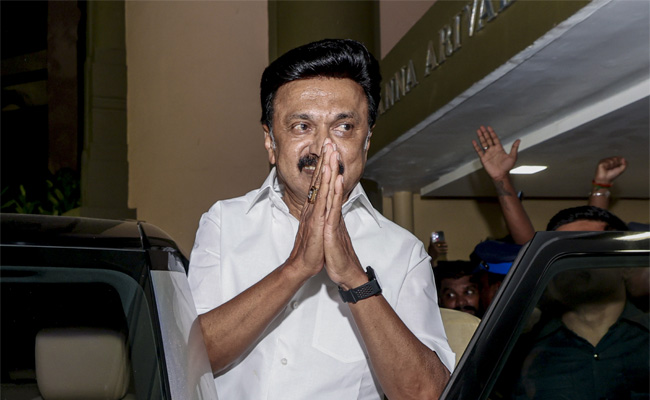
Chennai (PTI): DMK president M K Stalin on Tuesday, in a veiled reference to the TVK, claimed that the party that won additional constituencies has gained only 17.43 lakh more votes than the DMK.
He was referring to the April 23 Assembly polls where the DMK and its allies secured 74 seats, with the Dravidian party netting 59 constituencies.
In a statement, Stalin said, "the percentage difference in votes between us and them is just 3.52 per cent," in an apparent reference to the Vijay-led Tamilaga Vettri Kahzagam emerged victorious in the polls, the results of which were announced on Monday.
Claiming that the DMK alliance has secured 1.54 crore votes, Stalin said, "I consider each and every one of your votes as an invaluable token of trust".
Stating that DMK has been in power several times, he said "there is no victory we have not seen and there is no defeat we have not faced".
"Whether in victory or defeat, those who regard them equally and continue their journey toward their ideals are the comrades of the party", he said adding "you are the lifeblood and roots of the movement".
"The harvest of 1.54 crore votes is the fruit of your commitment", he said.
"What return can I offer for your hard work? With the feeling of being the chief worker, we will continue our journey," the DMK chief added.
Stalin said "if we are the ruling party, we will formulate schemes for the people. If we are the opposition party, we will fight for the people's demands. In that regard, now as a strong opposition party, we will continue to work for the people".
Asserting that the DMK will continue the journey of taking forward the policies of the century-old great Dravidian movement, protecting race, language, and nation, the DMK leader said "in our journey, I will not leave anyone behind. We will win again".