9-year-old boy from Pune scales Mount Kilimanjaro
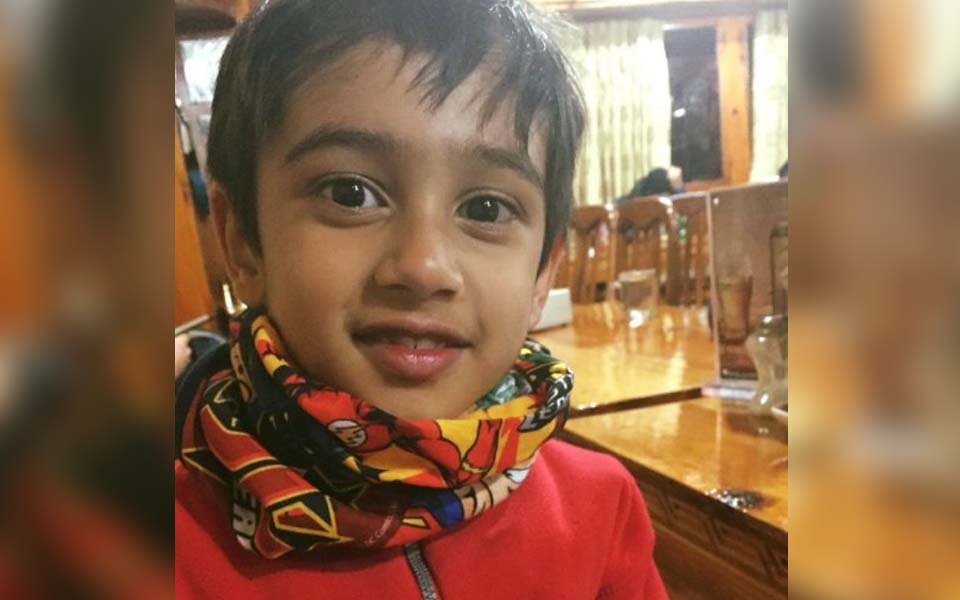
New Delhi, Aug 14: Most nine-year-olds would find it difficult to even put a finger on Mount Kilimanjaro on a map, but not Advait Bhartia, who recently scaled the the highest free-standing mountain in the world.
Mount Kilimanjaro in Tanzania, at 19,341 feet above sea level, is also the highest in Africa.
Fondly called 'Simbum ToTo' (Little Simba), Advait reached the top of mountain on July 31, under the supervision of his expedition leader Samir Patham.
To successfully accomplish the hike, the nine-year-old from Pune took the most recommended Machame route that begins at the southern base of the mountain.
Advait, who also successfully trekked to the Everest base camp as a boy of six in 2016, finished the summit in seven days.
"This trek was really difficult but fun at the same time. When I was summitting (sic) the Everest Base Camp, we were living in wooden houses but during the Kilimanjaro trek, we stayed in tents and it was a good experience being exposed to snow and the surroundings.
"I could have completed the trek faster but the mountains were very beautiful and I took a lot of breaks to take in the beauty," Advait, who has Europe's highest peak Mount Elbrus on his bucket list for next year, said.
He added that thin air, reducing atmospheric oxygen by approximately 50 per cent, and sub-zero temperatures ranging between minus 21 and 25 degrees celsius at higher altitudes were some of the challenges he braved during his expedition.
According to his mother Payal Bhartia, Advait underwent stringent training over a period of two months to gear up for the climb.
"His routine included swimming for an hour, cardiovascular training like playing football, cricket and tennis in the second hour and climbing 100 floors and practising Parkour (military obstacle training) was a regular part of the training during the third hour," she added.
Payal, who accompanied her son during the hike, had to cut short her journey by 1000 ft on the way up as she was unable to acclimatise to the increasing altitude.
"I am very proud of Advait and his dedication towards completing this trek. On the last day, Advait got emotional and he individually thanked the porters, the tent pitchers and the catering team for all their efforts," she said.
The trek was organized by Pune-based adventure and trekking company Adventure Pulse.
Let the Truth be known. If you read VB and like VB, please be a VB Supporter and Help us deliver the Truth to one and all.
Hospital wall collapse: CM orders suspension of executive engineer; kin of victims get solatium
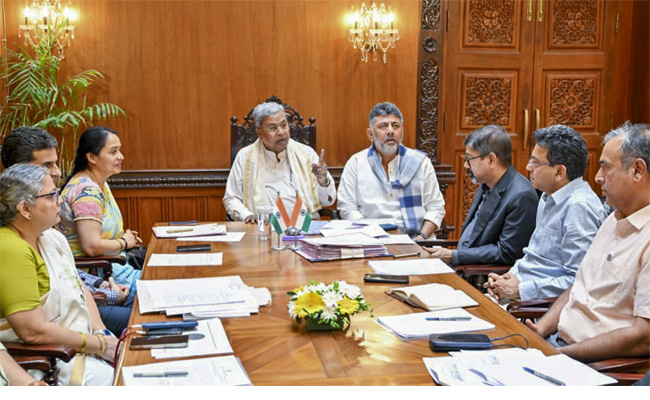
Bengaluru (PTI): Karnataka Chief Minister Siddaramaiah on Thursday ordered the immediate suspension of an executive engineer for the Bowring and Lady Curzon Hospital wall collapse that claimed the lives of seven people, during a high-level review meeting at Vidhana Soudha.
A compensation of Rs 5 lakh, as announced by the CM Siddaramaiah, was distributed to the families of seven victims who lost their lives in the tragedy on Wednesday evening, which occurred due to heavy downpour with gusty winds and hailstorm.
The meeting of municipal commissioners of the five corporations, chaired by the chief minister and attended by Deputy Chief Minister D K Shivakumar, focused on fixing accountability and examining lapses that led to the tragedy.
"Why was soil dumped in a way that damaged the wall? Why did you not monitor this?" Siddaramaiah asked, pulling up hospital authorities during the meeting.
A statement from the chief minister's office said that the CM ordered the immediate suspension of the executive engineer of the Karnataka Health Systems Development Project (KHSDP).
ALSO READ: Three arrested for running fake Aadhaar racket in UP's Badaun
He also questioned the hospital authorities, asking why they failed to monitor the dumping of soil that weakened the structure.
The chief minister directed that a notice be issued to the head of the Hospital.
During the meeting, Siddaramaiah said the rains had caused extensive damage in the city, with over 250 trees uprooted.
The Chief Minister instructed officials to take necessary measures before the onset of the monsoon to avoid untoward incidents.
Commissioners of all five municipal zones in Bengaluru have been asked to take precautionary steps, including trimming dry and dangerous tree branches, the CMO said.
Siddaramaiah also directed them to get the silt cleared from stormwater drains to prevent flooding, and that immediate action be taken to remove debris and fallen branches from roads.
Further, he instructed that barricades be placed at underpasses where water stagnates and restricts public movement.
The Greater Bengaluru Authority (GBA) Chief Commissioner M Maheshwar Rao said in a statement that Shivajinagar MLA Rizwan Arshad distributed compensation cheques of Rs 5 lakh each to the families of the deceased on Thursday.
Seven people, including a six-year-old girl, were killed and seven others injured when the compound wall collapsed amid heavy rain, strong winds and a hailstorm on Wednesday evening.
Police said the victims, comprising three from Bengaluru, two from Kerala on a study tour and one each from Uttar Pradesh and Assam, had taken shelter near the wall when it suddenly gave way, trapping them under the debris.
The chief minister questioned officials over the dumping of soil near the wall despite knowing it could weaken the structure, and directed that a notice be issued to the head of Bowring Hospital.
Siddaramaiah, who had visited the spot soon after the incident along with senior officials, reviewed the situation and ordered a detailed probe into the collapse.