90 Palestinians killed in Israeli airstrikes on Gaza’s humanitarian zones
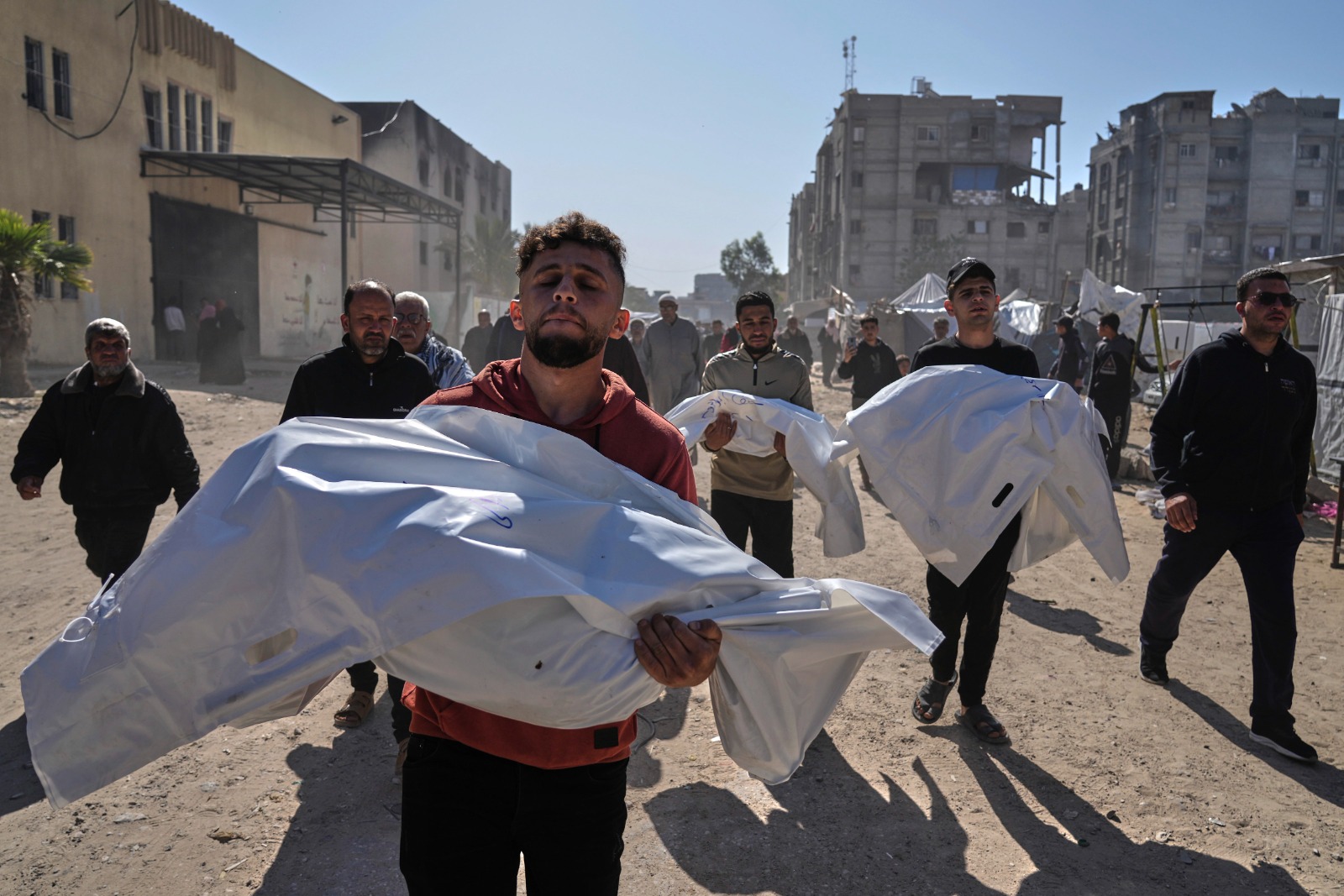
Deir Al-Balah: Over 90 Palestinians have been killed in Israeli airstrikes on Gaza in the past 48 hours, according to Gaza’s Health Ministry, as Israel continues its military campaign on the besieged territory.
Hospital sources reported that at least 15 people, including women and children, were killed overnight in a designated humanitarian zone. In Khan Younis, 11 people, including some sheltering in tents in the overcrowded Mwasi area, lost their lives. Israel has officially recognised Mwasi as a humanitarian zone.
Four others, including a mother and her daughter, were killed in separate attacks in Rafah. Their bodies were taken to the European Hospital, according to medical staff.
Humanitarian organisations have raised alarm over worsening conditions in Gaza, with thousands of children suffering from malnutrition and many residents surviving on just one meal a day, according to the United Nations.
On Friday, Dr Hanan Balkhy, head of the World Health Organization’s Eastern Mediterranean office, urged newly appointed U.S. ambassador to Israel, Mike Huckabee, to push Israeli authorities to ease the blockade and allow the entry of essential supplies. She expressed hope that visiting Gaza might change his stance.
Meanwhile, during his first public appearance, Huckabee visited the Western Wall in Jerusalem and placed a note said to contain a prayer written by U.S. President Donald Trump. He also said efforts were underway to secure the release of hostages held by Hamas.
The latest escalation comes as the Israeli military resumed operations after breaking a ceasefire agreement with Hamas. The ongoing war has killed nearly 51,000 Palestinians, the majority of them women and children, including at least 876 infants under the age of one. Health workers, aid personnel, and journalists are also among the dead.
Massive destruction across Gaza has wiped out critical infrastructure, including food production units, while around 90% of the population has been displaced, many forced to live in tents or damaged buildings.
Let the Truth be known. If you read VB and like VB, please be a VB Supporter and Help us deliver the Truth to one and all.
Vartha Bharati–Sankalp predictions align closely with Karnataka bypoll results

Bengaluru: The Vartha Bharati–Sankalp election analysis has shown a high level of accuracy in predicting the outcome of the recent Karnataka Assembly by-elections held in May 2026, correctly calling winners in both constituencies and closely estimating vote share trends.
The by-elections were held in Bagalkot and Davanagere South, drawing significant political attention as both seats were seen as key tests for the ruling Congress and opposition BJP.
According to the analysis, Vartha Bharati–Sankalp had made three major projections ahead of the results the winning party, vote share percentages, and margin of victory.
In both constituencies, the platform accurately predicted that the Congress would emerge victorious. The outcome matched the projections, with Congress candidates winning in Bagalkot and Davanagere South.
In terms of vote share, the predictions were largely in line with the final results. In Bagalkot, the BJP’s vote share was forecast in the range of 40 to 46 per cent, while the actual figure stood at 42.9 per cent. The Congress vote share, however, exceeded expectations, with the party securing 55.4 per cent against a projected range of 43 to 48 per cent.
The margin of victory in Bagalkot turned out to be significantly higher than anticipated. While the projection had placed the margin between 2,000 and 3,500 votes, the final margin was around 22,332 votes.
In Davanagere South, the predictions also remained largely accurate. The Congress vote share was projected between 43 and 51 per cent, and the final figure stood at 43.9 per cent. The BJP was expected to secure between 42 and 50 per cent but ended with 40.3 per cent.
The analysis had also identified the role of SDPI as a potential spoiler in the constituency. While its vote share was estimated around 6 per cent, the party eventually secured around 12 per cent of the vote.
The margin of victory in Davanagere South was predicted to be between 1,500 and 2,600 votes. The actual margin was higher at around 5,708 votes, though the contest remained relatively close as anticipated.
Overall, the performance of Vartha Bharati–Sankalp stood out for correctly identifying the winning parties in both seats and maintaining close accuracy in vote share estimates, with only limited deviations in specific cases.