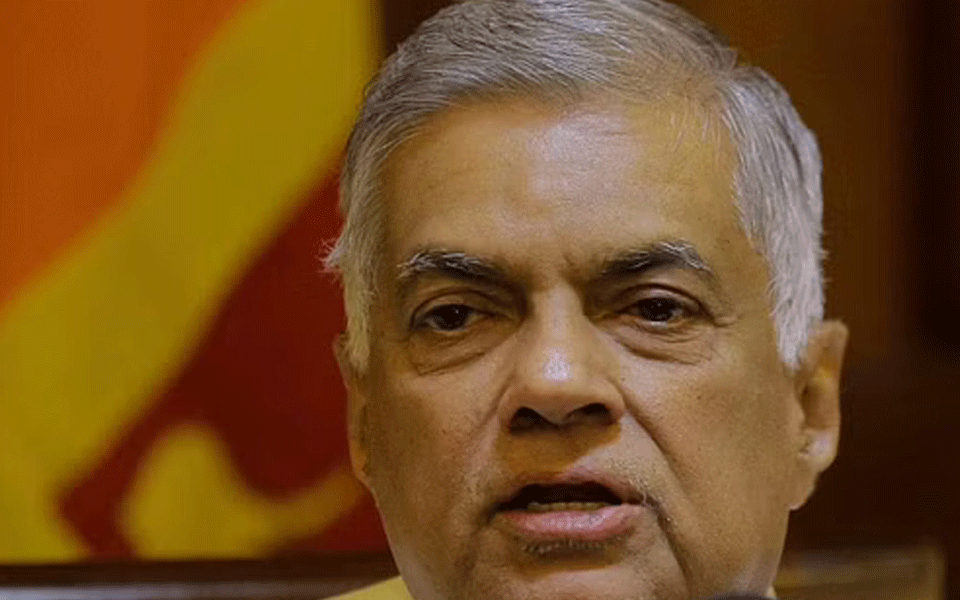
Colombo(PTI): Acting President of Sri Lanka Ranil Wickremesinghe on Wednesday said there was a fascist threat to democracy in the country and vowed to restore normalcy as well as stop the destruction of state property, hours after anti-government protesters stormed his office.
In his first televised address since being appointed to the post after embattled President Gotabaya Rajapaksa fled to the Maldives, Wickremesinghe said he had ordered military commanders and the police chief to do what is necessary to restore order.
We must end this fascist threat to democracy. We can't allow the destruction of state property. The President's office, the President's Secretariat and the Prime Minister's official residence must be returned to proper custody, he said.
Those who are in my office want to stop me from discharging my responsibilities as acting president. We can't let them tear up our Constitution. We can't allow fascists to take over. Some mainstream politicians too seem to be supporting these extremists. That is why I declared a nation-wide emergency and a curfew, Wickremesinghe said.
Wickremesinghe said he has ordered military commanders and the police chief to do what is necessary to restore order.
He said as acting President he is declaring a state of emergency and a curfew in the Western province after his office was stormed by protesters.
He said according to intelligence inputs, protesters were to capture his office and Parliament which prompted the action to impose emergency.
Protesters have been demanding resignation of both Rajapaksa and Wickremesinghe to restore normalcy in the country.
Let the Truth be known. If you read VB and like VB, please be a VB Supporter and Help us deliver the Truth to one and all.
New Delhi (PTI): To love someone is to care for them not just in times of joy, but in their saddest and darkest hours, the Supreme Court on Wednesday said while hailing the parents and siblings of Harish Rana, who is in coma for more than 13 years, for their unwavering support to him.
In its first-ever order allowing passive euthanasia, the top court permitted the withdrawal of artificial life support to 32-year-old Rana noting that prospects of his recovery are negligible.
Passive euthanasia is the intentional act of letting a patient die by withholding or withdrawing life support or the treatment necessary to keep him alive.
Rana, who was a student of Panjab University, suffered head injuries after falling from the fourth floor of his paying guest accommodation in 2013 and has been in a coma since.
A bench of justices J B Pardiwala and K V Viswanathan, which allowed the plea filed by Rana through his father Ashok Rana, said throughout the adjudication of this matter, it has been gripped by profound sadness.
"The issues in this matter have once again brought to the fore the fragility and transient nature of the life we live, and how swiftly the tide can turn for the worse. For the past thirteen years, the applicant has lived a life defined by pain and suffering. A suffering made all the more cruel by the fact that, unlike most of us, he was stripped of the ability to even give voice to his anguish.
"However, while this case highlights how unforgiving life can be, it is easy to lose sight of another vital fact. We note with immense respect that the applicant's parents and siblings have stood as unyielding pillars of support. They have exhausted every effort to care for him and continue to do so with unwavering dedication. We can only place on record our deepest appreciation for their boundless love, endurance, and kindness in the face of such adversity," the bench said.
The top court said among the manifold truths about human existence that this case reveals, the most enduring is the resilience of love.
"In our considered opinion, the greatest tragedy in life is not death, but abandonment. Despite the catastrophic tragedy that struck the applicant, his family never left his side. He has been cared for, protected, and cherished at every moment. To us, this unwavering vigil is a testament to the true meaning of love.
"To love someone is to care for them not just in times of joy, but in their saddest and darkest hours. It is to care for them even when the horizon is devoid of hope. It is to stand by them as they prepare to cross the threshold into the beyond. Ultimately, to love is nothing but to care deeply, softly, and endlessly," the bench said.
Observing that its decision does not neatly fit "within logic and reason" but between "love, loss, medicine and mercy", the bench said its order is not about choosing death, but is rather one of not artificially prolonging life.
"It is the decision to withdraw life sustaining treatment when that treatment no longer heals, restores, or meaningfully improves life. It is allowing nature to take its course when medicine can only delay the inevitable because survival is not always the same as living.
"To Harish's family, we want to acknowledge the deep emotional weight this decision carries. This decision can feel like an act of surrender, but we believe it is, in truth, an act of profound compassion and courage. You are not giving up on your son. You are allowing him to leave with dignity. It reflects the depth of your selfless love and devotion towards him," the bench said.