Afghan Taliban frees three Indian hostages: Reports
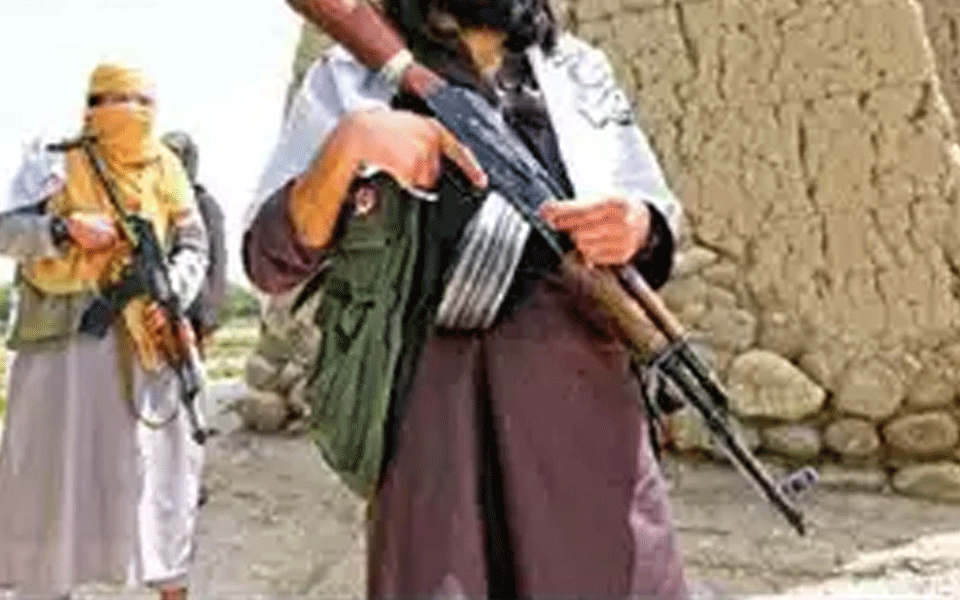
Islamabad: The Afghan Taliban said it has freed three Indian engineers held hostage for over a year in an exchange for securing the release of 11 of its members, including some high-ranking officials of the militant group, according to media reports on Monday.
Speaking on condition of anonymity, two Taliban officials refused to say who the militant group exchanged the prisoners with and whether the freed Taliban members were being held by Afghan authorities or US forces in Afghanistan, The Express Tribune reported.
However, the Associated Press reported that the 11 militants were released from Afghan jails.
The prisoner swap happened on Sunday, the paper quoted the Taliban officials as saying, but it did not disclose the location. Seven Indian engineers working for a power plant in Afghanistan's northern Baghlan Province were kidnapped in May 2018.
One of the hostages was released in March, but the fate of the others remained unknown. The identities of the released hostages were not disclosed by the militant group, the paper cited a RFE/RL report.
The officials said the freed Taliban leaders include Sheikh Abdur Rahim and Mawlawi Abdur Rashid, who had served as the insurgent group's governors of Kunar and Nimroz provinces respectively during the Taliban administration before it was deposed by the US-led forces in 2001.
The Taliban officials provided a photo and footage of what they said was the freed militants being greeted after their release. There was no immediate comment from Afghan or Indian authorities, the report said.
The release follows meetings between US special envoy to Afghanistan Zalmay Khalilzad and Taliban representatives led by Mullah Abdul Ghani Baradar.
Baradar along with a 12-member delegation had been in Islamabad since Wednesday on the invitation of the Pakistan government.
The Taliban delegation also called on Foreign Minister Shah Mahmood Qureshi and exchanged views on peace and stability in the South Asian region and bilateral relations in their meeting.
Since his appointment in September last year, Afghanistan-born Khalilzad has met with all sides in an attempt to end America's longest war in which the US has lost over 2,400 soldiers in more than 17 years.
The US and the Taliban had agreed on draft peace plan, but the process was suspend by US President Donald Trump following killing of an American soldier in Kabul last month in a suicide attack claimed by the Taliban.
Trump stunned the world when he suddenly declared that the Afghan peace talks with the Taliban were "dead".
He cancelled a secret meeting with the Taliban and Afghan President Ashraf Ghani at Camp David near Washington after the Taliban claimed responsibility for the attack in Kabul, in which an American soldier was among the dead.
The US has continued to push for a ceasefire in the war-torn country and the opening of negotiations between the Taliban and the Kabul government.
The Taliban, however, have repeatedly refused to meet with officials of the Afghan government, whom they dismiss as "puppets".
Let the Truth be known. If you read VB and like VB, please be a VB Supporter and Help us deliver the Truth to one and all.
AIITA welcomes Karnataka’s ban on obscene songs in school events
Bhatkal: The Karnataka unit of the All India Ideal Teachers Association (AIITA) has welcomed the Karnataka government’s decision to strictly ban school children from dancing to obscene songs during educational and cultural programmes in government, aided, and private schools across the state.
AIITA Karnataka State President M. R. Manvi congratulated the government for taking what he termed an important step to preserve the sanctity of education.
“Such decisions to safeguard the dignity of school children and uphold the values of education are the need of the hour. This rule should not be limited to government schools alone but must be strictly implemented in all private educational institutions as well,” he said.
He further urged the government to address other concerns within school programmes.
“The government should not only prohibit obscene dances in the name of school anniversaries, but also ensure that plays and dialogues that incite religious hatred are avoided. Schools should be centres of harmony, not platforms for spreading hatred,” he added.
According to a recent circular issued by the Department of School Education and Literacy, obscene dances are adversely affecting the mental health and moral values of students.
In this regard, schools have been advised to use songs that promote nationalism, positive thinking, the greatness of Kannada culture, and value-based traditions instead of inappropriate content during programmes.
The circular also emphasises that students should be dressed in decent attire.
AIITA also backed the department’s warning that disciplinary action would be taken against head teachers if such guidelines are violated. The association has further demanded that district Deputy Directors of Public Instruction strictly monitor the implementation of these rules.