Afghanistan is spinning out of control: UN chief
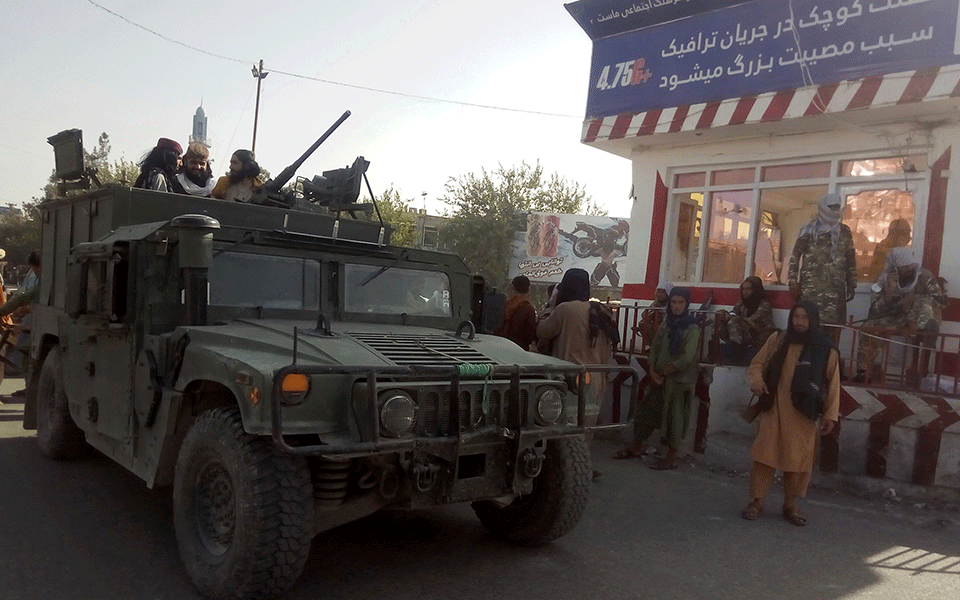
United Nations: Voicing concern that Afghanistan is spinning out of control , UN Secretary-General Antonio Guterres called on the Taliban to immediately halt the offensive and asserted that seizing power through military force is a "losing proposition" and can only lead to prolonged civil war and the complete isolation of the war-torn nation.
The Taliban has captured Herat and Kandahar, the country's second and third largest cities. As the Taliban insurgents increasingly gain ground in Afghanistan, some accounts state that 60 per cent of the country's territory is under their control.
There is growing concern that Kabul too could fall into the hands of the Taliban soon.
Even for a country that has tragically known generations of conflict, Afghanistan is in the throes of yet another chaotic and desperate chapter an incredible tragedy for its long-suffering people," Guterres said on Friday.
"Afghanistan is spinning out of control, he said, voicing concern over the grave situation" in the country.
The UN chief called on the Taliban, which is rapidly taking control over provincial capitals across the country, to immediately halt the offensive and negotiate in good faith in the interest of Afghanistan and its people.
The message from the international community to those on the warpath must be clear: seizing power through military force is a losing proposition. That can only lead to prolonged civil war or to the complete isolation of Afghanistan, Guterres said.
He asserted that directing attacks against civilians is a serious violation of international humanitarian law and amounts to a war crime, calling for perpetrators to be held accountable.
The UN chief said he is also deeply disturbed" by early indications that the Taliban are imposing severe restrictions on human rights in the areas under their control, particularly targeting women and journalists.
It is particularly horrifying and heartbreaking to see reports of the hard-won rights of Afghan girls and women being ripped away from them.
Guterres expressed hope that discussions in Doha between representatives of Afghanistan and the Taliban supported by the region and the wider international community will restore the pathway to a negotiated settlement to the conflict.
Only an Afghan-led negotiated political settlement can ensure peace, he said, adding that the United Nations is determined to contribute to such a settlement, promote the rights of all Afghans and provide life-saving humanitarian help to the ever-increasing numbers of civilians in need.
Guterres said that in the last month alone, more than 1,000 people have been killed or injured from indiscriminate attacks against civilians, notably in Helmand, Kandahar and Herat provinces.
The fighting between the Taliban and Afghan security forces in urban environments is causing tremendous harm, he said adding that at least 241,000 people have been forced to flee from their homes and humanitarian needs are growing by the hour.
With hospitals overflowing, food and medical supplies dwindling, roads, bridges, schools, clinics and other critical infrastructure being destroyed, Guterres said every day, the conflict is taking an ever bigger toll on women and children.
Continued urban conflict will mean continued carnage with civilians paying the highest price, he said calling on all parties to take heed of the conflict's heavy toll and its devastating impact on civilians.
They all must do more to protect civilians. I remind all parties of their legal and moral obligation to take all measures to protect civilians, Guterres said.
Under-Secretary-General for Political and Peacebuilding Affairs Rosemary DiCarlo said in a tweet that she is deeply concerned about the situation in Afghanistan and noted that yet again, civilians are bearing the brunt of the violence.
She underscored that one thing is clear from the country's recent history: durable peace and development will not be achieved militarily.
In response to a question on whether the UN has plans for a complete evacuation of the United Nations Assistance Mission in Afghanistan, Stephane Dujarric, Spokesman for the Secretary-General said, There [are] always contingency plans for the best case and for the worst case.
"At this point, we are remaining. We're remaining in Kabul. As I said, we have footprints in other parts of the country to fulfil our mandate and help civilians and alleviate the suffering of civilians as much as we can," he said.
Dujarric said at the daily press briefing that due to the conflict across the country, many people are arriving in Kabul and other large cities trying to seek safety for themselves and for their families. The humanitarian community has verified 10,350 internally displaced people who have arrived in Kabul between July 1 and August 12.
Dujarric said most of the displaced people are either renting accommodations or being hosted by friends or family, but unfortunately, a growing number are staying in the open. He said 20 inter-agency assessment teams have now been deployed in Kabul.
As of yesterday, we, along with our partners, have provided food, health, household items, and water and sanitation assistance to some 6,900 men, women and children who have been displaced in Kabul, he said.
Let the Truth be known. If you read VB and like VB, please be a VB Supporter and Help us deliver the Truth to one and all.
Two injuries, one DNF, a DQ as India end messy World Relays campaign

Gaborone (Botswana) (PTI): Amoj Jacob and Ragul Kumar got injured during the men's 4x400m and 4x100 races respectively as India ended their World Athletics Relays campaign in disappointment on the second day of competitions here on Sunday.
The Indian camp had high hopes of making the 2027 World Championships in the men's 4x400m relay but the team did not finish (DNF) the race as Jacob suffered cramps and pulled out of the race after taking the baton from the first leg runner Dharamveer Choudhary. Rajesh Ramesh and Vishal TK were to run in the third and fourth legs.
Those teams which could not qualify for the 2027 Beijing World Championships by reaching the final round of each of the six relay events on Saturday were given another chance in the second qualification round on Sunday.
The top two teams in each of the two heats (in all six relay events) booked the Beijing ticket on Sunday.
India will now have to try and qualify for the World Championships through the Top Lists of the World Athletics, which is a long and tedious process.
In the men's 4x100m race, third leg runner Ragul Kumar fell down the track after failing to hand over the baton inside the exchange zone to fourth leg runner Gurindervir Singh, which clearly showed the lack of coordination among the runners.
Harsh Santosh Raut and Animesh Kujur ran the first two legs.
The Indian quartet was disqualified and Kumar was seen being taken away from the Field of Play with the help of the volunteers.
It was a comedy of errors in the case of the women's 4x100m race, which saw the baton being dropped during an exchange between first leg runner Tamanna and second runner Nithya Gandhe, though the Indians finished the race in 53.09 seconds.
Gandhe started running quite a distance, but after realising that the baton was not in her hand, she turned and ran back to pick it up.
The only silver-lining for the Indian contingent was the national record time in the mixed 4x100m relay race, though the quartet of Ragul Kumar, Nithya Gandhe, Animesh Kujur and Sneha SS finished sixth in heat number two with a time of 41.35 seconds, bettering the previous national mark of 42.30 seconds set in March in Chandigarh.
The mixed 4x400m relay quartet of Theerthesh P Shetty, Kumari Saloni, Nihal William and Rashdeep Kaur ended at fifth in heat number one with a time of 3 minutes and 19.40 seconds.
On Saturday, all the five Indian relay teams had failed to make it to the respective final rounds and thus missed out on the 2027 World Championships berths.