Aga Khan, spiritual leader of Ismaili Muslims, philanthropist, passes away at 88
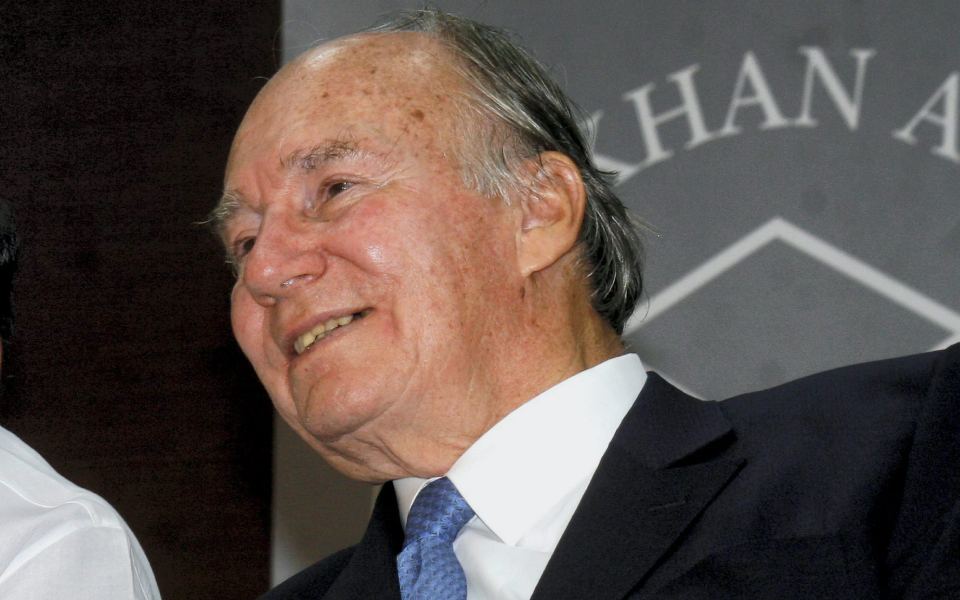
Paris, Feb 5 (AP): The Aga Khan, who became the spiritual leader of the world's millions of Ismaili Muslims at age 20 as a Harvard undergraduate and poured a material empire built on billions of dollars in tithes into building homes, hospitals and schools in developing countries, died Tuesday. He was 88.
His Aga Khan Development Network and the Ismaili religious community announced that His Highness Prince Karim Al-Hussaini, the Aga Khan IV and 49th hereditary imam of the Shia Ismaili Muslims, died in Portugal surrounded by his family.
His successor was designated in his will, which will be read in the presence of his family and religious leaders in Lisbon before the name is made public. A date has not been announced. The successor is chosen from among his male progeny or other relatives, according to the Ismaili community's website.
Considered by his followers to be a direct descendant of the Prophet Muhammad, His Highness Prince Karim Aga Khan IV was a student when his grandfather passed over his playboy father as his successor to lead the diaspora of Shia Ismaili Muslims, saying his followers should be led by a young man “who has been brought up in the midst of the new age.”
Over decades, the Aga Khan evolved into a business magnate and a philanthropist, moving between the spiritual and the worldly with ease.
While his death was announced late in the day in Europe and the Middle East, ceremonies were already being held Tuesday in Ismaili communities in the US. Condolences poured in online from charity groups he supported, as well as the equestrian world, where he was a well-known figure.
“An extraordinarily compassionate global leader,” Canadian Prime Minister Justin Trudeau said Tuesday, calling him a very good friend. “He will be deeply, deeply missed by people around the world.”
Treated as a head of state, the Aga Khan was given the title of “His Highness” by Queen Elizabeth in July 1957, two weeks after his grandfather the Aga Khan III unexpectedly made him heir to the family's 1,300-year dynasty as leader of the Ismaili Muslim sect.
He became the Aga Khan IV on October 19, 1957, in Dar es Salaam, Tanzania, on the spot where his grandfather once had his weight equalled in diamonds in gifts from his followers.
He had left Harvard to be at his ailing grandfather's side, and returned to school 18 months later with an entourage and a deep sense of responsibility.
“I was an undergraduate who knew what his work for the rest of his life was going to be,” he said in a 2012 interview with Vanity Fair magazine. “I don't think anyone in my situation would have been prepared.”
A defender of Islamic culture and values, he was widely regarded as a builder of bridges between Muslim societies and the West despite — or perhaps because of — his reticence to become involved in politics.
The Aga Khan Development Network, his main philanthropic organization, deals mainly with issues of health care, housing, education and rural economic development. It says it works in over 30 countries and has an annual budget of about USD 1 billion for nonprofit development activities.
A network of hospitals bearing his name are scattered in places where health care had lacked for the poorest, including Bangladesh, Tajikistan and Afghanistan, where he spent tens of millions of dollars for development of local economies.
The extent of the Aga Khan's financial empire is hard to measure. Some reports estimated his personal wealth to be in the billions.
The Ismailis — a sect originally centred in India but which expanded to large communities in east Africa, Central and South Asia and the Middle East — consider it a duty to tithe up to 12.5 per cent of their income to him as steward.
“We have no notion of the accumulation of wealth being evil,” he told Vanity Fair in 2012. “The Islamic ethic is that if God has given you the capacity or good fortune to be a privileged individual in society, you have a moral responsibility to society.”
The Ismaili community's website said he was born on December 13, 1936, in Creux-de-Genthod, near Geneva, Switzerland, the son of Joan Yarde-Buller and Aly Khan, and spent part of his childhood in Nairobi, Kenya — where a hospital now bears his name.
He became well-known as a horse breeder and owner, and he represented Iran in the 1964 Winter Olympics as a skier. His eye for building and design led him to establish an architecture prize, and programmes for Islamic Architecture at MIT and Harvard. He restored ancient Islamic structures throughout the world.
The Aga Khan lived at length in France and had been based in Portugal for the past several years. His development network and foundation are based in Switzerland.
The Aga Khan will be buried in Lisbon. The date was not released.
He is survived by three sons and a daughter and several grandchildren.
Let the Truth be known. If you read VB and like VB, please be a VB Supporter and Help us deliver the Truth to one and all.
EAM Jaishankar meets Jamaican PM, gifts over 10 BHISHM Cubes
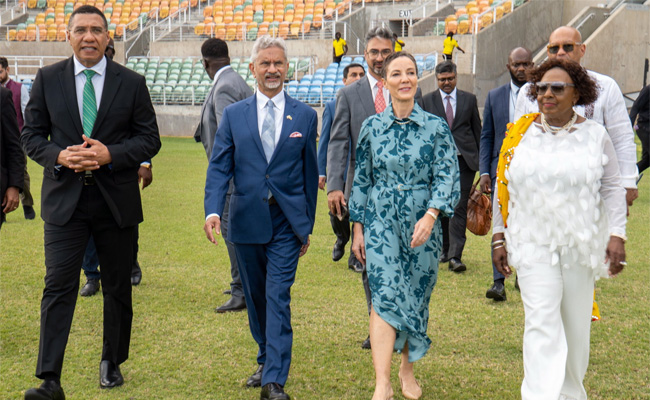
Kingston (PTI): External Affairs Minister S Jaishankar on Monday met Jamaican Prime Minister Andrew Holness and discussed ways to further deepen "political, economic and people-to-people cooperation."
Jaishankar also conveyed greetings from Prime Minister Narendra Modi to Holness.
"Pleased to call on Prime Minister @AndrewHolnessJM in Kingston. Conveyed the greetings of PM @narendramodi," Jaishankar posted on X.
"Discussed deepening our political, economic and people-to-people cooperation. Value his commitment towards further strengthening India-Jamaica relations," the post further read.
Also, the external affairs minister handed over 10 BHISHM (Bharat Health Initiative for Sahyog Hita & Maitri) Cubes as a gift to Jamaica.
"Formally handed over 10 BHISHM Cubes as a gift from India to Jamaica, in the presence of PM @AndrewHolnessJM, Health Minister @christufton and FM @kaminajsmith," Jaishankar posted on X.
"The BHISHM Cube mobile hospital system, designed for rapid deployment, will help Jamaica during disasters and emergencies. The gift of these cubes is a statement of friendship, a commitment to disaster preparedness, and an outcome of innovation," the post said.
Jaishankar arrived in Kingston on Saturday evening, marking the first leg of his nine-day tour of Jamaica, Suriname, and Trinidad and Tobago, aimed at further strengthening India's strategic and cultural ties with the Caribbean nations.
Earlier in the day, he interacted with the Indian diaspora and discussed India's ongoing transformation in infrastructure, human development and technology-driven governance and entrepreneurship with them.
He also highlighted the cricket bond between both countries as India gifted a scoreboard to Jamaica.
A scoreboard was dedicated at Sabina Park in Kingston. It is the home of the Jamaica cricket team and is the only Test cricket ground in the Caribbean island nation.
The minister expressed hope that the new scoreboard would witness many memorable innings, including those symbolising the enduring friendship between the two countries.
Cricket has long been a strong cultural bridge between India and Jamaica, which is part of the West Indies cricket team.
Jamaican players, including Chris Gayle, Courtney Walsh and Michael Holding, have played a major role in shaping the legacy of West Indies cricket in the international arena, contributing to its dominance in earlier decades and its continued global appeal.