Air strikes on Yemen kill 31 civilians after Saudi jet crash
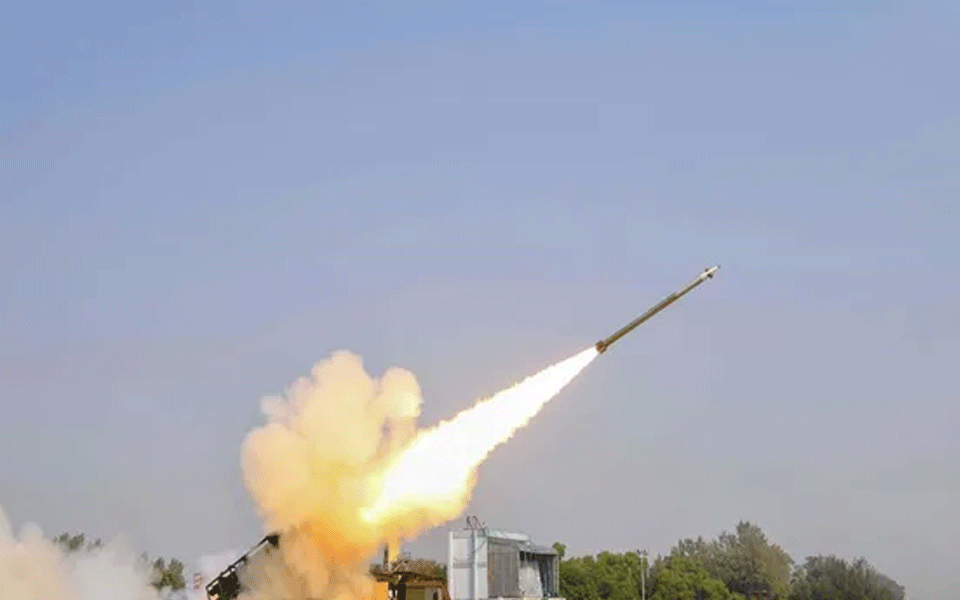
Dubai: Thirty-one people were killed in air strikes on Yemen Saturday, the United Nations said, the victims of an apparent Saudi-led retaliation after Iran-backed Huthi rebels claimed to have shot down one of its jets.
The Tornado aircraft came down Friday in northern Al-Jawf province during an operation to support government forces, a rare shooting down that prompted operations in the area by a Saudi-led military coalition fighting the rebels.
The deadly violence follows an upsurge in fighting in northern Yemen between the warring parties that threatens to worsen the war-battered country's humanitarian crisis.
"Preliminary field reports indicate that on 15 February as many as 31 civilians were killed and 12 others injured in strikes that hit Al-Hayjah area... in Al-Jawf governorate," the office of the UN humanitarian coordinator for Yemen said in a statement.
Lise Grande, the UN coordinator, denounced the "terrible strikes".
"Under international humanitarian law, parties which resort to force are obligated to protect civilians," she said.
"Five years into this conflict and belligerents are still failing to uphold this responsibility. It's shocking." The rebels reported multiple coalition air strikes in the area where the plane went down, adding that women and children were among the dead and wounded, according to rebel television station Al-Masirah.
The coalition conceded the "possibility of collateral damage" during a "search and rescue operation" at the site of the jet crash, which left the fate of its crew uncertain.
Without stating the cause of the crash, a coalition statement released by the official Saudi Press Agency said the crew, comprising two officers, ejected from the plane before it crashed but the rebels opened fire at them in "violation of the international humanitarian law".
"The lives and wellbeing of the crew is the responsibility of the terrorist Huthi militia," the statement said, without specifying whether they had survived.
The Huthi rebels released footage of what they called the launch of their "advanced surface-to-air missile" and the moment it struck the jet in the night sky, sending it crashing down in a ball of flames.
"The downing of a Tornado in the sky above Al-Jawf is a major blow to the enemy and an indication of remarkable growth in Yemeni (rebel) air defence capabilities," Huthi spokesman Mohammed Abdelsalam tweeted.
The escalation follows fierce fighting around the Huthi-held capital Sanaa, with the rebels seen to be advancing on several fronts towards Al-Hazm, the regional capital of Al-Jawf. The province of Al-Jawf has been mostly controlled by the Huthis, but its capital remains in the hands of the Saudi-backed government.
The downing of a coalition warplane marks a setback for a military alliance known for its air supremacy and signals the rebels' increasingly potent military arsenal.
"At the start of the conflict the Huthis were a ragtag militia," Fatima Abo Alasrar, a scholar at the Middle East Institute, told AFP.
"Today they have massively expanded their arsenal with the help of Iran and its proxy Hezbollah," Lebanon's powerful Shiite movement.
Huthi rebels now possess weapons bearing signs of Iranian origin, according to a UN report obtained by AFP earlier this month, in potential violation of a UN arms embargo.
Some of the new weapons, which the rebels obtained last year, "have technical characteristics similar to arms manufactured in the Islamic Republic of Iran," said the report, compiled by a panel of UN experts tasked with monitoring the embargo.
Let the Truth be known. If you read VB and like VB, please be a VB Supporter and Help us deliver the Truth to one and all.
Bridge portion collapses on Jammu outskirts; 3-4 labourers feared trapped, 1 rescued
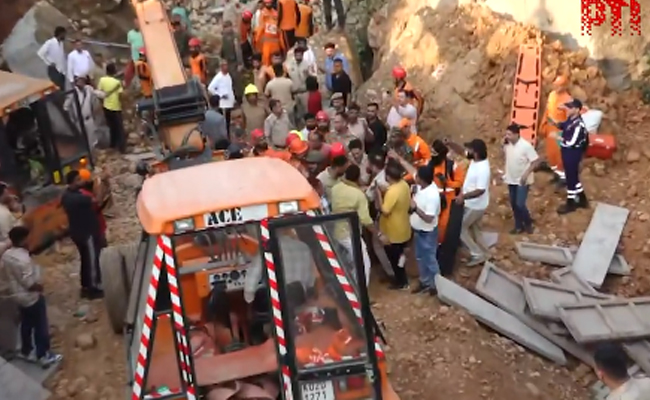
Jammu (PTI): A portion of a small bridge collapsed in the Bantalab area on the outskirts of Jammu city on Friday, trapping at least three to four labourers under the debris, while one injured worker was rescued, official sources said.
Authorities have closed the road link following the collapse of the portion of the bridge.
The incident occurred when labourers were carrying out repair work on a retaining wall near the bridge that was damaged in last year's flash floods, the sources said.
According to the sources, a section of the bridge suddenly gave way, burying workers engaged at the site under the rubble.
Police, Army and State Disaster Response Force (SDRF) teams launched rescue operations to extricate those buried under the debris. They pulled out one injured labourer and shifted him to a hospital, the sources said.
Family members of the labourers present at the site said around six workers engaged at the site at the time of the incident came under the debris when the structure collapsed. The family members said while two of the labourers managed to escape, four got trapped.
The sources said those trapped included the husband of a woman labourer, a mason, an unmarried labourer and a relative of the contractor.
There was no official confirmation on the exact number of persons trapped under the debris till the filing of this report.
The rescue operations are ongoing.