All 80 aboard Delta flight survive after jet flips upon arrival in Toronto
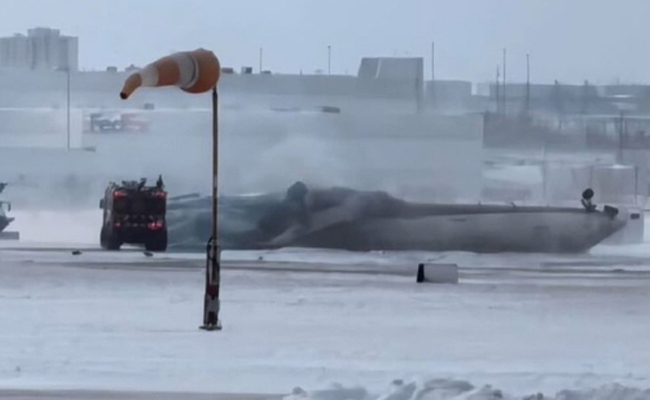
Toronto (AP): A Delta Air Lines jet flipped on its roof while landing Monday at Toronto's Pearson Airport, but all 80 people on board survived and those hurt had relatively minor injuries, the airport's chief executive said.
Snow was being blown by winds gusting to 40 mph (65 kph) when the flight from Minneapolis carrying 76 passengers and four crew attempted to land on a dry runway at around 2:15 pm. Authorities said the cause of the crash remained under investigation.
Video posted to social media only showed the aftermath with the Mitsubishi CRJ-900LR overturned, the fuselage seemingly intact and firefighters dousing what was left of the fire as passengers climbed out and walked across the tarmac.
“We are very grateful there was no loss of life and relatively minor injuries,” Deborah Flint, CEO of Greater Toronto Airports Authority, told reporters.
Toronto Pearson Fire Chief Todd Aitken said 18 passengers were taken to the hospital. Earlier in the day, Ornge air ambulance said it was transporting one pediatric patient to Toronto's SickKids hospital and two injured adults to other hospitals in the city.
Tower controllers were heard speaking with the crew of a medical helicopter that had just left Pearson and was returning to help with the crash. The plane came to a rest at the intersection of Runways 23 and 15L, the controller said. That's not far from the start of the runway.
“Just so you're aware, there's people outside walking around the aircraft there,” a tower controller said.
“Yeah, we've got it. The aircraft is upside down and burning,” the medical helicopter pilot responded.
According to the Meteorological Service of Canada, the airport was experiencing blowing snow and winds of 32 mph (51 kph) gusting to 40 mph (65 kph). The temperature was about 16.5 degrees Fahrenheit (minus 8.6 degrees Celsius).
“It's very rare to see something like this,” said John Cox, CEO of aviation safety consulting firm Safety Operating Systems in St. Petersburg, Florida. “We've seen a couple of cases of takeoffs where airplanes have ended up inverted, but it's pretty rare.”
The audio recording from the tower at Toronto Pearson International Airport shows the flight was cleared to land at about 2:10 pm local time. The tower warned the pilots of a possible air flow bump in the glide path as the plane came in to land.
“It sounds to me like a controller trying to be helpful, meaning the wind is going to give you a bumpy ride coming down, that you're going to be up and down through the glide path," Cox said.
Cox, who flew for US Air for 25 years and has worked on National Transportation Safety Board investigations, said the CRJ-900 aircraft is a proven aircraft that's been in service for decades and does a good job of handling inclement weather.
“So it was windy. But the airplanes are designed and certified to handle that," Cox said. "The pilots are trained and experienced to handle that."
Among the questions that need to be answered, Cox said, was why the plane was missing a right wing.
“If one wing is missing, it's going to have a tendency to roll over,” he said. “Those are going to be central questions as to what happened to the wing and the flight data recorder and cockpit voice recorder. They will be found, if not today, tomorrow, and the Transportation Safety Board of Canada will read them out and they will have a very good understanding of what actually occurred here.”
The last major crash at Pearson was on August 2, 2005, when an Airbus A340 landing from Paris skidded off the runway and burst into flames amid stormy weather. All 309 passengers and crew aboard Air France Flight 358 survived the crash.
The US Federal Aviation Administration said in a statement that the Transportation Safety Board of Canada would head up the investigation and provide any updates. The NTSB in the US said it is leading a team to assist in the Canadian investigation.
This is at least the fourth major aviation mishap in North America in the past month. A commercial jetliner and an Army helicopter collided near the nation's capital on January 29, killing 67 people. A medical transportation plane crashed in Philadelphia on January 31, killing the six people on board and another person on the ground, and 10 were killed in a plane crash in Alaska.
Ontario's Premier Doug Ford said on X he is "relieved there are no casualties after the incident at Toronto Pearson.” Toronto is the capital of Ontario. “Provincial officials are in contact with the airport and local authorities and will provide any help that's needed,” Ford said.
Delta CEO Ed Bastian said in a statement that “the hearts of the entire global Delta family are with those affected by today's incident at Toronto-Pearson International Airport.”
Minnesota Gov. Tim Walz said he has been in touch with Delta about the crash.
Endeavor Air, based in Minneapolis, is a subsidiary of Delta Air Lines and the world's largest operator of CRJ-900 aircraft. The airline operates 130 regional jets on 700 daily flights to over 126 cities in the US, Canada and the Caribbean, according to the company's website.
The CRJ-900, a popular regional jet, was developed by Canadian aerospace company Bombardier. It's in the same family of aircraft as the CRJ-700, the type of plane involved in the midair collision near Reagan National Airport on January 29.
Let the Truth be known. If you read VB and like VB, please be a VB Supporter and Help us deliver the Truth to one and all.
EAM Jaishankar meets Jamaican PM, gifts over 10 BHISHM Cubes

Kingston (PTI): External Affairs Minister S Jaishankar on Monday met Jamaican Prime Minister Andrew Holness and discussed ways to further deepen "political, economic and people-to-people cooperation."
Jaishankar also conveyed greetings from Prime Minister Narendra Modi to Holness.
"Pleased to call on Prime Minister @AndrewHolnessJM in Kingston. Conveyed the greetings of PM @narendramodi," Jaishankar posted on X.
"Discussed deepening our political, economic and people-to-people cooperation. Value his commitment towards further strengthening India-Jamaica relations," the post further read.
Also, the external affairs minister handed over 10 BHISHM (Bharat Health Initiative for Sahyog Hita & Maitri) Cubes as a gift to Jamaica.
"Formally handed over 10 BHISHM Cubes as a gift from India to Jamaica, in the presence of PM @AndrewHolnessJM, Health Minister @christufton and FM @kaminajsmith," Jaishankar posted on X.
"The BHISHM Cube mobile hospital system, designed for rapid deployment, will help Jamaica during disasters and emergencies. The gift of these cubes is a statement of friendship, a commitment to disaster preparedness, and an outcome of innovation," the post said.
Jaishankar arrived in Kingston on Saturday evening, marking the first leg of his nine-day tour of Jamaica, Suriname, and Trinidad and Tobago, aimed at further strengthening India's strategic and cultural ties with the Caribbean nations.
Earlier in the day, he interacted with the Indian diaspora and discussed India's ongoing transformation in infrastructure, human development and technology-driven governance and entrepreneurship with them.
He also highlighted the cricket bond between both countries as India gifted a scoreboard to Jamaica.
A scoreboard was dedicated at Sabina Park in Kingston. It is the home of the Jamaica cricket team and is the only Test cricket ground in the Caribbean island nation.
The minister expressed hope that the new scoreboard would witness many memorable innings, including those symbolising the enduring friendship between the two countries.
Cricket has long been a strong cultural bridge between India and Jamaica, which is part of the West Indies cricket team.
Jamaican players, including Chris Gayle, Courtney Walsh and Michael Holding, have played a major role in shaping the legacy of West Indies cricket in the international arena, contributing to its dominance in earlier decades and its continued global appeal.