American teen’s rendition of ‘Jana Gana Mana’ wins hearts on Independence Day

A video of a 17-year-old American teen with Down syndrome singing the Indian national anthem has gone viral. The video features Gabe Merritt’s heartfelt rendition of Jana Gana Mana, reported NDTV. It was shared on Instagram by Disha Pansuriya, an Indian-origin resident of the United States, who wrote in her post, “You feel proud when a 17-year-old American sings the Indian National Anthem.”
Pansuriya revealed that Merritt has learned the national anthems of several countries but has a special fondness for India’s 52-second-long anthem. “Oh my god! My heart just smiled through this. He is just amazing — he knows almost every country’s national anthem, but @india is his favourite! I pray and wish he goes places with his exceptional talent!!” she wrote.
The video has garnered nearly 60,000 views and hundreds of comments. “That was a super proud moment,” one user remarked. Another wrote, “Beautiful brother. Lots of love from me and India, and I invite you to come to India and visit the beautiful country.” A third added, “This was the best thing I saw today.”
View this post on Instagram
Let the Truth be known. If you read VB and like VB, please be a VB Supporter and Help us deliver the Truth to one and all.
Raghuvanshi, spinners fire KKR to seven-wicket win over SRH
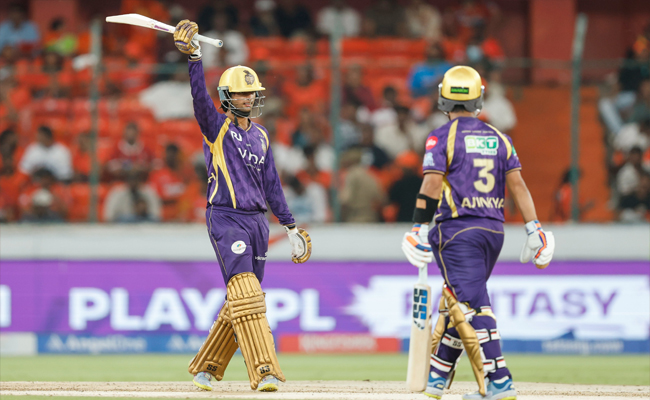
Hyderabad (PTI): The promising Angkrish Raghuvanshi (59) made a well-paced fifty as Kolkata Knight Riders defeated Sunrisers Hyderabad by seven wickets in their IPL match here on Sunday.
Skipper Ajinkya Rahane (43) and Raghuvanshi added 84 runs for the second wicket as KKR overhauled SRH’s under-par 165 all out with ease.
Finn Allen made an aggressive 29 off 13 balls upfront to give KKR a brisk start.
Earlier, Travis Head made a belligerent 61 off 28 balls but KKR's spinners bowled well to restrict SRH to 165.
Mystery spinners Varun Chakravarthy (3/36) and Sunil Narine (2/31) wrecked SRH middle-order with controlled spells.
Along the way of his two-wicket burst in his fourth-over, Narine also completed 200 IPL wickets.
The spinner was the third bowler to achieve the feat after Yuzvendra Chahal and Bhuvneshwar Kumar.
Ishan Kishan made 42 off 29 balls.
Brief Scores:
Sunrisers Hyderabad: 165 all out in 19 overs (Travis Head 61, Ishan Kishan 42; Varun Chakravarthy 3/36, Sunil Narine 2/31).
Kolkata Knight Riders: 169/3 in 18.2 overs (Angkrish Raghuvanshi 59, Ajinkya Rahane 43).