Anjali Bharadwaj among 12 people named by Biden admin for newly-instituted anti-corruption award
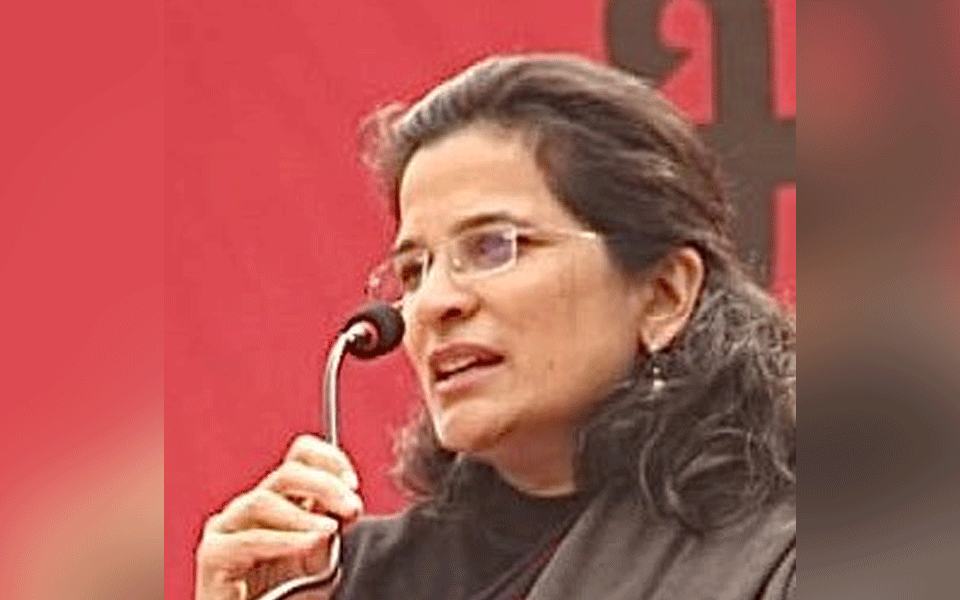
Washington: Anjali Bharadwaj, an Indian social activist working on issues of transparency and accountability, is one of the 12 "courageous" individuals named by the Biden administration for the newly-instituted International Anti-Corruption Champions Award.
According to the State Department, Bhardwaj, 48, has served as an active member of the Right to Information Movement in India for over two decades.
"The Biden administration recognises that we will only be successful in combating these issues by working in concert with committed partners, including courageous individuals who champion anti-corruption efforts and countries working to fulfil their commitments to international anti-corruption standards," US Secretary of State Tony Blinken said on Tuesday.
For that reason, I am announcing a new International Anti-Corruption Champions Award, recognising individuals who have worked tirelessly, often in the face of adversity, to defend transparency, combat corruption, and ensure accountability in their own countries, he said.
Bharadwaj is the founder of the Satark Nagrik Sangathan (SNS), a citizens' group with a mandate to promote transparency and accountability in government and encourage active participation of citizens.
She is also a convener of the National Campaign for Peoples' Right to Information, which successfully advocated for the creation of an anti-corruption ombudsman and the Whistle Blowers' Protection Act, offering protection to those who expose corruption and abuse of power.
Bharadwaj in a tweet said the honour is a "recognition of the collective effort of people and groups across the country who hold power to account .
In addition to Bharadwaj, the other honourees are: Ardian Dvorani of Albania, Diana Salazar of Ecuador, Sophia Pretrick of Micronesia, Juan Francisco Sandoval Alfaro of Guatemala, Ibrahima Kalil Gueye of Guinea, Dhuha A Mohammed of Iraq, Bolot Temirov of Kyrgyz Republic, Mustafa Abdullah Sanalla of Libya, Victor Sotto of The Philippines, Francis Ben Kaifala of Sierra Leone, and Ruslan Ryaboshapka of Ukraine.
"They inspire us and so many of their counterparts pursuing these ideals around the world. The United States enforces one of the most robust anti-corruption frameworks in the world, Blinken said.
The US, he said, was the first to criminalise foreign bribery and, in partnership with foreign counterparts, has recovered and returned more than USD 1 billion in stolen public assets in the past two years alone.
We use a range of tools to promote accountability for corrupt individuals, combat impunity globally, and engage in multilateral fora to fight corruption and strengthen citizen engagement, Blinken said.
Let the Truth be known. If you read VB and like VB, please be a VB Supporter and Help us deliver the Truth to one and all.
Two held for 'firing' at BJP leader's house in Bengal
Kolkata (PTI): A day before the counting of votes for the West Bengal assembly elections, two persons were arrested on Sunday for allegedly being involved in a firing incident outside the residence of a BJP leader in North 24 Parganas district, police said.
BJP leader Kundan Singh lodged a police complaint, alleging that a few gunmen fired at his house in the Noapara constituency around Saturday midnight.
Based on the CCTV footage, the two accused were apprehended, a senior officer said.
BJP's Noapara candidate Arjun Singh, in a post on social media, claimed that around 12.05 am, two armed miscreants arrived on a motorcycle at the residence of Kundan Singh, a BJP functionary and secretary of the Barrackpore organisational district, with an "intent to kill him".
According to the BJP leader, the accused are residents of Garulia and are known criminals.
Their names as offenders had been submitted to the Election Commission, he said.
The police officer did not specify whether the two arrested persons were the same individuals named by Arjun Singh.
According to the complaint, one round of firing took place outside Kundan Singh's house, triggering panic in the area.
The BJP candidate also questioned the role of the police, claiming that one of the accused had been detained by the police on the polling day but was later released in the evening.
The Noapara assembly seat went to the polls on April 29.
Several BJP leaders alleged that attempts were being made to create an atmosphere of fear ahead of the counting and weaken the organisation of the opposition parties.
The counting of votes will take place on May 4. Polling for the West Bengal assembly elections was held on April 23 and April 29.
The BJP urged the Election Commission to intervene immediately to ensure peaceful counting.
TMC candidate Somnath Shyam rubbished Arjun Singh’s allegation, claiming that the BJP nominee had orchestrated the firing incident to divert attention from imminent defeat.
“Arjun Singh knows all the gangsters in the Barrackpore belt. Everyone knows about his links with the underworld. Let the police investigate the incident,” Shyam said.