As Pelosi lands in Taiwan, China plans 'targeted' military operations to counter her trip
Beijing, Aug 2: China on Tuesday warned that US House Speaker Nancy Pelosi's visit to Taiwan disregarding its stern warnings will have a "severe impact" on bilateral ties and it "gravely undermines" regional peace and stability, as the official media here said that the military will launch a series of "targeted" operations to counter her trip.
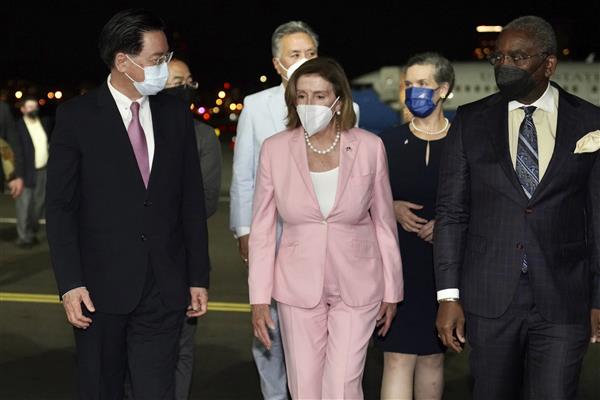
Pelosi landed in Taipei on Tuesday night, according to the television footage shown by US networks. She is the highest-ranking US official to visit Taiwan in 25 years.
After Pelosi arrived in Taiwan, China's Ministry of Foreign Affairs issued a strong statement, saying that her visit is a "serious violation of the one-China principle and the provisions of the three China-US joint communiques".
China claims Taiwan as part of the mainland and vows to integrate what it calls the rebel province even by force.
"It has a severe impact on the political foundation of China-US relations, and seriously infringes upon China's sovereignty and territorial integrity. It gravely undermines peace and stability across the Taiwan Strait, and sends a seriously wrong signal to the separatist forces for 'Taiwan independence'. China firmly opposes and sternly condemns this, and has made serious demarche and strong protest to the United States," the statement said.
There is but one-China in the world, Taiwan is an inalienable part of China's territory, and the Government of the People's Republic of China is the sole legal government representing the whole of China, it said.
This has been clearly recognised by United Nations General Assembly Resolution and 181 countries have established diplomatic relations with China on the basis of the one-China principle, it said.
"The one-China principle is a universal consensus of the international community and a basic norm in international relations," it said.
In 1979, the United States made a clear commitment in the China-US Joint Communique on the Establishment of Diplomatic Relations -- "The United States of America recognises the Government of the People's Republic of China as the sole legal Government of China," it said.
Dismissing US Secretary Antony Blinken's assertion that US Congress functioned independently from the government, the statement said the US "Congress, as a part of the US Government, is inherently obliged to strictly observe the one-China policy of the US Government and refrain from having any official exchanges with China's Taiwan region".
"China is all along opposed to the visit to Taiwan by US congressional members, and the US executive branch has the responsibility to stop such visit," it said.
"Since Speaker Pelosi is the incumbent leader of the US Congress, her visit to and activities in Taiwan, in whatever form and for whatever reason, is a major political provocation to upgrade US official exchanges with Taiwan. China absolutely does not accept this, and the Chinese people absolutely reject this," it said.
Citing the Ministry of National Defence spokesperson Sr. Col. Wu Qian, state-run Global Times reported that the Chinese military "will launch a series of targeted military operations to counter Pelosi's visit to Taiwan island, and resolutely defend national sovereignty and territorial integrity."
The Eastern Theatre Command of the Chinese People's Liberation Army (PLA) will launch a series of joint military operations around Taiwan Island starting Tuesday night.
The PLA Eastern Theatre Command will stage joint training exercises in the maritime areas off the northern, southwestern and south-eastern coasts of the island and their air space, conduct long-range live-fire drills in the Taiwan Strait and conventional missile tests in the waters off the eastern coast of the island, state-run Xinhua news agency reported.
The military operations are a stern deterrent against the recent major escalation of the negative acts by the United States on the Taiwan question and a serious warning against separatist activities seeking "Taiwan independence , it said.
After arriving in Taipei, Pelosi said that the US delegation's visit "honours America's unwavering commitment to supporting Taiwan's vibrant democracy."
"Our visit is one of several Congressional delegations to Taiwan - and it in no way contradicts longstanding United States policy, she said.
"By travelling to Taiwan, we honour our commitment to democracy: reaffirming that the freedoms of Taiwan and all democracies must be respected."
She said that her "visit reiterates that America stands with Taiwan: a robust, vibrant democracy and our important partner in the Indo-Pacific."
Beijing routinely protests any foreign dignitaries' visits to Taiwan, which claims its own and firmly insists all countries follow the One China policy acknowledging that the breakaway province is part of its mainland.
Arriving by the US Air Force plane, Pelosi and her delegation was received at the tarmac of the Taipei airport by Taiwan's Foreign Minister Joseph Wu.
She flew from Malaysia as militaries of China, Taiwan and the US went on full alert amid high voltage rhetoric from Beijing objecting to her visit, saying that it is violation of its sovereignty as Taiwan belongs to it.
Pelosi was expected to meet Taiwanese President Tsi-Ing-wen, whom China accuses as separatist, on Wednesday and spend the day touring the island including some of the industrial units.
Let the Truth be known. If you read VB and like VB, please be a VB Supporter and Help us deliver the Truth to one and all.
Delhi: Teenager slashes boy for refusing money for drugs; held

New Delhi (PTI): A 16-year-old boy has been apprehended for allegedly attacking a teenager with a paper cutter near the Red Fort area last month after the victim refused to give him money for drugs, an official said on Tuesday.
The juvenile, who had been absconding after the incident, was also found to be involved in another attempt to murder case registered at Jama Masjid police station, they said.
The case came to light on April 5 when police received information from LNJP Hospital about a 17-year-old boy, a resident of Nangloi, who had been admitted with serious injuries.
The victim had sustained sharp wounds on his neck and abdomen and was unfit to give a statement, the police said.
Preliminary inquiry revealed that the victim quarrelled with an unidentified boy at Parade Ground near the Red Fort, following which he was attacked. A case under relevant sections of the BNS was registered.
A team was constituted to trace the accused, which analysed CCTV footage from the area and identified a suspect seen fleeing the spot. The boy was later identified with the help of local intelligence as a vagabond frequenting the Chandni Chowk area, police said.
Despite multiple raids in Delhi and adjoining areas, the accused remained untraceable. Subsequently, his mobile number was tracked, and technical surveillance led police to Haridwar in Uttarakhand.
On April 29, the police team conducted a raid in a village in Haridwar and apprehended the juvenile after sustained efforts, an officer said.
During questioning, the accused disclosed that he had been living in the Chandni Chowk area for the past two years and was addicted to drugs. On the night of April 4, he allegedly got into an argument with the victim after the latter refused to give him money and slapped him. Enraged, he attacked the boy with a paper cutter, inflicting multiple injuries.
The police said the accused later attacked another person near the Jama Masjid Metro Station on the same night before fleeing to Haridwar.
He also disposed of the weapon and clothes by throwing them from a moving train to evade arrest, they said.
Further investigation is underway, they added.