At least 20 dead, 600 wounded in Equatorial Guinea blasts

Ouagadougou (Burkina Faso): A series of explosions at a military barracks in Equatorial Guinea killed at least 20 people and wounded more than 600 others on Sunday, authorities said.
President Teodoro Obiang Nguema said the explosion at 4 pm local time was due to the negligent handling of dynamite in the military barracks located in the neighbourhood of Mondong Nkuantoma in Bata.
The impact of the explosion caused damage in almost all the houses and buildings in Bata," the president said in a statement, which was in Spanish.
The defence ministry released a statement late Sunday saying that a fire at a weapons depot in the barracks caused the explosion of high-calibre ammunition. It said the provisional toll was 20 dead and 600 injured, adding that the cause of the explosions will be fully investigated.
The country's president said the fire may have been due residents burning the fields surrounding the barracks.
State television showed a huge plume of smoke rising above the explosion site as crowds fled, with many people crying out we don't know what happened, but it is all destroyed.
Images on local media seen by The Associated Press show people screaming and crying running through the streets amid debris and smoke. Roofs of houses were ripped off and wounded people were being carried into a hospital.
Equatorial Guinea, an African country of 1.3 million people located south of Cameroon, was a colony of Spain until it gained its independence in 1968. Bata has roughly 175,000 inhabitants.
Earlier, the Health Ministry had tweeted that 17 were killed and the president's statement mentioned 15 dead.
The Health Ministry made a call for blood donors and volunteer health workers to go to the Regional Hospital de Bata, one of three hospitals treating the wounded.
The ministry said its health workers were treating the injured at the site of the tragedy and in medical facilities, but feared people were still missing under the rubble.
The blasts were a shock for the oil rich Central African nation. Foreign Minister Sime n Oyono Esono Angue met with foreign ambassadors and asked for aid.
It is important for us to ask our brother countries for their assistance in this lamentable situation since we have a health emergency (due to COVID-19) and the tragedy in Bata, he said.
A doctor calling into TVGE, who went by his first name, Florentino, said the situation was a moment of crisis and that the hospitals were overcrowded. He said a sports center set up for COVID-19 patients would be used to receive minor cases.
Radio station, Radio Macuto, said on Twitter that people were being evacuated within four kilometers of the city because the fumes might be harmful.
Following the blast, the Spanish Embassy in Equatorial Guinea recommended on Twitter that Spanish nationals stay in their homes."
Let the Truth be known. If you read VB and like VB, please be a VB Supporter and Help us deliver the Truth to one and all.
Indian startup's 'Drishti' satellite launched aboard SpaceX rocket
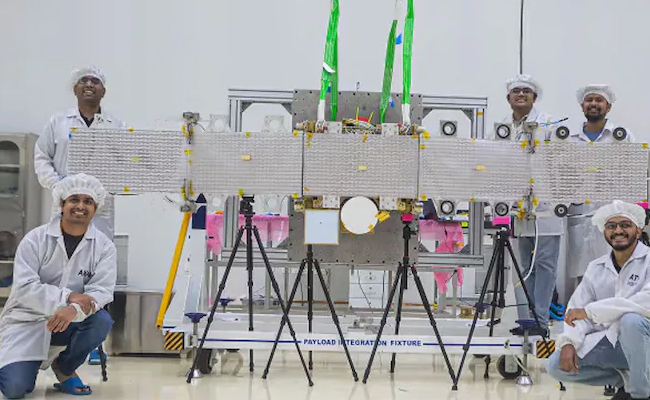
New Delhi (PTI): Bengaluru-based space start-up GalaxEye's Mission Drishti satellite was launched on Sunday aboard SpaceX's Falcon 9 rocket from California.
Mission Drishti is the world's first OptoSAR satellite, integrating electro-optical (EO) and synthetic aperture radar (SAR) sensors into a single operational platform, according to the company.
While EO sensors capture high-resolution images during sunlight and clear skies, SAR sensors provide all-weather and all-time images, using radar pulses.
In a statement, Suyash Singh, founder and CEO of GalaxEye, said, "With the satellite (Mission Drishti) now successfully in orbit, our immediate focus is on completing its commissioning. As we move through this phase, we are already witnessing strong global interest in the differentiated datasets enabled by our OptoSAR payload."
The satellite will help address long-standing limitations of conventional systems and enable more reliable and consistent data acquisition across diverse environmental conditions, the company said.
As a dual-use Earth observation satellite, the mission will support use cases across defence, agriculture, disaster management, maritime monitoring, and infrastructure planning.
The satellite is also expected to complement India's broader initiatives, including the 29 active Earth Observation satellites outlined in ISRO's recent annual report.
The launch came after five years of indigenous research and development, and extensive environmental testing and performance validation of the Mission Drishti.
In a statement, Lt Gen AK Bhatt (Retd), director general of Indian Space Association (ISpA), said, "GalaxEye has achieved what only a few global players have, which is seamlessly combining optical and SAR capabilities on a single platform to enable persistent, all-weather intelligence."
What stands out is not just the technology, but its broader impact on how downstream applications will increasingly define value in the space economy, particularly in Earth observation, where timely, decision-grade insights are critical," he added.
ISpA is the premier industry association of space and satellite companies in the country.
Union Minister Jitendra Singh also took note of the Mission Drishti launch, saying the development marked a significant milestone in India's space journey.
In a post on X, the minister said, "The successful launch of the world's first OptoSAR satellite, and the largest privately-built satellite in the country, reflects the immense potential of our young innovators driving nation-building."
GalaxEye aims to scale up Mission Drishti to a constellation of 10 satellites by 2030, developing a robust and sovereign Earth observation infrastructure for India.