Venezuela's government accuses US of attacking civilian, military installations in multiple states
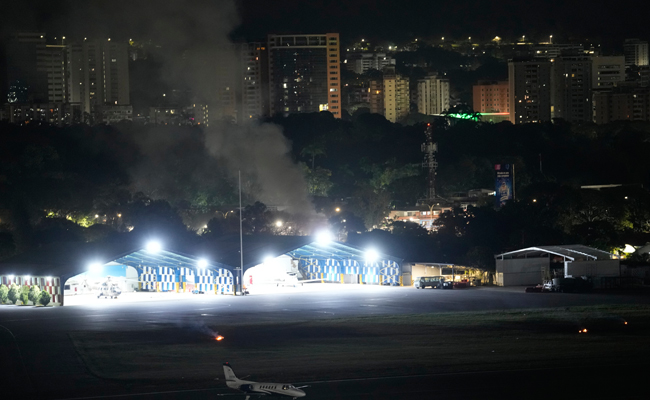
Caracas(Venezuela) (AP): At least seven explosions and low-flying aircraft were heard around 2 am local time Saturday in the capital, Caracas. Venezuela's government accused the United States of attacking civilian and military installations in multiple states.
Pentagon referred requests for comment to the White House, which didn't immediately return an email seeking comment. Meanwhile, the Federal Aviation Authority has banned US commercial flights in Venezuela airspace over “ongoing military activity” ahead of explosions in Caracas.
Smoke could be seen rising from the hangar of a military base in Caracas. Another military installation in the capital was without power.
People in various neighbourhoods rushed to the streets. Some could be seen in the distance from various areas of Caracas.
“The whole ground shook. This is horrible. We heard explosions and planes,” said Carmen Hidalgo, a 21-year-old office worker, her voice trembling. She was walking briskly with two relatives, returning from a birthday party. “We felt like the air was hitting us.”
Venezuela's government, in the statement, called on its supporters to take to the streets.
“People to the streets!” the statement said. “The Bolivarian Government calls on all social and political forces in the country to activate mobilization plans and repudiate this imperialist attack.”
The statement added that President Nicolás Maduro had “ordered all national defence plans to be implemented” and declared “a state of external disturbance.”
This comes as the US military has been targeting, in recent days, alleged drug-smuggling boats. On Friday, Venezuela said it was open to negotiating an agreement with the US to combat drug trafficking.
Maduro also said in a pretaped interview aired Thursday that the US wants to force a government change in Venezuela and gain access to its vast oil reserves through the monthslong pressure campaign that began with a massive military deployment to the Caribbean Sea in August.
Maduro has been charged with narco-terrorism in the US. The CIA was behind a drone strike last week at a docking area believed to have been used by Venezuelan drug cartels in what was the first known direct operation on Venezuelan soil since the US began strikes on boats in September.
US President Donald Trump for months had threatened that he could soon order strikes on targets on Venezuelan land. The US has also seized sanctioned oil tankers off the coast of Venezuela, and Trump ordered a blockade of others in a move that seemed designed to put a tighter chokehold on the South American country's economy.
The US military has been attacking boats in the Caribbean Sea and the eastern Pacific Ocean since early September. As of Friday, the number of known boat strikes is 35 and the number of people killed is at least 115, according to numbers announced by the Trump administration.
They followed a major buildup of American forces in the waters off South America, including the arrival in November of the nation's most advanced aircraft carrier, which added thousands more troops to what was already the largest military presence in the region in generations.
Trump has justified the boat strikes as a necessary escalation to stem the flow of drugs into the US and asserted that the US is engaged in an “armed conflict” with drug cartels.
Meanwhile, Iranian state television reported on the explosions in Caracas on Saturday, showing images of the Venezuelan capital. Iran has been close to Venezuela for years, in part due to their shared enmity of the US.
BREAKING 🚨 Explosions in Caracas, capital of Venezuela. Reports of US Army CH-47 ‘Chinook’ helicopters flying over. Total electricity blackout. pic.twitter.com/p4amRSvico
— Toria Brooke (@realtoriabrooke) January 3, 2026
Let the Truth be known. If you read VB and like VB, please be a VB Supporter and Help us deliver the Truth to one and all.
26-year-old youth from Andhra dies by suicide in US
Kurnool (Andhra Pradesh) (PTI): A 26-year-old youth from this district has died allegedly by suicide in Chicago, US, recently, due to distress over debt, sources said on Saturday.
The family members of the deceased have requested that the identity of their relative be withheld, noting that his parents are senior citizens suffering from medical conditions.
Reacting to the incident, Andhra Pradesh IT Minister Nara Lokesh expressed condolences and assured assistance for the repatriation of the mortal remains of the deceased.
"My heartfelt condolences to the bereaved family. I request Union Aviation Minister K Ram Mohan Naidu to ensure smooth and hassle-free transport of the mortal remains," Lokesh said in a post on X.
An NRI community member from the US posted on social media that one of their members from Kurnool on Optional Practical Training (OPT) passed away in Chicago a few days ago.
He said Telugu Association of North America (TANA) had completed all necessary documentation and formalities to send the mortal remains to India for final rites.
He further requested assistance in expediting the cargo pickup, currently scheduled for Sunday, seeking an earlier arrangement considering the urgency.
(Assistance for overcoming suicidal thoughts is available on the state’s health helpline 104, Tele-MANAS 14416.)