Australia passes law to make Google, Facebook pay for news

Canberra: Australia's laws forcing Google and Facebook to pay for news are ready to take effect, though the laws' architect said it will take time for the digital giants to strike media deals.
The Parliament on Thursday passed amendments to the so-called News Media Bargaining Code agreed between Treasurer Josh Frydenberg and Facebook chief executive Mark Zuckerberg on Tuesday.
In return for the changes, Facebook agreed to lift a ban on Australians accessing and sharing news.
Rod Sims, the competition regulator who drafted the code, said he was happy that the amended legislation would address the market imbalance between Australian news publishers and the two gateways to the internet.
All signs are good, Sims told Australian Broadcasting Corp.
The purpose of the code is to address the market power that clearly Google and Facebook have. Google and Facebook need media, but they don't need any particular media company, and that meant media companies couldn't do commercial deals, the Australian Competition and Consumer Commission chair added.
The rest of the laws had passed earlier, so they can now be implemented.
Google has already struck deals with major Australian news businesses in recent weeks including News Corp and Seven West Media.
Frydenberg said he was pleased to see progress by Google and more recently Facebook in reaching commercial deals with Australian news businesses.
But Country Press Australia, which represents 161 regional newspapers across the country, has raised concerns that tiny publications outside large cities might miss out.
Sims said he was not surprised that the platforms would strike deals with the large city businesses first.
I don't see any reason why anybody should doubt that all journalism will benefit, Sims said.
There things take time. Google and Facebook don't have unlimited resources to go around talking to everybody. I think this has got a long way to play out, he added.
Chris Moos, a lecturer at Oxford University's Business School, said the latest amendments amounted to a small victory for Zuckerberg.
Moos said the legislation would likely result in small payouts for most Australian news publishers. But Facebook could again block Australian news if negotiations broke down.
The legislation was designed to curb the outsized bargaining power of Facebook and Google in their negotiations with Australian news providers. The digital giants would not be able to abuse their positions by making take-it-or-leave-it payment offers to news businesses for their journalism.
Instead, in the case of a standoff, an arbitration panel would make a binding decision on a winning offer.
Frydenberg and Facebook confirmed that the two sides agreed to amendments to the proposed legislation. The changes would give digital platforms one month's notice before they are formally designated under the code. That would give those involved more time to broker agreements before they are forced to enter binding arbitration arrangements.
A statement on Tuesday by Campbell Brown, Facebook's vice president for news partnerships, added that the deal allows the company to choose which publishers it will support, including small and local ones.
Frydenberg said his department will review the code within a year to ensure it is delivering outcomes that are consistent with government's policy intent.
Let the Truth be known. If you read VB and like VB, please be a VB Supporter and Help us deliver the Truth to one and all.
Two held for 'firing' at BJP leader's house in Bengal

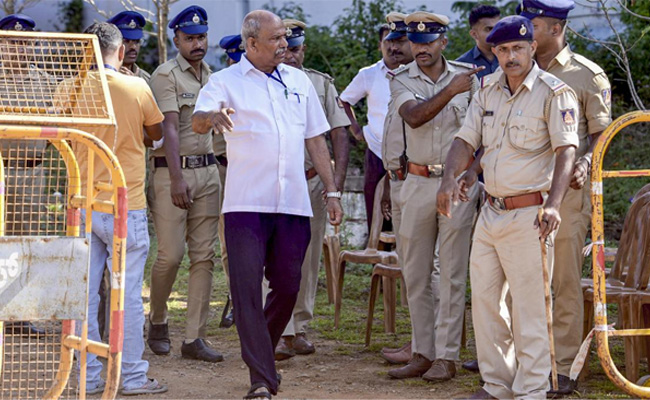
Kolkata (PTI): A day before the counting of votes for the West Bengal assembly elections, two persons were arrested on Sunday for allegedly being involved in a firing incident outside the residence of a BJP leader in North 24 Parganas district, police said.
BJP leader Kundan Singh lodged a police complaint, alleging that a few gunmen fired at his house in the Noapara constituency around Saturday midnight.
Based on the CCTV footage, the two accused were apprehended, a senior officer said.
BJP's Noapara candidate Arjun Singh, in a post on social media, claimed that around 12.05 am, two armed miscreants arrived on a motorcycle at the residence of Kundan Singh, a BJP functionary and secretary of the Barrackpore organisational district, with an "intent to kill him".
According to the BJP leader, the accused are residents of Garulia and are known criminals.
Their names as offenders had been submitted to the Election Commission, he said.
The police officer did not specify whether the two arrested persons were the same individuals named by Arjun Singh.
According to the complaint, one round of firing took place outside Kundan Singh's house, triggering panic in the area.
The BJP candidate also questioned the role of the police, claiming that one of the accused had been detained by the police on the polling day but was later released in the evening.
The Noapara assembly seat went to the polls on April 29.
Several BJP leaders alleged that attempts were being made to create an atmosphere of fear ahead of the counting and weaken the organisation of the opposition parties.
The counting of votes will take place on May 4. Polling for the West Bengal assembly elections was held on April 23 and April 29.
The BJP urged the Election Commission to intervene immediately to ensure peaceful counting.
TMC candidate Somnath Shyam rubbished Arjun Singh’s allegation, claiming that the BJP nominee had orchestrated the firing incident to divert attention from imminent defeat.
“Arjun Singh knows all the gangsters in the Barrackpore belt. Everyone knows about his links with the underworld. Let the police investigate the incident,” Shyam said.