Australian PM Morrison looks set to form majority govt: report
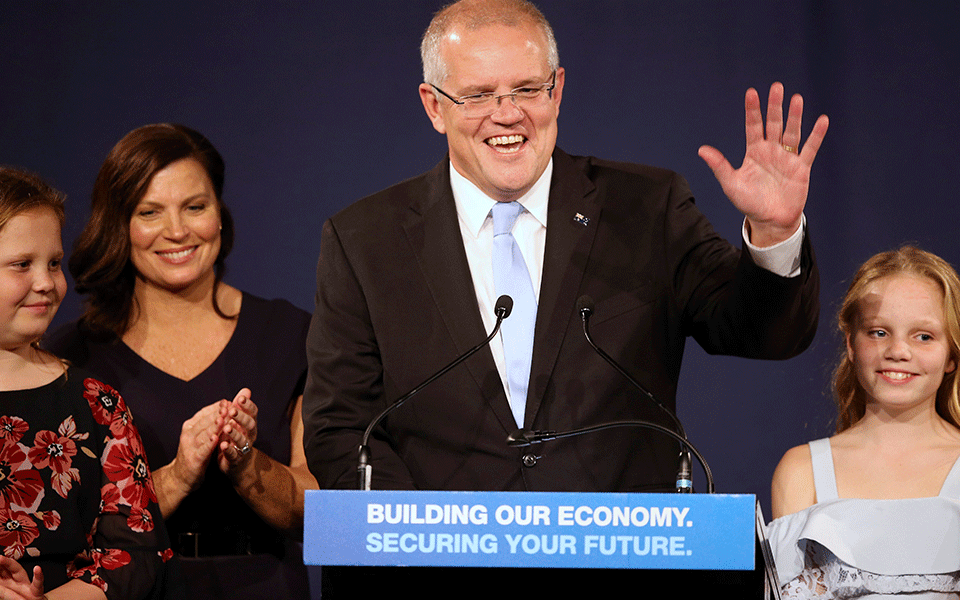
Melbourne: Australian Prime Minister Scott Morrison could form a majority government as the ruling conservative coalition was on course to win some more seats in the election which defied exit polls to deliver a shock defeat to the opposition Labor Party, forcing its leader Bill Shorten to resign.
A party needs 76 seats for a simple majority in the 151-member House of Representatives, the lower house of Parliament. Before the election, the Coalition held 73 seats, while Labor 72.
According to ABC, the Liberal party led by Prime Minister Morrison was expected to secure Bass, Chisholm, Boothby and Wentworth seats that could lead the Coalition to secure majority with at least 77 seats.
On Monday morning, another Liberal candidate of Indian-origin Dave Sharma raced ahead of the independent candidate Kerryn Phelps. Phelps later conceded that she had lost the eastern suburbs Sydney seat to Sharma who was leading the sitting MP by 2572 vote.
So far, coalition has won 75 seats as compared to Labor's 65.
"As far as I'm concerned, on the numbers to come, Bass will be the 76th seat. Postals and absent votes favour the coalition in Bass and they're already ahead," ABC chief elections analyst Antony Green was quoted as saying.
"At some time today, Bass will tick over to become the 76th seat, delivering the government a majority," he said.
Green further said that he was expecting Chisholm to become the 77th seat, with Boothby and Wentworth already in the Liberal count.
Backed by "quiet Australians" and defying exit polls, the ruling conservative coalition staged a "miraculous" victory in the general election on Sunday, devastating the opposition Labor Party and forcing its leader Shorten to step down.
The Labor party has started looking for a new leader.
Former deputy prime minister Anthony Albanese and deputy leader Tanya Plibersek are both considering their options as the next Labor party leader.
"I believe I'm the best person to lead Labor back into government. We've lost three elections in a row. That has an impact on those Australians who rely upon us to improve their education, to look after their health care, to build public transport infrastructure," Albanese said.
Apart from Plibersek who has been the deputy leader for six years and held the foreign affairs, Shadow Treasurer Chris Bowen was also considering running for the Labor leader.
"We have an obligation as Labor Party people to keep fighting for a fairer Australia, for a strong economy and a fair society. We'll keep doing that," Plibersek said.
Meanwhile, media reports suggested that the election results have pushed the stocks for banks, private health to record high with over a billion dollars added to the value of ASX-listed health insurers after the coalition's victory.
According to The Age, "the Scott Morrison-led coalition was now tipped as likely to form a majority government... investors sent Medibank (private health insurance) shares soaring over 11 per cent by late Monday morning".
The market capitalisation of the big four banks in the country - NAB, ANZ, Commonwealth and Westpac - was 24 billion Australian dollars, higher with traders turning to buy, reports said.
Even Australian dollar was recorded higher following the coalition's victory.
Around 16 million Australians swarmed to the polling booths across the country on Saturday to elect the nation's 31st prime minister, in what was widely referred to as the climate-change election.
Earlier, a Nine-Galaxy poll released shortly before the voting stations closed in the east of the country showed a victory for the opposition Labor party and Liberal Party-led coalition losing its bid for a third three-year term.
The poll showed the Labor winning as many as 82 seats, beating the ruling Coalition. On Friday, media reports also endorsed Labor leader Shorten as the best chance to end a "cycle of instability" in Australian politics.
Australia has compulsory voting and a complex system of ballots ranked by voter preference. The political, economic and cultural differences varies from state to state on the vast island-continent.
Let the Truth be known. If you read VB and like VB, please be a VB Supporter and Help us deliver the Truth to one and all.
Bhatkal: AIITA welcomes Karnataka’s ban on obscene songs in school events

Bhatkal: The Karnataka unit of the All India Ideal Teachers Association (AIITA) has welcomed the Karnataka government’s decision to strictly ban school children from dancing to obscene songs during educational and cultural programmes in government, aided, and private schools across the state.
AIITA Karnataka State President M. R. Manvi congratulated the government for taking what he termed an important step to preserve the sanctity of education.
“Such decisions to safeguard the dignity of school children and uphold the values of education are the need of the hour. This rule should not be limited to government schools alone but must be strictly implemented in all private educational institutions as well,” he said.
He further urged the government to address other concerns within school programmes.
“The government should not only prohibit obscene dances in the name of school anniversaries, but also ensure that plays and dialogues that incite religious hatred are avoided. Schools should be centres of harmony, not platforms for spreading hatred,” he added.
According to a recent circular issued by the Department of School Education and Literacy, obscene dances are adversely affecting the mental health and moral values of students.
In this regard, schools have been advised to use songs that promote nationalism, positive thinking, the greatness of Kannada culture, and value-based traditions instead of inappropriate content during programmes.
The circular also emphasises that students should be dressed in decent attire.
AIITA also backed the department’s warning that disciplinary action would be taken against head teachers if such guidelines are violated. The association has further demanded that district Deputy Directors of Public Instruction strictly monitor the implementation of these rules.