Australian PM Scott Morrison urges Facebook to lift its news blockade
Canberra, Feb 19: Australia's prime minister on Friday urged Facebook to lift its blockade of Australian users and return to the negotiating table with news publishing businesses, warning that other countries would follow his government's example in making digital giants pay for journalism.
Prime Minister Scott Morrison described Facebook's move Thursday to prevent Australians accessing and sharing news as a threat.
The blockade has escalated a fight with the government over whether powerful tech companies should have to pay news organizations for content.
The idea of shutting down the sorts of sites they did yesterday, as some sort of threat well, I know how Australians react to that and I thought that was not a good move on their part, Morrison told reporters.
They should move quickly past that, come back to the table and we'll sort it out, he added.
There was public outrage at how the Facebook blockade was bungled, cutting access at least temporarily to pandemic, public health and emergency services.
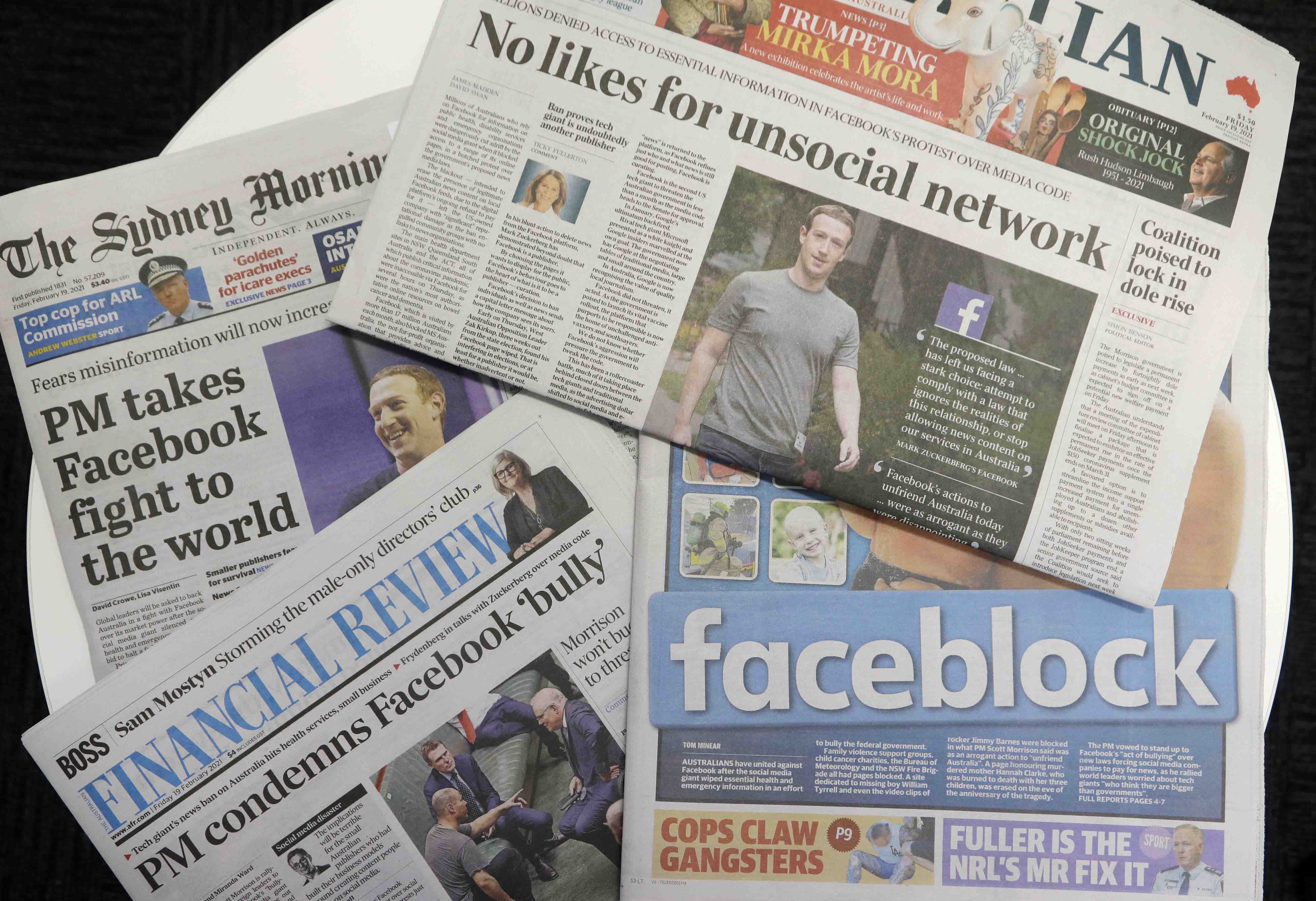
Newspaper headlines included: No likes for unsocial network, and Faceblock.
An article about how fake news would replace credible journalism in Australian feeds carried the headline: 'Fakebook' shows all it cares about is profit, not people.
Some non-Australian outlets also appeared affected, with posts disappearing from Facebook pages belonging to Britain's Daily Telegraph and Sky News. Both share names with news outlets in Australia.
The blockade was a response to the House of Representatives on Wednesday night passing a bill that would make Facebook and Google pay Australian media companies fair compensation for the journalism that the platforms link to. The legislation must be passed by the Senate to become law.
Google has responded by quickly working out licensing content deals with major Australian media companies under its own News Showcase model.
Rupert Murdoch's News Corp. has announced a wide-ranging deal with Google covering operations in the United States and Britain as well as Australia. Major Australian media organization Seven West Media also reached a deal earlier in the week. Rival Nine Entertainment is reportedly close to its own pact, and state-owned Australian Broadcasting Corp. is in negotiations.
Morrison said he discussed the Facebook dispute with Indian Prime Minister Narendra Modi on Thursday. Morrison was also discussing Australia's proposed law with the leaders of Britain, Canada and France.
There is a lot of world interest in what Australia is doing, Morrison said. That's why I invite, as we did with Google, Facebook to constructively engage because they know that what Australia will do here is likely to be followed by many other Western jurisdictions.
Treasurer Josh Frydenberg, the minister responsible for the proposed News Media Bargaining Code, had a telephone conversation with Facebook chief executive Mark Zuckerberg after the blockade began on Thursday and again on Friday.
We talked through their remaining issues & agreed our respective teams would work through them immediately. We'll talk again over the weekend, Frydenberg tweeted on Friday.
I reiterated Australia remains committed to implementing the code, Frydenberg added.
Frydenberg maintains that Facebook had been having constructive negotiations with Australian media on pay deals immediately before the surprise blockade.
Facebook said on Thursday the proposed Australian law fundamentally misunderstands the relationship between our platform and publishers who use it.
Morrison said his government was happy to listen to them on the technical issues, but remained determined to pass the law.
It's not OK to unfriend Australia because Australia is very friendly, Morrison said. We'd like to remain very friendly and it's time for them to friend us again.
Let the Truth be known. If you read VB and like VB, please be a VB Supporter and Help us deliver the Truth to one and all.
Two held for 'firing' at BJP leader's house in Bengal
Kolkata (PTI): A day before the counting of votes for the West Bengal assembly elections, two persons were arrested on Sunday for allegedly being involved in a firing incident outside the residence of a BJP leader in North 24 Parganas district, police said.
BJP leader Kundan Singh lodged a police complaint, alleging that a few gunmen fired at his house in the Noapara constituency around Saturday midnight.
Based on the CCTV footage, the two accused were apprehended, a senior officer said.
BJP's Noapara candidate Arjun Singh, in a post on social media, claimed that around 12.05 am, two armed miscreants arrived on a motorcycle at the residence of Kundan Singh, a BJP functionary and secretary of the Barrackpore organisational district, with an "intent to kill him".
According to the BJP leader, the accused are residents of Garulia and are known criminals.
Their names as offenders had been submitted to the Election Commission, he said.
The police officer did not specify whether the two arrested persons were the same individuals named by Arjun Singh.
According to the complaint, one round of firing took place outside Kundan Singh's house, triggering panic in the area.
The BJP candidate also questioned the role of the police, claiming that one of the accused had been detained by the police on the polling day but was later released in the evening.
The Noapara assembly seat went to the polls on April 29.
Several BJP leaders alleged that attempts were being made to create an atmosphere of fear ahead of the counting and weaken the organisation of the opposition parties.
The counting of votes will take place on May 4. Polling for the West Bengal assembly elections was held on April 23 and April 29.
The BJP urged the Election Commission to intervene immediately to ensure peaceful counting.
TMC candidate Somnath Shyam rubbished Arjun Singh’s allegation, claiming that the BJP nominee had orchestrated the firing incident to divert attention from imminent defeat.
“Arjun Singh knows all the gangsters in the Barrackpore belt. Everyone knows about his links with the underworld. Let the police investigate the incident,” Shyam said.