Bangladesh's interim govt revokes ban on Jamaat-e-Islami, its student wing Islami Chhatra Shibir
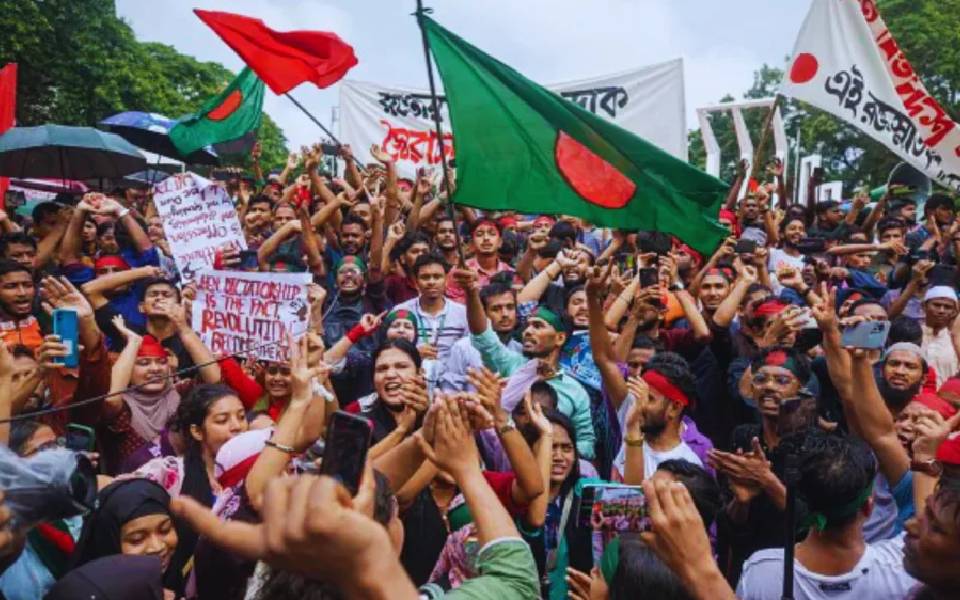
Dhaka, Aug 28: Bangladesh's interim government Wednesday revoked a ban on the rightwing Jamaat-e-Islami and its student wing Islami Chhatra Shibir, less than a month after it was outlawed by former prime minister Sheikh Hasina.
"It (lifting the ban) will come under effect immediately," the Home Ministry said in a gazette notification, noting that there was no particular evidence against the organisation.
The erstwhile Awami League government led by Hasina had imposed a ban on Jamaat on August 1, 2024, accusing the Islamist party as a “militant and terrorist” organisation. The government blamed Jamaat's student wing for inciting chaos over a quota system for government jobs.
Welcoming the interim government's decision, Ameer of Bangladesh Jamaat-e-Islami, Shafiqur Rahman, called for an end to the politics of hatred and division in Bangladesh.
"We want the politics of hatred to be buried... it shouldn’t rise again. We want the politics of division to be buried,” he told journalists.
Rahman said that Jamaat-e-Islami does not support the division of the nation over any issue, saying, “In all cases, we want the nation to be united.”
The ban on Jamaat-e-Islami and its student wing, Chhatra Shibir, was a deliberate attempt to divert attention from the anti-government movement, he said.
The government notification said the ban under the Anti-Terrorism Act 2009 has been lifted as there was no particular evidence against the organisation. The government believed that Jamaat and its associate bodies, including its student front Chhatra Shibir, were not involved in terrorist activities and violence.
The decision, formally published in a gazette notification on Wednesday, represents a significant change from the decision taken by the erstwhile Awami League government earlier this month, just days before its ouster.
The development came a day after Attorney General Mohammad Asaduzzaman urged the High Court to summarily reject a writ petition seeking an order on the government to ban Hasina's Awami League as a political party and scrap its registration.
"The current (interim) government has no intention to ban any political organisation,” the government's top law officer told a two-judge High Court bench, which set August 29 for its decision on the writ filed by one Sarda Society as a public interest litigation.
The interim government's law adviser, equivalent to a minister, Asif Nazrul on Wednesday told reporters he was opposed to the call for a ban on Awami League or any other political parties unless there was any strong evidence of their involvement in terrorist activities.
"Awami League is the party which led Bangladesh's independence movement and contributed to different democratic movements. (But) what they did in the past 15 years does not go with their heritage, the spirit of the Liberation War,” Nazrul said.
He said the party had established the "most barbaric fascism" in Bangladesh's history for which someone might have individual or its leaders might have collective responsibility “but I don’t think it will be a wise decision to ban it as a political party”.
Secretary General of ex-premier Khaleda Zia’s Bangladesh Nationalist Party (BNP) Mirza Fakhrul Islam Alamgir said that anyone should be able to form an independent political party, that is the main goal of democracy.
"We are not in favour of banning any political party; any party and any individual has the right to form an independent party. But they must be on the side of freedom and sovereignty. Those who do not believe in freedom cannot be supported," he said at a media briefing on Tuesday.
No senior leader of the Awami League, which ran the country for the past 15 years, is seen in the public domain while several ministers of Hasina’s cabinet were arrested, on the run or believed to have fled the country since the ouster of the regime.
The Jamaat opposed Bangladesh's 1971 independence from Pakistan and sided with the Pakistani troops during the Liberation War.
The Jamaat, founded in 1941 in undivided India, was first banned in 1972, the year Bangladesh framed its Constitution, which disbanded the functioning of any association, union or political party based on religion.
But the subsequent military government led by General Ziaur Rahman revoked the ban by issuing a martial law proclamation, which allowed Jamaat to refloat and years later became a crucial partner of the then prime minister Khaleda Zia’s 2001-2006 four-party alliance government. Two senior Jamaat leaders were inducted into her cabinet.
The Jamaat remained active despite losing its registration and being barred from elections due to court rulings.
Let the Truth be known. If you read VB and like VB, please be a VB Supporter and Help us deliver the Truth to one and all.
CM Siddaramaiah alleges ‘criminal conspiracy’ in Sringeri recount, vows legal action
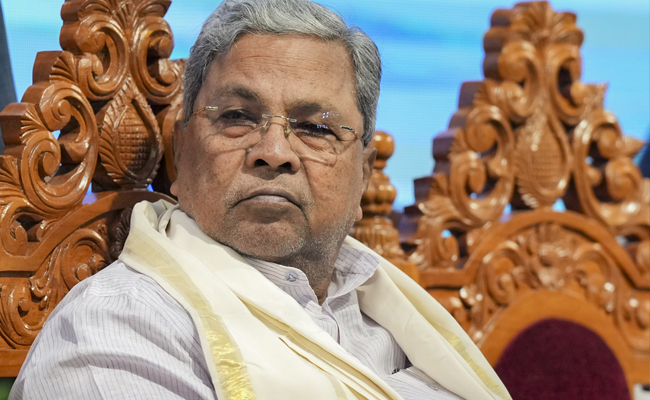
Bengaluru (PTI): Alleging a “criminal conspiracy” by BJP candidate D N Jeevaraj in the Sringeri Assembly poll recounting, Karnataka CM Siddaramaiah on Tuesday said the outcome was manipulated after valid postal ballot votes in favour of Congress leader T D Raje Gowda were tampered with during the recounting process.
Following a Karnataka High Court order on an election petition filed by Jeevaraj, challenging Raje Gowda’s election, the reverification and recounting were conducted on Saturday.
After the reverification and recount of postal ballots for the Sringeri Assembly constituency, votes polled in favour of Raje Gowda were reduced by 255, the returning officer said.
A report on the matter has been submitted to the Election Commission of India for further action, the officer added.
Congress leader Raje Gowda had won the 2023 Assembly polls from Sringeri by 201 votes, defeating his nearest rival Jeevaraj.
Addressing a press conference in Bengaluru, Siddaramaiah said the High Court had directed the recounting of postal ballots and that irregularities were noticed during the exercise conducted on May 2.
“This is a clear case of criminal conspiracy,” Siddaramaiah said, alleging that valid votes cast in favour of Raje Gowda were altered after being accepted by counting agents of all parties, including Congress, BJP, and JD(S).
He claimed that during the recounting of postal ballots, 255 votes were initially accepted as valid by all agents but were later tampered with by subordinate officials.
“There is a second mark on the votes polled in favour of Raje Gowda. They had accepted these as valid votes. Subsequently, another mark was made by officials. This is a clear case of criminal conspiracy,” he said.
When asked who was behind the alleged conspiracy, the CM replied, “It was hatched by Jeevaraj and others. It is planned.”
Siddaramaiah further alleged that the returning officer acted improperly by declaring the result despite the presence of an Election Commission observer during the recounting.
“Immediately after the counting, the returning officer announced the result. He should not have done so; this is against the law,” he said.
He pointed out that Raje Gowda had originally won by 201 votes, but after the recounting, the BJP candidate was declared the winner by 52 votes.
“The BJP has committed a criminal act of conspiracy. This is not vote chori but vote dacoity,” he alleged.
The CM said a police complaint had already been filed by Raje Gowda’s election agent, Sudhir Kumar, and emphasised the need for electoral integrity.
“We want transparency and free and fair elections. That is what our Constitution mandates,” he added.
Stating that the government would pursue legal remedies, Siddaramaiah said, “We are preparing an appeal challenging the returning officer’s announcement in a court of law.”
Responding to a separate query on elections in other states, the CM said there appeared to be an anti-incumbency factor in West Bengal, while results in Tamil Nadu were “surprising,” adding that Vijay’s party was emerging as the largest there.
Following the victory of party candidates in Bagalkote and Davanagere South, Siddaramaiah expressed confidence about future electoral prospects in Karnataka.
“Even in 2028, we will win the Assembly elections. We will come back,” the CM said.
Siddaramaiah added that he would order a forensic examination into the alleged tampering of postal ballots.