Bappi Lahiri’s 'Jimmy, Jimmy' becomes new anthem for Chinese to protest COVID lockdowns
Beijing(PTI): Millions of Chinese suffering the dreaded lockdowns have turned to Hindi cinema legend Bappi Lahiri's superhit song "Jimmy Jimmy Aaja Aaja" from 1982 movie "Disco Dancer" to express their anger and frustration over the country's stringent zero-COVID policy.
In the Chinese social media networks Douyin - the Chinese name for TikTok, the song composed by Lahiri and sung by Parvati Khan is sung in Mandarin "Jie mi, jie mi", which translates into "Give me rice, give me rice", by people in the videos mockingly showing empty vessels to show how they are deprived of essential food items during the lockdowns.
The video has so far managed to escape Chinese censors that are quick to remove any post deemed critical of the country's regime.
Indian movies have always enjoyed huge popularity in China, starting from the days of cinema legend Raj Kapoor in 1950s and 60s to the recent years when films such as "3 Idiots", "Secret Superstar", "Hindi Medium", "Dangal" and "Andhadhun" performed exceptionally well at the Chinese box office.
Observers say Chinese have found a smart way of using "Jie mi, jie mi" to make soft protests in their bid to highlight the public plight over the zero-COVID policy, which has literally cut-off China from the outside world.
China has been bogged down with zero-COVID policy under which dozens of cities, including Shanghai which has a population over 25 million, were under lockdown for weeks with people confined to their flats.
Scores of videos have surfaced in which security officials can be seen severely cracking down on people protesting the lockdowns.
In the latest protests, workers engaged to assemble Apple Inc.'s newest iPhone staged a walkout from a factory in central China's Zhengzhou following a virus outbreak and complaints of unsafe working conditions.
Reports said workers started leaving the Foxconn factory after some of them fell ill in mid-October and received no treatment.
On Sunday, China reported 2,675 cases, up from 802 from the previous day.
Under the zero-COVID policy mandated by President Xi Jinping, the cities and localities have to undergo strict lockdowns and people of the area are shifted to quarantine centres if any positive cases are reported.
In almost all cities, including Beijing, testing is mandatory for all residents. Without negative test results, people in the cities cannot enter public places including restaurants and markets.
Let the Truth be known. If you read VB and like VB, please be a VB Supporter and Help us deliver the Truth to one and all.
CM Siddaramaiah alleges ‘criminal conspiracy’ in Sringeri recount, vows legal action
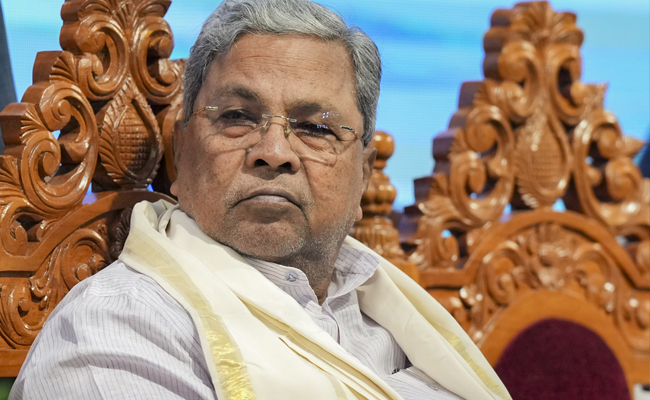
Bengaluru (PTI): Alleging a “criminal conspiracy” by BJP candidate D N Jeevaraj in the Sringeri Assembly poll recounting, Karnataka CM Siddaramaiah on Tuesday said the outcome was manipulated after valid postal ballot votes in favour of Congress leader T D Raje Gowda were tampered with during the recounting process.
Following a Karnataka High Court order on an election petition filed by Jeevaraj, challenging Raje Gowda’s election, the reverification and recounting were conducted on Saturday.
After the reverification and recount of postal ballots for the Sringeri Assembly constituency, votes polled in favour of Raje Gowda were reduced by 255, the returning officer said.
A report on the matter has been submitted to the Election Commission of India for further action, the officer added.
Congress leader Raje Gowda had won the 2023 Assembly polls from Sringeri by 201 votes, defeating his nearest rival Jeevaraj.
Addressing a press conference in Bengaluru, Siddaramaiah said the High Court had directed the recounting of postal ballots and that irregularities were noticed during the exercise conducted on May 2.
“This is a clear case of criminal conspiracy,” Siddaramaiah said, alleging that valid votes cast in favour of Raje Gowda were altered after being accepted by counting agents of all parties, including Congress, BJP, and JD(S).
He claimed that during the recounting of postal ballots, 255 votes were initially accepted as valid by all agents but were later tampered with by subordinate officials.
“There is a second mark on the votes polled in favour of Raje Gowda. They had accepted these as valid votes. Subsequently, another mark was made by officials. This is a clear case of criminal conspiracy,” he said.
When asked who was behind the alleged conspiracy, the CM replied, “It was hatched by Jeevaraj and others. It is planned.”
Siddaramaiah further alleged that the returning officer acted improperly by declaring the result despite the presence of an Election Commission observer during the recounting.
“Immediately after the counting, the returning officer announced the result. He should not have done so; this is against the law,” he said.
He pointed out that Raje Gowda had originally won by 201 votes, but after the recounting, the BJP candidate was declared the winner by 52 votes.
“The BJP has committed a criminal act of conspiracy. This is not vote chori but vote dacoity,” he alleged.
The CM said a police complaint had already been filed by Raje Gowda’s election agent, Sudhir Kumar, and emphasised the need for electoral integrity.
“We want transparency and free and fair elections. That is what our Constitution mandates,” he added.
Stating that the government would pursue legal remedies, Siddaramaiah said, “We are preparing an appeal challenging the returning officer’s announcement in a court of law.”
Responding to a separate query on elections in other states, the CM said there appeared to be an anti-incumbency factor in West Bengal, while results in Tamil Nadu were “surprising,” adding that Vijay’s party was emerging as the largest there.
Following the victory of party candidates in Bagalkote and Davanagere South, Siddaramaiah expressed confidence about future electoral prospects in Karnataka.
“Even in 2028, we will win the Assembly elections. We will come back,” the CM said.
Siddaramaiah added that he would order a forensic examination into the alleged tampering of postal ballots.