Beds run out at Beijing hospital as COVID brings more sick
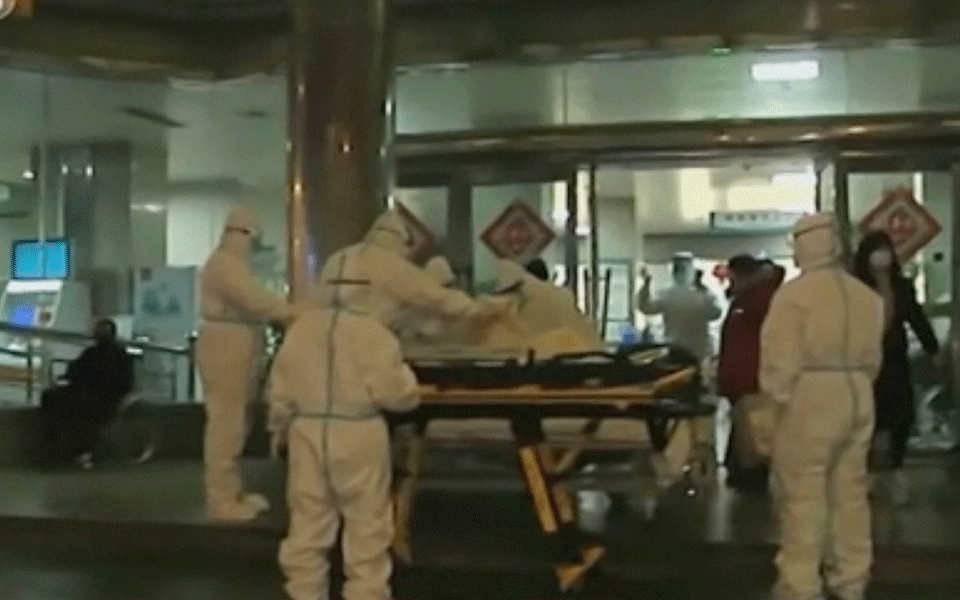
Beijing(AP): Patients, most of them elderly, are lying on stretchers in hallways and taking oxygen while sitting in wheelchairs as COVID-19 surges in China's capital Beijing.
The Chuiyangliu hospital in the city's east was packed with newly arrived patients on Thursday. By mid-morning beds had run out, even as ambulances continued to bring those in need.
Hard-pressed nurses and doctors rushed to take information and triage the most urgent cases.
The surge in severely ill people needing hospital care follows China abandonment of its most severe pandemic restrictions last month after nearly three years of lockdowns, travels bans and school closures that weighed heavily on the economy and prompted street protests not seen since the late 1980s.
It also comes as the the European Union on Wednesday "strongly encouraged" its member states to impose pre-departure COVID-19 testing of passengers from China.
Over the past week, EU nations have reacted with a variety of restrictions toward travelers from China, disregarding an earlier commitment to act in unity.
Italy where the pandemic first exacted a heavy toll in Europe in early 2020 was the first EU member to require coronavirus tests for airline passengers coming from China, but France and Spain quickly followed with their own measures.
That followed the imposition by the US of a requirement that all passengers from China show a negative test result obtained in the previous 48 hours before departure. China has warned of "countermeasures" if such policies were to be imposed across the bloc.
Still, World Health Organisation head Tedros Adhanom Ghebreyesus said Wednesday he was concerned about the lack of outbreak data from the Chinese government.
At a daily briefing on Thursday, Chinese Foreign Ministry spokesperson Mao Ning said Beijing has consistently "shared information and data with the international community in an open and transparent manner."
"At present, China's COVID-19 situation is under control," Mao said. "Also, we hope that the WHO secretariat will take a science-based, objective and impartial position to play a positive role in addressing the pandemic globally."
The terse language between China and the WHO contrasts sharply with what critics in the US Congress and elsewhere called an overly friendly relationship between the two as the UN organisation sought to probe the origins of the pandemic.
While the first cases were reported in the central Chinese city of Wuhan in late 2019, China has claimed the virus originated in the US or Europe and has been accused of withholding data that could help narrow the search for the cause.
In dealing with the latest outbreak, China has sought to get more of its elderly population vaccinated, but those efforts have been hampered by past scandals involving fake medications and previous warnings about adverse reactions to the vaccines among older people.
China's domestically developed vaccines are also considered less effective than the mRNA jabs used elsewhere.
Meanwhile, local authorities in some areas are appealing to the public to avoid traveling during this month's Lunar New Year holiday, as the last formal restrictions on movement are lifted.
"We recommend that everyone not return to their hometowns unless necessary during the peak of the outbreak," the government of Shaoyang county in Hunan province in central China said in a notice dated Thursday.
"Avoid visiting relatives and traveling between regions. Minimize travel."
Similar appeals were issued by Shouxian county in Anhui province southeast of Beijing and the cities of Qingyang in Gansu province in the northwest and Weifang in Shandong on the east coast.
The Weifang government notice said residents should celebrate the holiday with video and phone gatherings.
"Avoid visiting relatives and friends to protect yourself and others," it said.
Despite such concerns, Hong Kong announced it will reopen its border with mainland China on Sunday and allow tens of thousands of people to cross from each side every day without being quarantined.
It was unclear what restrictions people travelling to the mainland side would face.
The city's land and sea border checkpoints with the mainland have been largely closed for almost three years and the reopening is expected to provide a much-needed boost to Hong Kong's tourism and retail sectors.
Let the Truth be known. If you read VB and like VB, please be a VB Supporter and Help us deliver the Truth to one and all.
Kohli's U-19 teammate Amanpreet Singh Gill dies at 36

New Delhi (PTI): Former India U-19 and Punjab medium pacer Amanpreet Singh Gill died at the age of 36 in Chandigarh on Wednesday, leaving the cricket fraternity in mourning.
The cause of death is not yet known.
Gill, who was Virat Kohli's U-19 teammate, featured in six first-class matches for Punjab, picking up 11 wickets.
He was also part of the Punjab franchise (Kings XI Punjab) in the inaugural Indian Premier League season, and later served as a member of Punjab's senior selection committee.
"Punjab Cricket Association deeply mourns the sad demise of Amanpreet Singh Gill, former Punjab cricketer and Member, Senior Selection Committee Punjab,” the Punjab Cricket Association announced on X.
"Our heartfelt condolences to the bereaved family and loved ones. May Waheguru grant eternal peace to the departed soul and strength to the family in this difficult time."
Two-time World Cup-winning India all-rounder Yuvraj Singh also paid tribute to Gill.
"Deeply saddened to hear about Amanpreet Singh Gill’s passing. Shared the dressing room in our early days, he was a quiet, hardworking cricketer who loved the game. My heartfelt condolences to his family and loved ones. Rest in peace Om Shanti,” Singh posted on X.
Gill played five Youth ODIs and one Youth Test for India in 2007.
In the longer format, he claimed the wicket of former Sri Lanka all-rounder Thisara Perera.
However, he did not make the Virat Kohli-led India U-19 side that went on to win the 2008 World Cup.
“Deeply saddened by the passing of Amanpreet Singh Shergill, who proudly represented Punjab and was a part of the Punjab Kings family. Our heartfelt condolences to his family, friends, and the entire cricketing fraternity,” Punjab Kings posted on their official Instagram account.