Biden admin to reconsider objections to H1B visas during Trump regime
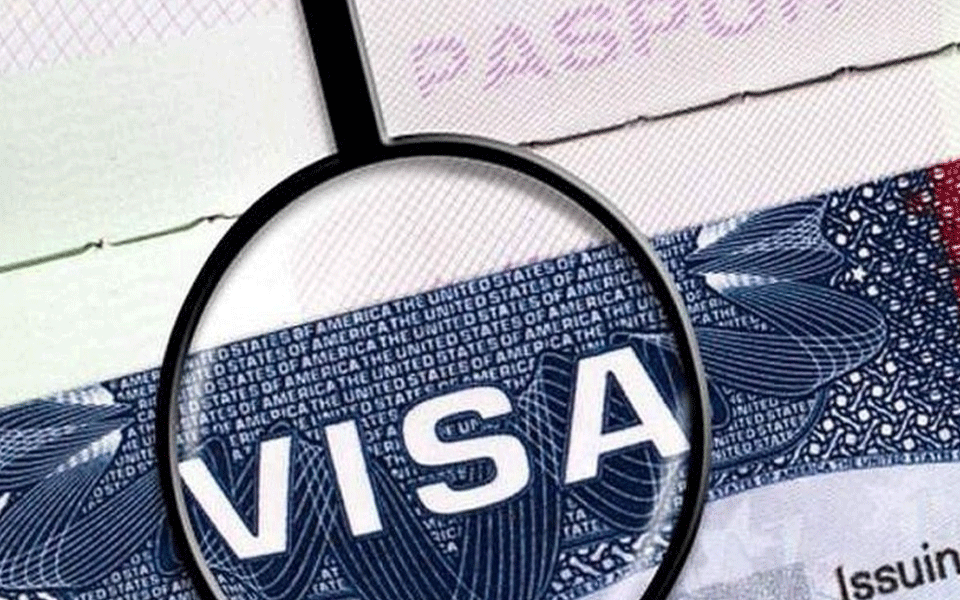
Washington: The Biden administration on Friday said it is willing to reconsider the objections or adverse decisions to foreign workers on visas like H-1B due to the three policy memos by the previous Trump administration which now have been rescinded.
The move is expected to come to the rescue of a large number of Indian IT professionals who were having a tough time during the previous Trump administration due to various policies and memorandums on non-immigrant work visas, in particular H-1B.
US Citizenship and Immigration Services (USCIS) on Friday announced "it may reopen and/or reconsider adverse decisions" on Form I-129, Petition for a Nonimmigrant Worker, made based on three rescinded policy memos.
USCIS said it will generally use its discretion to accept a motion to reopen filed more than 30 days after the decision, if filed before the end of the validity period requested on the petition or labour condition application, whichever is earlier, and the decision was based on one or more policies in the three rescinded H-1B memoranda.
On June 17, 2020, USCIS issued Policy Memorandum 602-0114, which officially rescinded two prior policy memoranda. First titled "Determining Employer-Employee Relationship for Adjudication of H-1B Petitions, Including Third-Party Site Placements," that was issued on January 8, 2010; and second "Contracts and Itineraries Requirements for H-1B Petitions Involving Third-Party Worksites," issued on February 22, 2018.
On February 3, 2021, USCIS issued Policy Memorandum 602-0142.1, which officially rescinded PM-602-0142, "Rescission of the December 22, 2000 'Guidance memo on H1B computer related positions'," issued on March 31, 2017. Both Policy Memorandum 602-0114 and Policy Memorandum 602-0142.1 state that they apply to "any pending or new [H-1B Petitions], including motions on and appeals of revocations and denials of H-1B classification."
USCIS said a petitioner may request that it reopen and/or reconsider adverse decisions based on the three rescinded policy memos by properly filing Form I-290B, Notice of Appeal or Motion, accompanied by the appropriate fee.
In addition, USCIS has the discretionary authority to accept and consider untimely motions under certain circumstances as explained in the form instructions and permitted by regulation.
"Petitioners who received an adverse decision on an H-1B petition based on the now-rescinded policy memoranda should consider whether there is time remaining in the validity period requested on the previously filed H-1B petition and the relevant labour condition application," USCIS said.
USCIS will generally process motions based on filing order, and consistent with current policy guidance, the federal agency said.
Let the Truth be known. If you read VB and like VB, please be a VB Supporter and Help us deliver the Truth to one and all.
Indian startup's 'Drishti' satellite launched aboard SpaceX rocket
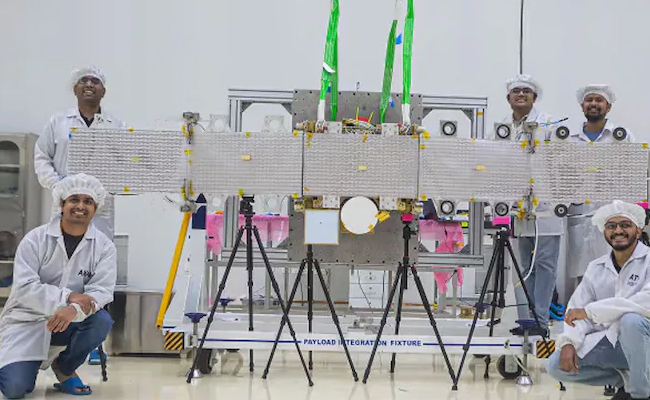
New Delhi (PTI): Bengaluru-based space start-up GalaxEye's Mission Drishti satellite was launched on Sunday aboard SpaceX's Falcon 9 rocket from California.
Mission Drishti is the world's first OptoSAR satellite, integrating electro-optical (EO) and synthetic aperture radar (SAR) sensors into a single operational platform, according to the company.
While EO sensors capture high-resolution images during sunlight and clear skies, SAR sensors provide all-weather and all-time images, using radar pulses.
In a statement, Suyash Singh, founder and CEO of GalaxEye, said, "With the satellite (Mission Drishti) now successfully in orbit, our immediate focus is on completing its commissioning. As we move through this phase, we are already witnessing strong global interest in the differentiated datasets enabled by our OptoSAR payload."
The satellite will help address long-standing limitations of conventional systems and enable more reliable and consistent data acquisition across diverse environmental conditions, the company said.
As a dual-use Earth observation satellite, the mission will support use cases across defence, agriculture, disaster management, maritime monitoring, and infrastructure planning.
The satellite is also expected to complement India's broader initiatives, including the 29 active Earth Observation satellites outlined in ISRO's recent annual report.
The launch came after five years of indigenous research and development, and extensive environmental testing and performance validation of the Mission Drishti.
In a statement, Lt Gen AK Bhatt (Retd), director general of Indian Space Association (ISpA), said, "GalaxEye has achieved what only a few global players have, which is seamlessly combining optical and SAR capabilities on a single platform to enable persistent, all-weather intelligence."
What stands out is not just the technology, but its broader impact on how downstream applications will increasingly define value in the space economy, particularly in Earth observation, where timely, decision-grade insights are critical," he added.
ISpA is the premier industry association of space and satellite companies in the country.
Union Minister Jitendra Singh also took note of the Mission Drishti launch, saying the development marked a significant milestone in India's space journey.
In a post on X, the minister said, "The successful launch of the world's first OptoSAR satellite, and the largest privately-built satellite in the country, reflects the immense potential of our young innovators driving nation-building."
GalaxEye aims to scale up Mission Drishti to a constellation of 10 satellites by 2030, developing a robust and sovereign Earth observation infrastructure for India.