Biden admin urges US court to certify India's request to extradite Tahawwur Rana
Washington: The Biden administration has urged a federal court in Los Angeles to certify India's request to extradite fugitive Pakistani-origin Canadian businessman Tahawwur Rana, sought for his involvement in the 2008 Mumbai terror attack, saying he meets all the criteria required for the handover.
US District Court Judge in Los Angeles Jacqueline Chooljian has scheduled the extradition hearing for April 22.
Assistant US Attorney John J Lulejian, in his submission before a federal US court in Los Angeles, California, said Rana, 59, meets all the criteria to be extradited to India for his trial in the Mumbai terrorist attack. On February 4, Rana's attorney had opposed his extradition.
"The United States respectfully requests that following the April 22, 2021, extradition hearing, the Court certify India's request for Rana's extradition for the Secretary of State's surrender decision," Lulejian said in his 61-page court submission on Monday.
Rana, a childhood friend of David Coleman Headley, was re-arrested on June 10 in Los Angeles on an extradition request by India for his involvement in the Mumbai terror attack in which 166 people, including six Americans, were killed. He has been declared a fugitive by India.
"Fugitive Tahawwur Hussain Rana is wanted in India to stand trial for offences related to his role in the 2008 terrorist attacks in Mumbai, India, that resulted in the death of 166 people, the injury of 239 people, and the damage to property in excess of USD 1.5 billion," Lulejian said.
As per the India-US Extradition Treaty, the Indian government has requested the formal extradition of Rana, and the United States has initiated the extradition proceeding.
Lulejian said the criteria warranting certification of extradition are satisfied in this case.
These criteria are: the court has both personal and subject matter jurisdiction, there is an extradition treaty between the United States and India that is in full force and effect, and the crimes for which Rana's extradition is sought are covered by the terms of the treaty.
India's extradition request contains evidence to establish probable cause that the individual appearing in court is the fugitive who committed the offence for which extradition is requested, Lulejian argued.
In his court submission on February 4, Rana's attorney had argued that Rana's extradition is barred under Article 6 of the United States-India extradition treaty because he had previously been acquitted of the offences for which his extradition is sought, and under Article 9 of the treaty because the government has not established probable cause to believe that Rana committed the alleged offences.
Lulejian said that the court should find that Rana's extradition is not barred under Article 6 of the India-US Extradition Treaty.
Although there is ample evidence that Rana aided and abetted the Mumbai attack, he claims that he should not be extradited because probable cause is lacking. Rana's claim is based on an improper attempt to attack the credibility of a key witness against him, Lulejian said.
Rana also does not contest that he is the person who India alleges committed the charged crimes. Instead, he challenges only whether Article 6 of the treaty bars his extradition and whether probable cause exists to believe that he committed the offences for which India requests his extradition, the Assistant US Attorney said.
Lulejian said Headley's plea agreement is irrelevant because Rana cannot benefit from its terms. Not only is Rana in a different position than Headley because he did not plead guilty or cooperate with the United States, as is his right, but his inability to benefit from the negotiated terms of Headley's plea agreement is confirmed by the text of the plea agreement itself.
He said Rana's extradition proceedings are separate from Headley's criminal proceedings and are being litigated by a different United States attorney's office from the one who negotiated the plea agreement with Headley.
According to its very terms, Rana has no rights under Headley's plea agreement and is therefore prohibited from relying on it in an attempt to undermine the United States' position on his extraditability under the treaty, he added.
"Rana has failed to demonstrate that he cannot be extradited to India as a result of his prior prosecution in the United States," the attorney said.
Rana attempts to undermine India's evidence of probable cause by questioning the credibility of the key witness, David Headley. Not only is Rana's challenge improper in this extradition proceeding, but his claims are also not supported by the law or the evidence, Lulejian said.
Pakistani-American LeT terrorist Headley was involved in plotting the 2008 Mumbai terror attack. He was made an approver in the case, and is currently serving a 35-year prison term in the US for his role in the attack.
Let the Truth be known. If you read VB and like VB, please be a VB Supporter and Help us deliver the Truth to one and all.
Indian startup's 'Drishti' satellite launched aboard SpaceX rocket
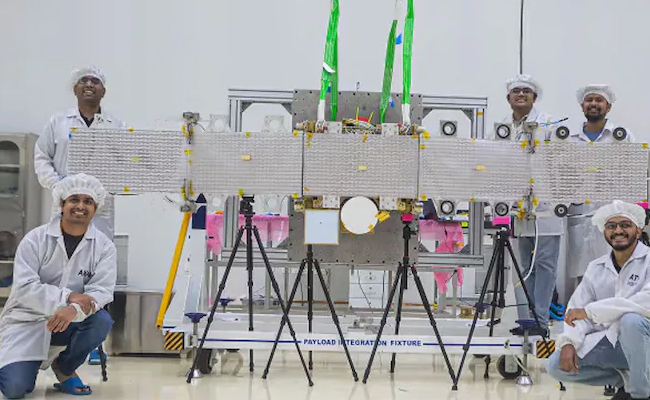
New Delhi (PTI): Bengaluru-based space start-up GalaxEye's Mission Drishti satellite was launched on Sunday aboard SpaceX's Falcon 9 rocket from California.
Mission Drishti is the world's first OptoSAR satellite, integrating electro-optical (EO) and synthetic aperture radar (SAR) sensors into a single operational platform, according to the company.
While EO sensors capture high-resolution images during sunlight and clear skies, SAR sensors provide all-weather and all-time images, using radar pulses.
In a statement, Suyash Singh, founder and CEO of GalaxEye, said, "With the satellite (Mission Drishti) now successfully in orbit, our immediate focus is on completing its commissioning. As we move through this phase, we are already witnessing strong global interest in the differentiated datasets enabled by our OptoSAR payload."
The satellite will help address long-standing limitations of conventional systems and enable more reliable and consistent data acquisition across diverse environmental conditions, the company said.
As a dual-use Earth observation satellite, the mission will support use cases across defence, agriculture, disaster management, maritime monitoring, and infrastructure planning.
The satellite is also expected to complement India's broader initiatives, including the 29 active Earth Observation satellites outlined in ISRO's recent annual report.
The launch came after five years of indigenous research and development, and extensive environmental testing and performance validation of the Mission Drishti.
In a statement, Lt Gen AK Bhatt (Retd), director general of Indian Space Association (ISpA), said, "GalaxEye has achieved what only a few global players have, which is seamlessly combining optical and SAR capabilities on a single platform to enable persistent, all-weather intelligence."
What stands out is not just the technology, but its broader impact on how downstream applications will increasingly define value in the space economy, particularly in Earth observation, where timely, decision-grade insights are critical," he added.
ISpA is the premier industry association of space and satellite companies in the country.
Union Minister Jitendra Singh also took note of the Mission Drishti launch, saying the development marked a significant milestone in India's space journey.
In a post on X, the minister said, "The successful launch of the world's first OptoSAR satellite, and the largest privately-built satellite in the country, reflects the immense potential of our young innovators driving nation-building."
GalaxEye aims to scale up Mission Drishti to a constellation of 10 satellites by 2030, developing a robust and sovereign Earth observation infrastructure for India.