Biden: US would intervene with military to defend Taiwan
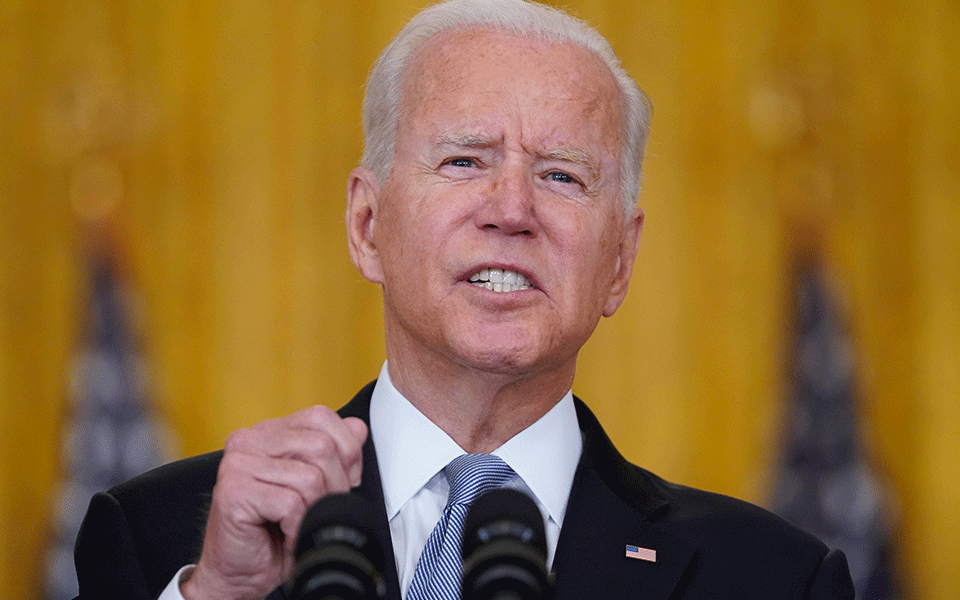
Tokyo(AP): President Joe Biden said Monday that the US would intervene militarily if China were to invade Taiwan, saying the burden to protect Taiwan is "even stronger' after Russia's invasion of Ukraine. It was one of the most forceful presidential statements in support of self-governing in decades.
Biden, at a news conference in Tokyo, said yes when asked if he was willing to get involved militarily to defend Taiwan if China invaded. That's the commitment we made, he added.
The US traditionally has avoided making such an explicit security guarantee to Taiwan, with which it no longer has a mutual defense treaty. The 1979 Taiwan Relations Act, which has governed US relations with the island, does not require the US to step in militarily to defend Taiwan if China invades, but makes it American policy to ensure Taiwan has the resources to defend itself and to prevent any unilateral change of status in Taiwan by Beijing.
Biden's comments were likely to draw a sharp response from the mainland, which has claimed Taiwan to be a rogue province.
A White House official said Biden's comments did not reflect a policy shift.
Speaking alongside Japanese Prime Minister Fumio Kishida, Biden said any effort by China to use force against Taiwan would just not be appropriate, adding that it will dislocate the entire region and be another action similar to what happened in Ukraine.
China has stepped up its military provocations against democratic Taiwan in recent years aimed at intimidating it into accepting Beijing's demands to unify with the communist mainland.
They're already flirting with danger right now by flying so close and all the maneuvers that are undertaken, Biden said of China.
Under the one China policy, the US recognises Beijing as the government of China and doesn't have diplomatic relations with Taiwan. However, the US maintains unofficial contacts including a de facto embassy in Taipei, the capital, and supplies military equipment for the island's defence.
Biden said it is his expectation that China would not try to seize Taiwan by force, but he said that assessment depends upon just how strong the world makes clear that that kind of action is going to result in long-term disapprobation by the rest of the community."
He added that deterring China from attacking Taiwan was one reason why it's important that Russian President Vladimir Putin "pay a dear price for his barbarism in Ukraine," lest China and other nations get the idea that such action is acceptable.
Fearing escalation with nuclear-armed Russia, Biden quickly ruled out putting US forces into direct conflict with Russia, but he has shipped billions of dollars in US military assistance that has helped Ukraine put up a stiffer-than-expected resistance to Russia's onslaught.
Biden's comments came just before he formally launched a long-anticipated Indo-Pacific trade pact that excludes Taiwan.
White House national security adviser Jake Sullivan confirmed Sunday that Taiwan isn't among the governments signed up for the Indo-Pacific Economic Framework, which is meant to allow the US to work more closely with key Asian economies on issues like supply chains, digital trade, clean energy and anti-corruption.
Inclusion of Taiwan would have irked China.
Sullivan said the US wants to deepen its economic partnership with Taiwan on a one-to-one basis.
Let the Truth be known. If you read VB and like VB, please be a VB Supporter and Help us deliver the Truth to one and all.
Vijay''s TVK wins an impressive 108 seats in TN polls

Chennai (PTI): Vijay-led TVK secured an impressive 108 seats trouncing the incumbent DMK led by M K Stalin which finished with only 59 seats in the Tamil Nadu Assembly elections held on April 23, as per the final tally of the ECI on Tuesday.
The opposition AIADMK won 47 seats while its allies the PMK obtained 4 and the BJP and AMMK clinched one seat each respectively in the election, according to the data available on the Election commission of India's website.
The DMK's allies - the Congress managed to win 5 seats, the IUML, CPI, CPI (M), and VCK: 2 each and DMDK secured one seat, among a total of 234 Assembly constituencies in the state.
The votes were taken up for counting on May 4 and the final tally was announced on Tuesday.
Actor-politician Vijay's Tamilaga Vettri Kazhagam on Monday created a record of sorts in the electoral history of Tamil Nadu and emerged as the single largest party by delivering a shock defeat to DMK and its president Stalin in his Kolathur constituency, while the AIADMK was pushed to a distant third spot.
Vijay won from both Perambur and Tiruchirappalli East constituencies.
The TVK has clocked nearly 35 per cent (34.92) vote share in its debut polls.
This will be the first time in Tamil Nadu that a party will assume power a little over two years after its founding in February 2024.