Biden's immigration bill proposes to eliminate per country cap, to benefit Indian IT professionals
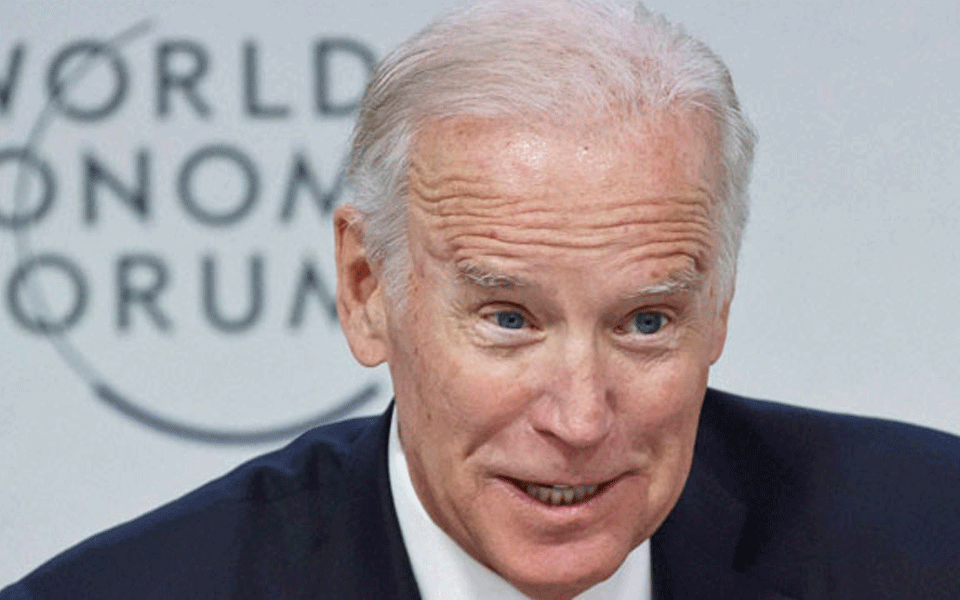
Washington: Joe Biden, hours after being sworn in as the 46th President, will send a comprehensive immigration bill to Congress which among other things proposes to eliminate the per country cap for employment-based green cards, a move that would benefit hundreds and thousands of Indian IT professionals in the US, whose current wait period for legal permanent residency runs into several decades.
Called the US Citizenship Act of 2021, the legislation modernises the immigration system, according to an incoming White House official.
It prioritises keeping families together, grows the country's economy, responsibly manages the border with smart investments, addresses the root causes of migration from Central America, and also ensures that the US remains a refuge for those fleeing persecution, said the official, who spoke on condition of anonymity.
Describing this as a common-sense approach to solving immigration challenges, focusing on what works, the US Citizenship Act 2021 creates a roadmap to citizenship for a population that lives and works in the United States.
January 1, 2021 is the cut-off date for those undocumented workers. Two-thirds of undocumented immigrants have been in the US for 10 years or longer.
It provides an immediate pathway to green cards for individuals who meet certain criteria as they were dreamers or have been recipients of the Temporary Protected Status (TPS), or are farm workers and meet certain criteria.
They can apply for citizenship three years later. For those who don't meet those qualifications, there will be another path to citizenship, where they would be in an interim status for five years.
Afterwards they would be eligible to apply for citizenship within three years after becoming green card holders.
According to the incoming White House official, the bill reforms the family-based immigration system by recapturing unused visas to clear the backlog, eliminating the lengthy waits, and it increases their per country visa caps.
It also eliminates the bars and other provisions that have kept families apart.
"The bill also clears employment-based immigration backlogs by reducing those backlogs altogether, eliminating the per country. It makes it easier for graduates of US universities with advanced degrees, in the Science, Technology, Engineering and Mathematics (STEM) fields to stay in the US. It also improves access to green cards for workers from the low wage sectors, said the official.
It eliminates again, many of the unnecessary hurdles for employment based green cards. The bill also includes the No Ban Act that prohibits discrimination based on religion and limits presidential authority to issue future bans, the official added.
Indian IT professionals, most of whom are highly skilled and come to the US mainly on the H-1B work visas, are the worst sufferers of the current immigration system which imposes a seven per cent per country quota on allotment of the coveted Green Card or permanent legal residency.
Post the November election outcome, a document of the Biden transition had said he will reform the visa system that has kept so many Indian families in waiting for too long.
"He (Biden) will support first reforming the temporary visa system for high-skill, specialty jobs to protect wages and workers, then expanding the number of visas offered and eliminating the limits on employment-based green cards by country, which have kept so many Indian families in waiting for too long," the document stated.
Biden's bill also increases the diversity visa programme from 55,000 visas to 80,000 per year. This bill is Biden's vision to fix the immigration system once and for all. But it's only the Congress that can provide immigrants with a path to citizenship.
Biden looks forward to working with the Congress to fix our broken immigration system and protect vulnerable populations, including dreamers, those with TPS farm workers and essential workers, said the official.
Let the Truth be known. If you read VB and like VB, please be a VB Supporter and Help us deliver the Truth to one and all.
NCW chief condemns rape-murder of 4-year-old girl in Pune, calls for swift action
New Delhi (PTI): National Commission for Women (NCW) Chairperson Vijaya Rahatkar has condemned the alleged rape and murder of a four-year-old girl in Maharashtra's Pune, calling it "deeply distressing" and a "blot on humanity".
The girl was allegedly raped and killed by a 65-year-old labourer, who has a criminal record, in Bhor tehsil of Pune on Friday. The accused allegedly lured the child to a cattle enclosure on the pretext of giving her food. After raping her, he killed her by hitting her with a stone, according to police.
The accused has been arrested.
In a post on X on Saturday, Rahatkar said the incident in the Nasrapur area in Pune was heartbreaking and has shaken society.
"The brutal torture and murder of a four-year-old innocent girl in Nasrapur (Bhor, Pune) is deeply painful, heartbreaking, and shocking. It is a blot on humanity," she said.
She said Pune Rural police has arrested the accused and noted that Maharashtra Chief Minister Devendra Fadnavis and Deputy Chief Minister Sunetra Pawar have assured strict action in the case.
Rahatkar said the NCW has taken cognisance of the matter and written to the National Commission for Protection of Child Rights (NCPCR), requesting the body to ensure necessary and prompt action.
It has also been recommended that the case be pursued under stringent provisions of the Protection of Children from Sexual Offences (POCSO) Act and be closely monitored from the filing of the chargesheet to proceedings in a fast-track special court to ensure time-bound justice, she added.
Ensuring justice for the victim and stringent punishment for the accused is a collective responsibility, the NCW chairperson underlined.
In a post on X, the NCW said it has taken suo motu cognisance of the extremely "heinous" incident.
"This heinous crime causes profound pain and outrage, and it highlights serious concerns regarding the safety of young girls," it said.
Strongly condemning this grave "inhuman act", the NCW said such crimes constitute a serious violation of children's rights and raise questions about society's security system.