Bolsonaro and Lula headed to a runoff after a tight Brazil election
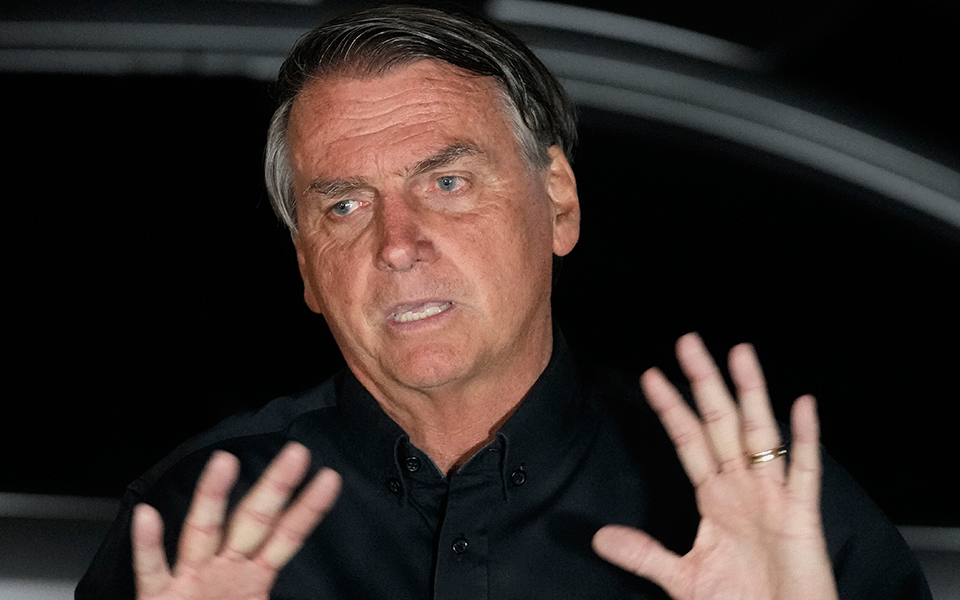
Rio de Janeiro(AP): Brazil's top two presidential candidates will face each other in a runoff vote after neither got enough support to win outright Sunday in an election to decide if the country returns a leftist to the helm of the world's fourth-largest democracy or keeps the far-right incumbent in office.
With 99.6% of the votes tallied, former President Luiz In cio Lula da Silva had 48.3% support and President Jair Bolsonaro had 43.3%. Nine other candidates were also competing, but their support pales to that of Bolsonaro and da Silva, who is commonly known as Lula.
The tightness of the result came as a surprise since pre-election polls had given da Silva a commanding lead. The last Datafolha survey published Saturday had found a 50% to 36% advantage for da Silva. It interviewed 12,800 people, with a margin of error of 2 percentage points.
This tight difference between Lula and Bolsonaro wasn't predicted, said Nara Pav o, who teaches political science at the Federal University of Pernambuco.
Speaking at a post-vote press conference, da Silva referred to the scheduled Oct. 30 runoff vote against Bolsonaro as extra time in a soccer game.
I want to win every election in the first round. But it isn't always possible, he said.
Bolsonaro outperformed expectations in Brazil's southeast region, which includes populous Sao Paulo, Rio de Janeiro, and Minas Gerais states, according to Rafael Cortez, who oversees political risk at consultancy Tendencias Consultoria.
The polls didn't capture that growth, Cortez said.
Carlos Melo, a political science professor at Insper University in Sao Paulo, said: It is too soon to go too deep, but this election shows Bolsonaro's victory in 2018 was not a hiccup.
Bolsonaro's administration has been marked by incendiary speech, his testing of democratic institutions, his widely criticized handling of the COVID-19 pandemic, and the worst deforestation in the Amazon rainforest in 15 years.
But he has built a devoted base by defending conservative values, rebuffing political correctness, and presenting himself as protecting the nation from leftist policies that he says infringe on personal liberties and produce economic turmoil.
While voting earlier Sunday, Marley Melo, a 53-year-old trader in the capital Brasilia, sported the yellow of Brazilian flag, which Bolsonaro and his supporters have coopted for demonstrations. Melo said he is once again voting for Bolsonaro, who met his expectations, and he doesn't believe the surveys that show him trailing.
Polls can be manipulated. They all belong to companies with interests, he said.
A slow economic recovery has yet to reach the poor, with 33 million Brazilians going hungry despite higher welfare payments. Like several of its Latin American neighbors coping with high inflation and a vast number of people excluded from formal employment, Brazil is considering a shift to the political left.
Bolsonaro has repeatedly questioned the reliability not just of opinion polls, but also of Brazil's electronic voting machines. Analysts fear he has laid the groundwork to reject results.
At one point, Bolsonaro claimed to possess evidence of fraud, but never presented any, even after the electoral authority set a deadline to do so. He said as recently as Sept. 18 that if he doesn't win in the first round, something must be abnormal.
Da Silva, 76, was once a metalworker who rose from poverty to the presidency and is credited with building an extensive social welfare program during his 2003-2010 tenure that helped lift tens of millions into the middle class.
But he is also remembered for his administration's involvement in vast corruption scandals that entangled politicians and business executives.
Da Silva's own convictions for corruption and money laundering led to 19 months of imprisonment, sidelining him from the 2018 presidential race that polls indicated he had been leading against Bolsonaro. The Supreme Court later annulled da Silva's convictions on grounds that the judge was biased and colluded with prosecutors.
Social worker Nadja Oliveira, 59, said she voted for da Silva and even attended his rallies, but since 2018 voted for Bolsonaro.
Unfortunately, the Workers' Party disappointed us. It promised to be different, she said in Brasilia.
Others, like Marialva Pereira, are more forgiving. She said she would vote for the former president for the first time since 2002.
I didn't like the scandals in his first administration, never voted for the Workers' Party again. Now I will because I think he was unjustly jailed and because Bolsonaro is such a bad president that it makes everyone else look better, said Pereira, 47.
Speaking after casting his ballot in Sao Bernardo do Campo, the manufacturing hub in Sao Paulo state where he was a union leader, da Silva recalled that four years ago he was imprisoned and unable to vote.
Bolsonaro grew up in a lower-middle-class family before joining the army. He turned to politics after being forced out of the military for openly pushing to raise servicemen's pay. During his seven terms as a fringe lawmaker in Congress' lower house, he regularly expressed nostalgia for the country's two-decade military dictatorship.
His overtures to the armed forces have raised concern that his possible rejection of election results could be backed by top brass.
On Saturday, Bolsonaro shared social media posts by right-leaning foreign politicians, including former U.S. President Donald Trump, who called on Brazilians to vote for him. Israel's former Prime Minister Benjamin Netanyahu expressed gratitude for stronger bilateral relations and Hungarian Prime Minister Viktor Orb n also praised him.
After voting Sunday morning, Bolsonaro told journalists that clean elections must be respected and that the first round would be decisive. Asked if he would respect results, he gave a thumbs up and walked away.
Leda Wasem, 68, had no doubt Bolsonaro will not just be reelected. Wearing a jersey of the national soccer squad at a polling place in downtown Curitiba, the real estate agent said an eventual da Silva victory could have only one explanation: fraud.
I wouldn't believe it. Where I work, where I go every day, I don't see a single person who supports Lula, she said.
Let the Truth be known. If you read VB and like VB, please be a VB Supporter and Help us deliver the Truth to one and all.
BJP councillor dies by suicide after being threatened by youths following party's bypoll win
Agartala (PTI): A BJP councillor of Dharmanagar Municipal Council (DMC) in North Tripura died by suicide on Tuesday after he was allegedly threatened and humiliated by a group of youth following the saffron party's victory in the Dharmanagar bypoll, police said.
Rahul Kishore Roy, who was also the BJP's Yuva Morcha mandal president, took the extreme step a day after BJP candidate Jahar Chakraborti won the bypoll for the Dharmagar Assembly constituency by a massive margin.
Chief Minister Manik Saha expressed shock over the youth leader's death and assured an impartial inquiry into the allegations brought by the deceased’s wife, Ananya Bhattacharjee.
"I am shocked by the untimely death of Rahul Kishore Roy. May his soul rest in peace, and also offer my sympathy to the bereaved family. I also assured that an impartial inquiry will be conducted following the complaint of the deceased's wife", the CM wrote on Facebook.
Roy's wife has lodged a complaint with the local police station, holding seven persons responsible for her husband's death.
"Soon after the announcement of the results of the bypoll to the Dharmagnar Assembly bypoll, six to seven youths attacked our residence at Chandrapur at 3 pm and started hurling abuses at my husband. They also assaulted me to hand over my husband to them," she stated in the complaint.
Ananya said, "The same gang returned late at night again, attacked our house and hurled two or three bombs. They also threatened to eliminate my husband whenever he is found at Dharmanagar."
Deeply upset by the attacks and threats, my husband committed suicide by hanging from the ceiling early Tuesday morning. I urge the Officer in Charge (OC), Dharmanagar police station, to investigate against these people for justice, she said.
"Based on a specific complaint, we have registered a case, and an investigation is underway. No one has been arrested yet," SP, North Tripura, Avinash Kumar Rai said.
(Assistance for overcoming suicidal thoughts is available on the state’s health helpline 104, Tele-MANAS 14416.)