Boris Johnson formally takes charge as Britain's new PM
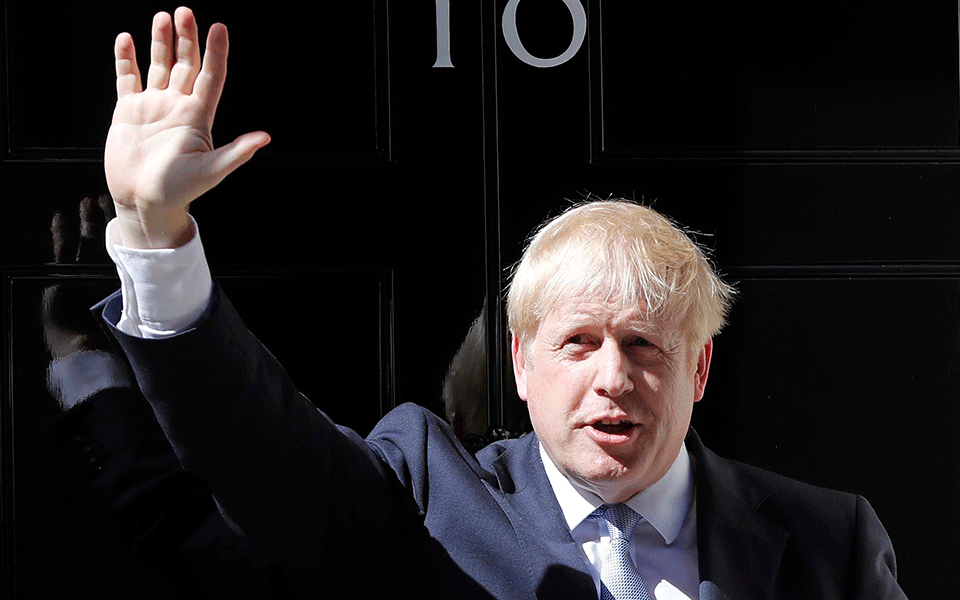
London, Jul 24: Boris Johnson officially became Britain's new Prime Minister on Wednesday and promised to leave the European Union on October 31 "no ifs, no buts" under a "new deal" with the 28-member economic bloc.
The 55-year-old former foreign secretary and London Mayor laid out his vision as Prime Minister in his first speech on the steps of Downing Street after a meeting with Queen Elizabeth II at Buckingham Palace, during which the 93-year-old monarch formally invited him to form a government after accepting Theresa May's resignation a little earlier.
"We will restore trust in our democracy and we are going to fulfil the repeated promises of Parliament to the people and come out of the EU on October 31, no ifs or buts," Johnson said, adding that while he does have 99 days to that deadline, the country has had enough of waiting and the time to act on Brexit is right away.
"Brexit was a fundamental decision by the British people. We must now respect that decision and create a new partnership with our European friends The work begins immediately behind that black door and I take personal responsibility of the change I want to see. Never mind the backstop, the buck stops here," the prime minister said just before he went into that iconic black No. 10 door of Downing Street, the British PM's office.
However, mindful of not just focussing on Brexit at this "extraordinary moment in history", he laid out a range of other promises around 20,000 additional police to make Britain's streets safer, introducing crucial social care and education reforms as well as begin work on free trade deals around the world.
"It is time we look not at the risks [of Brexit] but opportunities that lie before us. Let's start now on those free trade deals that lift billions out of poverty," he said.
Johnson, who has in the past described himself as a son-in-law of India by virtue of his now estranged wife Marina Wheeler's Indian mother - Dip Kaur, has stressed that the UK's relationship with India must run deeper than just trade.
In reference to India-UK relations, Johnson is on the record saying he wants to pursue a new trade deal and is expected to build on his self-confessed "personal relationship" with Prime Minister Narendra Modi to deliver a "truly special" bilateral relationship.
"The sooner we leave the EU and take back control of our trade policy, the sooner we can strike a new trade deal with India that will deliver new jobs, growth and prosperity for both our countries. Securing this new and improved trading relationship with our friends in India will be a priority for me," he said, during the course of a month-long leadership contest.
Johnson becomes the 14th Prime Minister to be appointed by Queen Elizabeth II, the 55th to hold the post of British PM and the third in fairly quick succession since Britain voted to leave the EU in June 2016 following on from David Cameron and Theresa May.
May, who was forced to resign amid a mounting rebellion from within her party over her Brexit strategy that failed to clear the Parliament votes threshold three times, had been functioning as a caretaker Prime Minister during the course of the Tory leadership.
She addressed her final Prime Minister's Questions in the House of Commons on Wednesday and then made a farewell speech on the steps of Downing Street before being driven to Buckingham Palace to formally hand in her resignation to the Queen. It is during this meeting that May would have indicated to the Queen who commands the requisite support to form the next government, following which Johnson was driven to the palace for his private audience with the Queen.
In some drama on his way to the palace, Johnson's cavalcade was blocked by Greenpeace protestors wanting to hand over a climate change petition to the new Prime Minister. The group that formed a human chain blockage were quickly moved out of the way by security officials.
As the face of hard Brexit in the ruling Conservative Party, Johnson has pledged to get Britain out of the EU within the deadline of October 31 with or without a deal. The prospect will prove divisive as the Opposition Labour Party and pro-EU Lib Dems have already voiced plans to bring down his government if he attempts a drastic no-deal exit from the EU.
Labour leader Jeremy Corbyn has demanded that Johnson call a General Election and promised to table a motion of no confidence in him when it is appropriate to do so .
MPs from within Johnson's own party remain vehemently opposed to a no-deal Brexit, with Chancellor Philip Hammond, justice secretary David Gauke and international development secretary Rory Stewart among some of the Cabinet members who have already declared their defiance by refusing to serve in his Cabinet.
Johnson is expected to spend his first few hours at No. 10 Downing Street finalising the top jobs in his Cabinet, with Indian-origin MP Priti Patel widely tipped to be back in the frontline after she had been forced to resign from May's Cabinet as international development secretary in 2017.
The 47-year-old ardent Brexiteer declined to speculate over Johnson's plans but said that she was confident the prime minister has plans for a diverse Cabinet, given his track record of deploying a diverse team as the Mayor of London.
Fellow Brexiteer Rishi Sunak, the son-in-law of Infosys co-founder Narayana Murthy, and housing minister Alok Sharma are also in line for frontline jobs in what Indian-origin peer Lord Jitesh Gadhia has hailed as the most diverse Cabinet in British history.
Let the Truth be known. If you read VB and like VB, please be a VB Supporter and Help us deliver the Truth to one and all.
KERC increases electricity tariffs for commercial, industrial consumers
Bengaluru (PTI): The Karnataka Electricity Regulatory Commission has reduced electricity tariffs for agricultural pump sets for 2025–26 from the earlier uniform rate of Rs 8.30 per unit to a range of Rs 6.57 to Rs 7.79 per unit across the state.
However, the Commission has increased tariffs for select commercial and industrial consumers by 10 paise to a maximum of 95 paise per unit.
As per the Commission’s order, the revised tariffs are as follows: LT-3a (low-tension commercial) consumers will pay a fixed charge of Rs 235 per kW and an energy charge of Rs 7.10 per unit, while LT-5 (industrial) consumers will be charged Rs 165 per HP as fixed charges and Rs 5.20 per unit as energy charges.
In the high-tension segment, HT-2a (industrial) consumers will pay a demand charge of Rs 365 per kVA and an energy charge of Rs 6.70 per unit, while HT-2b (commercial) consumers will pay Rs 390 per kVA as demand charges and Rs 6.90 per unit as energy charges.
The revised tariffs were notified in an order issued on March 3 after the Commission allowed a review petition filed by five state-run electricity supply companies—Bangalore Electricity Supply Company, Mangalore Electricity Supply Company, Chamundeshwari Electricity Supply Corporation, Hubli Electricity Supply Company and Gulbarga Electricity Supply Company.
The order, however, does not specify the date from which the revised tariffs will come into effect.
In its earlier tariff order dated March 27, 2025, the Commission had fixed the LT-4a tariff uniformly at Rs 8.30 per unit across all ESCOMs.
Consumers in the LT-4a category — primarily agricultural pump set users — are provided free power supply, with the state government reimbursing the cost through subsidies.
According to the order, the petitioners informed the Commission that despite the Government of Karnataka allocating Rs 16,021 crore towards subsidies for free power supply to LT-4a consumers, the ESCOMs would not be able to fully recover the cost of electricity supplied under the earlier tariff structure.
The Commission noted that this would leave distribution companies with no option but to demand payment of the balance amount from farmers, leading to “unexpected and undue hardship” for the agricultural community, which it described as the backbone of the state’s agricultural production.
The reduction in the LT-4a tariff would, however, result in a revenue shortfall of Rs 2,362.47 crore compared to the tariffs considered in the order under review.
Observing that it was necessary to safeguard farmers’ interests while ensuring that ESCOMs reasonably recover costs, the Commission said the review petition could be allowed under the provisions of the Code of Civil Procedure, 1908.
The petitioners informed the Commission that the Government of Karnataka has allocated an additional Rs 2,362.47 crore, supplementing the existing budgetary provision of Rs 16,021 crore, recognising that the entire financial burden should not be passed on to consumers and must be partially borne by the government.
The petitioners further stated that they will mobilise Rs 1,107.60 crore through miscellaneous revenue.
“The balance shortfall to be met by increasing tariffs for industrial and commercial consumers, amounting to Rs 1,254.88 crore, appears reasonable and justifiable,” the Commission added.