Brazil's army fights Amazon fires after hundreds more flare up
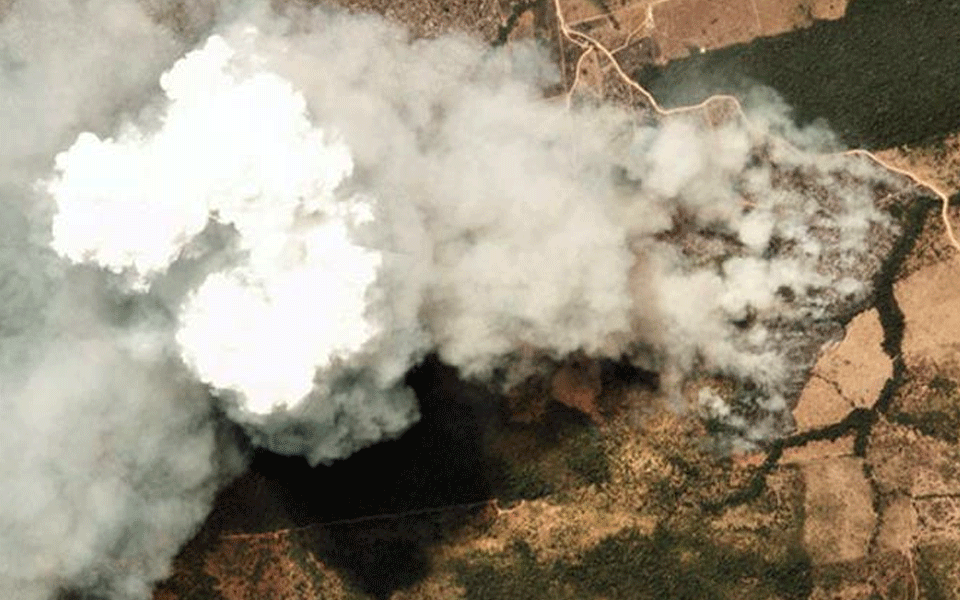
Porto Velho (Brazil): Brazil on Sunday deployed two C-130 Hercules aircraft to douse fires devouring parts of the Amazon rainforest, as hundreds of new blazes were ignited ahead of nationwide protests over the destruction.
Heavy smoke covered the city of Porto Velho in the northwestern state of Rondonia where the defense ministry said the planes have started dumping thousands of liters of water, amid a global uproar over the worst fires in years.
Swathes of the remote region bordering Bolivia have been scorched by the blazes, sending thick smoke billowing into the sky and increasing air pollution across the world's largest rainforest, which is seen as crucial to mitigating climate change.
Experts say increased land clearing during the months-long dry season to make way for crops or grazing has aggravated the problem this year. "It gets worse every year -- this year, the smoke has been really serious," Deliana Amorim, 46, told AFP in Porto Velho where half a million people live.
At least seven states, including Rondonia, have requested the army's help in the Amazon, where more than 43,000 troops are based and available to combat fires, officials said.
Dozens of firefighters are en route to Porto Velho to help put out the blazes. Justice Minister Sergio Moro has also given the green light for the deployment of security forces to tackle illegal deforestation in the region. The fires have triggered a global outcry and are a major topic of concern at the G7 meeting in Biarritz in southern France.
World leaders at the summit have agreed to help the countries affected by the fires "as fast as possible," French President Emmanuel Macron said Sunday. US President Donald Trump and British Prime Minister Boris Johnson had earlier offered their countries' assistance.
Bolivian President Evo Morales said Sunday he would accept international help to combat wildfires raging in the country's southeast as he suspended his election campaign to deal with the crisis.
Although about 60 percent of the Amazon is in Brazil, the vast forest also spreads over parts of eight other countries or territories: Bolivia, Colombia, Ecuador, French Guiana, Guyana, Peru, Suriname and Venezuela.
Macron's remarks come amid an escalating war of words with his Brazilian counterpart Jair Bolsonaro, who he has accused of lying over Brazil's stance on climate change. Bolsonaro has denounced what he calls Macron's "colonialist mentality."
The fires threaten to torpedo a huge trade agreement between the European Union and South American countries, including Brazil, that took 20 years to negotiate.
EU Council president Donald Tusk told reporters at the G7 on Saturday that it was hard to imagine European countries ratifying a trade pact with the Mercosur bloc as long as Brazil fails to curb the fires ravaging the Amazon.
Pope Francis on Sunday also voiced concern for the rainforest, which he described as a "vital" lung for the planet.
Under intensifying pressure, Bolsonaro on Friday vowed a "zero tolerance" approach to criminal activities in the Amazon and promised strong action to control the fires.
Days earlier, he had accused non-government organizations of igniting the blazes. "There are forest fires all over the world, and this cannot be used as a pretext for possible international sanctions," Bolsonaro said. The latest official figures show 79,513 forest fires have been recorded in Brazil this year, the highest number of any year since 2013.
More than half of the fires are in the massive Amazon basin, where more than 20 million people live. Some 1,130 new fires were ignited between Friday and Saturday, according to Brazil's National Institute for Space Research (INPE).
The new data come as protesters plan to take to the streets across Brazil on Sunday, after thousands held demonstrations in the country and in Europe on Friday.
Let the Truth be known. If you read VB and like VB, please be a VB Supporter and Help us deliver the Truth to one and all.
Online fraud: Hotel chef from Udupi cheated of over Rs 1 lakh by WhatsApp contact

Udupi: Udupi City Police have registered a case of online fraud after a 62-year-old hotel chef was allegedly cheated of Rs 1.13 lakh by a woman who befriended him on WhatsApp, claiming to be based in London.
The victim, identified as Pandu Kariappa Poojary, a resident of Kuthpadi in Udupi, was working at a hotel in Mangaluru.
He reportedly came into contact with a woman identifying herself as Emilda William on WhatsApp. During their interactions, she told Poojary that she planned to start a cosmetics and hotel business in India and would meet him during a visit to Mangaluru.
On April 7, Emilda sent Poojary a flight ticket from London to Delhi via WhatsApp. The following day, Poojary received a phone call from a woman who informed him that Emilda had arrived at Delhi airport carrying a demand draft worth Rs 5 crore along with other items. The caller allegedly asked him to pay Rs 70,000.
Subsequently, Poojary also received a call from Emilda, who was reportedly crying and spoke about the situation. Believing the claims, he transferred a total of Rs 1,13,300 in phases using a scanner. He later realised that he had been cheated.