BRICS nations must put human rights first: Amnesty

Johannesburg, July 25 : The BRICS nations "must" put human rights at the forefront of their discussions, Amnesty International said here on Wednesday.
Amnesty International India and South Africa, in a joint statement released at the commencement of the 10th BRICS Summit, said that all the BRICS countries face a number of human rights challenges.
Citing incidents like the murder of Marielle Franco in Brazil, the Marikana tragedy in South Africa, Tibetan HRD Tashi Wangchuck have being handed an "unjust" five year prison sentence, it said the leaders of these countries must redress human rights violations.
It also referred to the hate crimes against marginalised communities in India, and LGBTI people facing serious threats and living in constant fear in Russia.
"With such wide ranging human rights issues plaguing these emerging economies, the leaders of these countries must act immediately to redress violations and ensure accountability," said Shenilla Mohamed, Executive Director, Amnesty International South Africa.
"Attacks on HRDs and marginalized communities cannot become the order of the day. HRDs defend truth and justice.
However, instead of commending them for their efforts, they are silenced and their work is shut down," he said.
The statement highlighted harassment of Indian HRDs with reference to the detention of Chandrashekhar Azad, a Dalit HRD working on issues of caste-based discrimination.
"Human rights defenders, the champions of truth and justice, are portrayed as criminals, anti-nationals or even foreign agents. They are maligned, locked up and attacked for speaking out," said Aakar Patel, Executive Director, Amnesty International India.
He urged Prime Minister Narendra Modi, and other heads of state at the Summit, "to acknowledge their responsibility towards upholding human rights and work collectively to end human rights violations."
Let the Truth be known. If you read VB and like VB, please be a VB Supporter and Help us deliver the Truth to one and all.
Indian startup's 'Drishti' satellite launched aboard SpaceX rocket
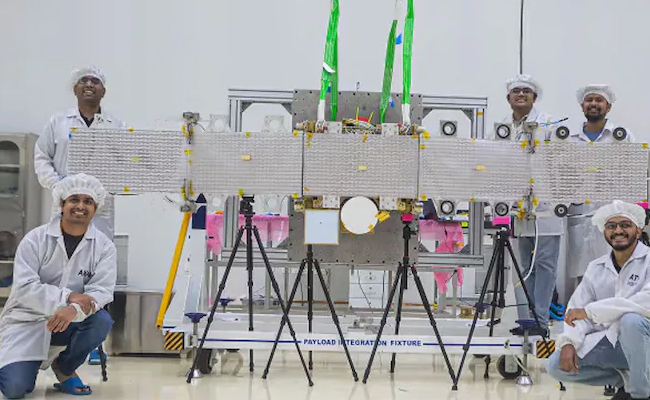
New Delhi (PTI): Bengaluru-based space start-up GalaxEye's Mission Drishti satellite was launched on Sunday aboard SpaceX's Falcon 9 rocket from California.
Mission Drishti is the world's first OptoSAR satellite, integrating electro-optical (EO) and synthetic aperture radar (SAR) sensors into a single operational platform, according to the company.
While EO sensors capture high-resolution images during sunlight and clear skies, SAR sensors provide all-weather and all-time images, using radar pulses.
In a statement, Suyash Singh, founder and CEO of GalaxEye, said, "With the satellite (Mission Drishti) now successfully in orbit, our immediate focus is on completing its commissioning. As we move through this phase, we are already witnessing strong global interest in the differentiated datasets enabled by our OptoSAR payload."
The satellite will help address long-standing limitations of conventional systems and enable more reliable and consistent data acquisition across diverse environmental conditions, the company said.
As a dual-use Earth observation satellite, the mission will support use cases across defence, agriculture, disaster management, maritime monitoring, and infrastructure planning.
The satellite is also expected to complement India's broader initiatives, including the 29 active Earth Observation satellites outlined in ISRO's recent annual report.
The launch came after five years of indigenous research and development, and extensive environmental testing and performance validation of the Mission Drishti.
In a statement, Lt Gen AK Bhatt (Retd), director general of Indian Space Association (ISpA), said, "GalaxEye has achieved what only a few global players have, which is seamlessly combining optical and SAR capabilities on a single platform to enable persistent, all-weather intelligence."
What stands out is not just the technology, but its broader impact on how downstream applications will increasingly define value in the space economy, particularly in Earth observation, where timely, decision-grade insights are critical," he added.
ISpA is the premier industry association of space and satellite companies in the country.
Union Minister Jitendra Singh also took note of the Mission Drishti launch, saying the development marked a significant milestone in India's space journey.
In a post on X, the minister said, "The successful launch of the world's first OptoSAR satellite, and the largest privately-built satellite in the country, reflects the immense potential of our young innovators driving nation-building."
GalaxEye aims to scale up Mission Drishti to a constellation of 10 satellites by 2030, developing a robust and sovereign Earth observation infrastructure for India.