Calls for freedom of speech on rise in China as coronavirus death toll soars to over 1,100
Beijing/Wuhan: The coronavirus outbreak in China has led to rare open calls for freedom of speech in the Communist nation amid growing public discontent over the handling of the epidemic, as the death toll continued to climb which prompted the government on Wednesday to announce fresh restrictions in top cities.
So far, the virus outbreak has claimed 1,115 lives with 97 new fatalities reported mostly in the worst-affected Hubei province on Tuesday while the confirmed cases of infection jumped to 44,763, the state-run CGTN TV reported.
The number of confirmed cases abroad rose to 440 with one death so far in the Philippines. Japan reported the highest number of 203 cases with a majority of them from a cruise ship.
Two Indian crew on board the cruise ship off the Japanese coast have tested positive for the novel coronavirus, the Indian Embassy in Japan said on Wednesday.
The virus, now named COVID-19, has spread to over 20 countries, including India.
The outbreak which led to the lockdown of nearly 20 cities in China with over 50 million people in Hubei province has led to increasing calls for freedom of speech, especially after the death of 34-year-old doctor, Li Wenliang, who faced a stern warning from police when he along with eight others tried to inform authorities about the virus epidemic in December.
Tragically, Li, an ophthalmologist died of the coronavirus on February 6, sparking a nation-wide outpouring rarely seen in China in recent years.
Following his death, hundreds of Chinese, led by academics have signed an online petition calling on the national legislature to protect citizens' right to freedom of speech, the Hong Kong-based South China Morning Post reported.
The petition is addressed to the National People's Congress (NPC) often termed as the rubber-stamp parliament for its routine approval of the proposals of the ruling Communist Party of China (CPC). The NPC is scheduled to meet early next month but the spread of the virulent virus cast doubts about the meeting as the government discouraged large gatherings.
The petition lists five demands to protect the people's right to freedom of expression, discussion on this issue at the NPC, make February 6, the day of Dr Li's death as a national day for free speech.
The petition also demands the government to ensure no one is punished, threatened, interrogated, censored or locked up for their speech, civil assembly, letters or communication and to give equitable treatment, such as medical care, to people from Wuhan and Hubei province, the Post reported.
The petition is gaining momentum online, but some of the signatories have already come under pressure, the report said.
Those signed the petition included Tsinghua University sociologist Guo Yuhua and her colleague, law professor Xu Zhangrun, whose accounts on social media network WeChat have been blocked.
Xu wrote a critical letter last week blaming that the crackdown on civil society and freedom of expression is making it impossible to raise the alarm about coronavirus outbreak, the report said.
Another report said that a prominent blogger went missing from Wuhan after writing critical posts about the handling of the virus outbreak.
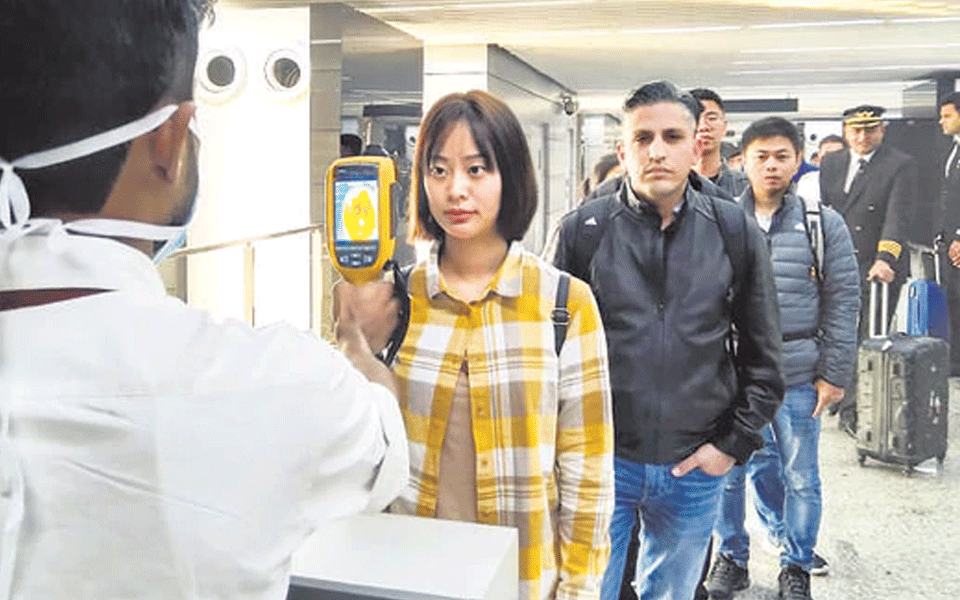
Meanwhile, the authorities in Beijing and Shanghai, China's two biggest cities, have announced fresh restrictions on residential communities to prevent the spread of the deadly coronavirus, joining dozens of mainland cities that have gone into partial lockdown since the epidemic began last month.
Measures unveiled by the authorities on Monday include stricter controls on the movement of residents and vehicles, compulsory mask-wearing and shutting down leisure and other non-essential community services, the Post report said.
The lockdown-style measures appear to be aimed at controlling possible community transmission of the virus as the country returns to work at the end of an extended Lunar New Year holiday.
Millions of Chinese returned to the cities after the extended New Year Holiday on Monday. The government is encouraging people to work from home.While the government highlighted that the cases of the virus have started showing a declining trend, analysts however cautioned that the people should not be too optimistic as the turning point has not emerged yet, state-run Global Times reported.And the most challenging battleground is still in Wuhan, the epicentre of the outbreak, it said.
Zhong Nanshan, China's top epidemiologist, told the newspaper that the inflection point of the outbreak cannot be predicted now."It may peak in mid or late-February," he said.
Chinese President Xi Jinping said on Wednesday that the epidemic situation has shown positive changes due to concerted hard work and that the prevention and control work has achieved notable outcomes."The results are hard-won progress made by all sides," Xi told a high-powered meeting of the CPC.
Noting that epidemic prevention and control have entered a critical stage that requires stringent efforts, Xi stressed focusing on priorities without any let-up and strengthening prevention and control in areas where the epidemic situation is particularly serious or at greater risk, state-run Xinhua news agency reported.
Let the Truth be known. If you read VB and like VB, please be a VB Supporter and Help us deliver the Truth to one and all.
25 lakh properties in Bengaluru brought under e-Khata system: Shivakumar
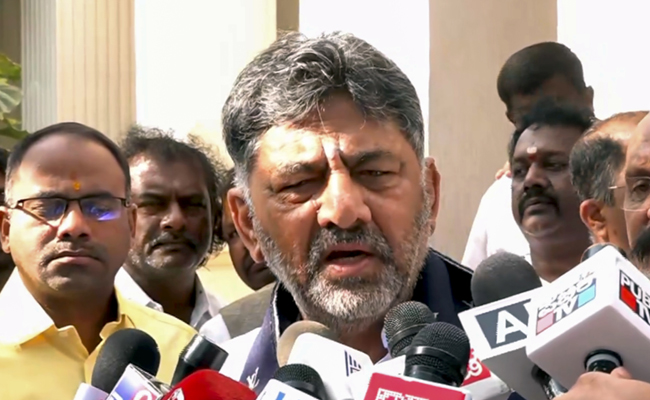
Bengaluru (PTI): Karnataka Deputy Chief Minister D K Shivakumar on Friday said that the state government has brought over 25 lakh properties under the e-Khata system in Bengaluru.
e-Khata is an electronic property certificate that maintains ownership information in an online database.
The e-Khata initiative aimed to ensure accuracy, transparency and universal coverage for property owners, he said.
Addressing a press conference here, Shivakumar, who is also the Bengaluru in-charge Minister, said over 25 lakh properties are being brought under the e-Khata system. Of them more than 7,000 applications have been processed, and additional outreach measures being planned for those yet to obtain their e-Khata.
"Twenty five lakh e-Khatas is a great number which has created history," he said.
The Deputy CM said the government is ensuring that every e-Khata will have its GPS, the shape of the property, and the measurement with every photo and document.
He explained that the government is integrating Aadhaar details, digital documentation, GPS mapping and property sketches to create a robust database.
"We want to see that every record is filled right. They (officials) are asking for documentation, stamp, digital documents. We wanted to connect every Aadhaar card and have it online," Shivakumar said.
To facilitate access, the Deputy CM announced the opening of more than 50 centres across Bengaluru, many of them in government schools, where citizens can apply for or rectify their e-Khata records.
"All of them will be working this Saturday. This 'Khata Mela' will be done. It is 'Nanna Khata, Nanna Swathu'," he said.
Applicants whose documents require verification will be given an acknowledgement and asked to return after 15 days, during which officials will conduct site inspections, he said.
Shivakumar said the government has also taken steps to identify and reclaim properties recorded as roads in revenue documents, asserting that such lands belong to the government.
"We have decided through the law that all the roads in the revenue records have been taken out. Those properties belong to the government itself," he said.
He noted that the initiative has received recognition from the Union government. "The Government of India has awarded us. It said that it is the model for the entire country," he said, while thanking officials involved in the project.
The Deputy CM said the government expects around 10 lakh additional households to benefit from the drive and assured that even those who have not downloaded their documents will receive printed copies free of cost at their residences.
"We will see that all the 25 lakh people will get their e-Khata to their home free of cost," Shivakumar said.
On apartment properties, he said all flats that have obtained occupancy certificates have been cleared.
"All the 37,460 flats (who have applied for e-Khata) have been issued an occupancy certificate. We have cleared all of them," the Deputy CM said.