Cargo aircraft skids off Hong Kong airport runway into sea, 2 dead
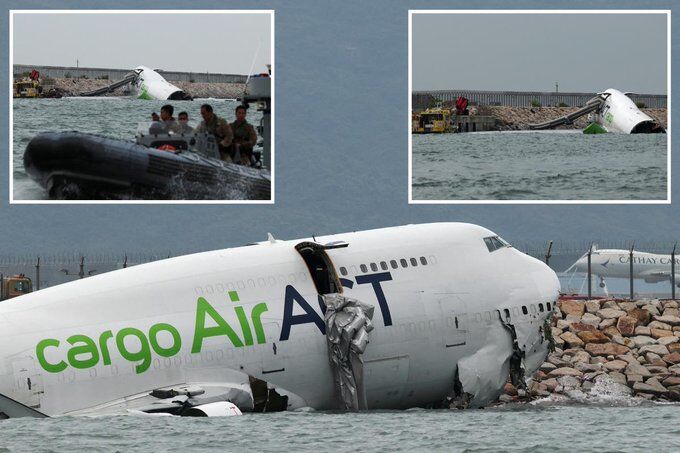
Hong Kong (AP): A cargo aircraft skidded off a Hong Kong runway into the sea when landing early Monday, killing two people.
The Boeing 747, flown by Turkey-based ACT Airlines, was landing at Hong Kong International Airport around 3.50 am on arrival from Dubai, United Arab Emirates, authorities said. The airline had leased the aircraft from Emirates, a long-haul carrier based in Dubai.
Four crew members on the plane were rescued and taken to a hospital. Initial reports from police said two people in an airport ground vehicle were killed.
Emirates said the Boeing 747 freighter flying as EK9788 was wet leased and operated by ACT Airlines. In wet leases, the company supplying the plane also provides the crew, maintenance and insurance. Emirates said there was no cargo on board.
Local Hong Kong broadcasters showed the aircraft partially submerged just off the edge of the airport's sea wall. The aircraft's front half and cockpit were visible above water but the tail end appearing to have broken off.
The crash occurred on the north runway of Hong Kong's airport, one of Asia's busiest. That runway remained closed, while the two other runways at the airport continue to operate.
Hong Kong's Civil Aviation Department said in a statement it was following up with the airlines and other parties involved in the crash.
Emirates, the Dubai-based long haul carrier, is known for its passenger flights coming out of Dubai International Airport, the world's busiest for international travel.
However, it also operates a thriving cargo business out of Al Maktoum International Airport at Dubai World Central, the sheikhdom's second airport where it plans a USD 35 billion improvement over the coming decade. The ACT Airlines' flight had taken off from Al Maktoum, known as DWC.
Emirates, owned by a sovereign wealth fund in the city-state, noted in its most-recent annual report that it had added two wet-leased Boeing 747s "to serve surging customer demand." Emirates has some 260 aircraft in its fleet, the majority either Boeing 777s or double-decker Airbus A380s.
Let the Truth be known. If you read VB and like VB, please be a VB Supporter and Help us deliver the Truth to one and all.
4 workers die after being buried under coal slurry in Jharkhand's Dhanbad

Dhanbad (Jharkhand) (PTI): At least four workers died after being buried under coal slurry in Jharkhand's Dhanbad district on Saturday, a police official said.
The incident took place at Moonidih coal washery in the command area of Bharat Coking Coal Limited (BCCL).
"Bodies of all four workers were dug out of debris during a rescue operation," Putki police station in-charge Waqar Hussain told PTI.
The incident took place when coal slurry was being loaded into trucks by workers, during which a large chunk of slurry fell and trapped several workers underneath, officials said.
The deceased have been identified as Manik Bauri, Dinesh Bauri, Deepak Bauri, and Hemlal Gope.
Meanwhile, the family members of the deceased and local villagers placed the bodies in front of the washery gate and began a protest.
They demanded compensation, jobs for dependents and action against those responsible for the incident.
Police and administration officials are trying to pacify the protesters, an official said.