Case study links ChatGPT health advice to rare metal poisoning in 60-year-old man

PHILADELPHIA, USA: A newly published medical case study has detailed how health guidance from ChatGPT allegedly contributed to a rare case of bromism, a form of metal poisoning caused by prolonged sodium bromide consumption, in a 60-year-old man according to the report published by NDTV's Gadgets360.
The report, appearing in Annals of Internal Medicine Clinical Cases under the title “A Case of Bromism Influenced by Use of Artificial Intelligence,” describes how the patient developed symptoms including psychosis, paranoia, hallucinations, insomnia, fatigue, ataxia and skin changes after three months of substituting sodium chloride (table salt) with sodium bromide in his diet.
According to the patient, he made the switch after asking ChatGPT for alternatives to sodium chloride. The study suggests that either GPT-3.5 or GPT-4 generated a response listing bromide as an option, without a clear medical warning or follow-up questions about the intended use. While the researchers could not access the original chat log, they note that their own tests with ChatGPT 3.5 produced similar answers.
Medical staff diagnosed bromism after sedation, toxicology testing and consultation with the Poison Control Department and the man's symptoms improved after three weeks of treatment.
The authors have cautioned that AI chatbots can produce scientific inaccuracies, lack critical medical judgment and spread misinformation. OpenAI, when contacted, pointed to its terms of use, which explicitly warn users not to rely on ChatGPT as a substitute for professional advice.
Let the Truth be known. If you read VB and like VB, please be a VB Supporter and Help us deliver the Truth to one and all.
Indian startup's 'Drishti' satellite launched aboard SpaceX rocket
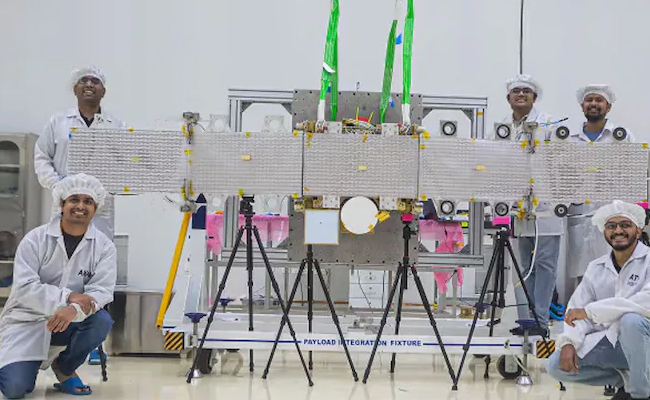
New Delhi (PTI): Bengaluru-based space start-up GalaxEye's Mission Drishti satellite was launched on Sunday aboard SpaceX's Falcon 9 rocket from California.
Mission Drishti is the world's first OptoSAR satellite, integrating electro-optical (EO) and synthetic aperture radar (SAR) sensors into a single operational platform, according to the company.
While EO sensors capture high-resolution images during sunlight and clear skies, SAR sensors provide all-weather and all-time images, using radar pulses.
In a statement, Suyash Singh, founder and CEO of GalaxEye, said, "With the satellite (Mission Drishti) now successfully in orbit, our immediate focus is on completing its commissioning. As we move through this phase, we are already witnessing strong global interest in the differentiated datasets enabled by our OptoSAR payload."
The satellite will help address long-standing limitations of conventional systems and enable more reliable and consistent data acquisition across diverse environmental conditions, the company said.
As a dual-use Earth observation satellite, the mission will support use cases across defence, agriculture, disaster management, maritime monitoring, and infrastructure planning.
The satellite is also expected to complement India's broader initiatives, including the 29 active Earth Observation satellites outlined in ISRO's recent annual report.
The launch came after five years of indigenous research and development, and extensive environmental testing and performance validation of the Mission Drishti.
In a statement, Lt Gen AK Bhatt (Retd), director general of Indian Space Association (ISpA), said, "GalaxEye has achieved what only a few global players have, which is seamlessly combining optical and SAR capabilities on a single platform to enable persistent, all-weather intelligence."
What stands out is not just the technology, but its broader impact on how downstream applications will increasingly define value in the space economy, particularly in Earth observation, where timely, decision-grade insights are critical," he added.
ISpA is the premier industry association of space and satellite companies in the country.
Union Minister Jitendra Singh also took note of the Mission Drishti launch, saying the development marked a significant milestone in India's space journey.
In a post on X, the minister said, "The successful launch of the world's first OptoSAR satellite, and the largest privately-built satellite in the country, reflects the immense potential of our young innovators driving nation-building."
GalaxEye aims to scale up Mission Drishti to a constellation of 10 satellites by 2030, developing a robust and sovereign Earth observation infrastructure for India.