CEOs of 40 US companies create global task force to help India fight COVID-19

Washington: In a show of solidarity, CEOs of some 40 top American companies have come together to create a global task force to mobilise resources to help India fight the battle against COVID-19.
A collective initiative of the US-India Business Council of the US Chambers of Commerce, and the US-India Strategic and Partnership Forum and Business Roundtable, the task force during its meeting here on Monday committed to get 20,000 oxygen concentrators to India in the next few weeks, Deloitte CEO Puneet Renjen told PTI.
The new US public-private partnership to provide India critical medical supplies, vaccines, oxygen and other life-saving assistance amid an unprecedented surge in coronavirus cases is called the Global Task Force on Pandemic Response: Mobilizing for India.
The first-of-its-kind country-specific global task force to address a public health crisis in another country was addressed by US Secretary of State Tony Blinken.
The conversation showed how the United States and India can leverage the expertise and capabilities of the US private sector towards solutions for India's COVID-19 crisis, Blinken said in a tweet.
"A number of American companies have come together over the weekend. We are focused on doing our very best to help in any way that we possibly can. As the prime minister said, we were very confident, our spirits were up after successfully tackling the first wave, but this storm has shaken the nation. It is up to us to help in any way possible," Renjen said in response to a question.
Observing that the first issue is around oxygen and its concentrators, Renjen said they have commitments to get 20,000 oxygen concentrators to India in the next few weeks.
The first 1,000 will arrive in the middle of this week, he said, adding that by May 5, they expect another 11,000 oxygen concentrators to reach the country.
"Our goal is to get 25,000, and maybe even a number higher than that," he added.
The second issue is to look at oxygen cylinders with 10-litre and 45-litre capacity and to get other supplies like monitoring kits, Renjen said.
"I am very pleased with the fact that these companies have come together. We're working with the USISPF, as well as the USIBC and with the Business Roundtable to coordinate this effort to help India in any way that that is required, he said.
Welcoming the call between Prime Minister Narendra Modi and President Joe Biden and the decision of the US to urgently send supplies to India, the Deloitte CEO reiterated that the two countries are natural allies.
"I'm very heartened by the fact that the US government is going to step up and do its part," he said.
The fight against COVID-19 is personal for him. Several family members of Renjen, who comes from Rohtak in India's Haryana, have contracted the disease.
Around 2,000 of Deloitte's employees in India have been infected, he said.
"We are facilitating individuals getting the vaccines. We are providing them medical assistance, home testing kits. This is being consistently done by all entities that have big footprints in India. That is really important to do," Renjen said.
"We will do everything on our part to take care of our employees, like I believe every one of the multinationals that were on the call with me are committed to doing. But they have really stepped up," he said.
"This is a real kudos to Indian talent," Renjen said.
The task force also comprises representations from retail sector, e-commerce, pharmaceutical, technology industry and large manufacturing entities.
"This global crisis requires a global response, and the American business community could not be better positioned, or more determined, to help lead the way, said Suzanne Clark, president and chief executive officer of the US Chamber of Commerce.
It was wonderful to see everybody focused on making sure that they do their part, that they contribute. Out of that discussion, the first step that we came up with was these oxygen concentrators, Renjen said.
Our point to the US government is to provide assistance (to India), wherever it's requested, he added.
These US companies are coordinating with the Indian Ambassador to the US, Taranjit Singh Sandhu.
Earlier in the week, he gave us the list of items that are of critical need, Renjen said.
The list includes oxygen concentrators, oxygen generators, two critical medicines that he wanted to see if the US government can release, monitoring kits, and encouraging the US government to ease supply of critical materials for vaccines.
Responding to a question, Renjen exuded confidence that India would overcome this.
This too shall pass. I am very confident in my Indian brothers and sisters; we will overcome this, he said.
I don't think we need to panic. We listen to the scientists and listen to the people that are managing this in the country. I think we just have to navigate through it. We will have two or three weeks of very difficult times.
"It is a tragic situation, particularly for people that have COVID or who have lost loved ones. My heart goes out to them, but we are going to do our part, Renjen said.
Let the Truth be known. If you read VB and like VB, please be a VB Supporter and Help us deliver the Truth to one and all.
Double-decker electric bus gutted in fire at Kurla BEST depot
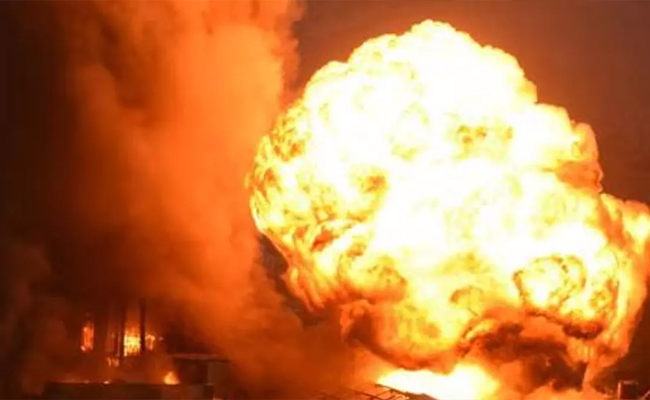
Mumbai (PTI): An empty double-decker electric bus was gutted in a fire during servicing at a BEST depot in Mumbai's Kurla area on Sunday, officials said, adding that nobody was injured.
The blaze broke out inside the Kurla BEST bus depot near Kanakia Building at 4.14 pm, according to preliminary information from the Mumbai Fire Brigade.
The parked bus was unoccupied at the time of the incident.
Fire brigade personnel rushed to the spot and brought the blaze under control. The exact cause of the fire was yet to be ascertained, they said.
No injuries were reported in the incident, officials added.
The Brihanmumbai Electricity Supply and Transport (BEST) Undertaking has hired 50 electric double-decker buses from Switch Mobility in its fleet of around 2,700 buses.