China announces 304 deaths, 14,380 total cases of coronavirus outbreak
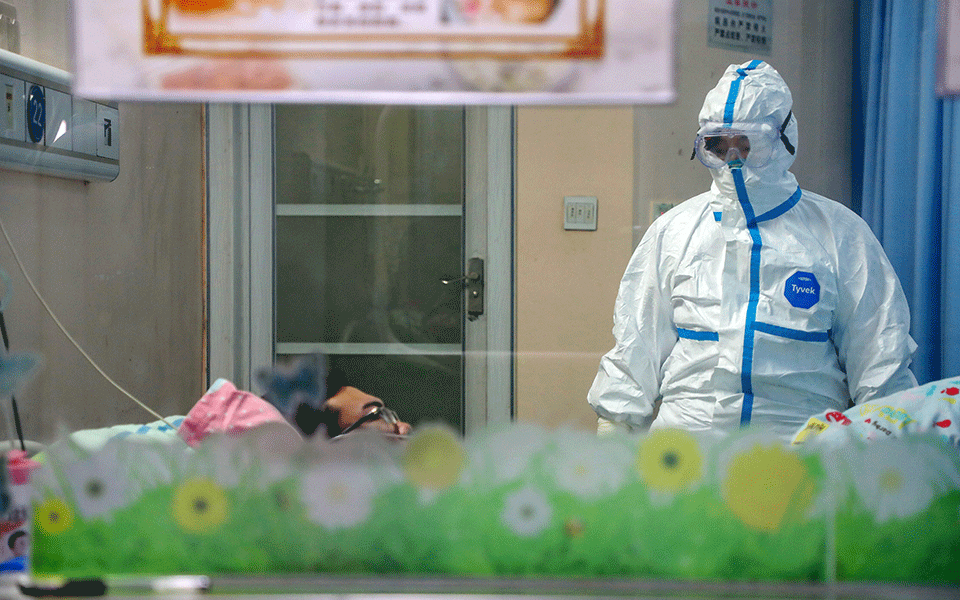
Beijing: China's death toll from a new virus has increased to 304 with more than 14,000 cases, amid warnings from the World Health Organization that other countries need to be prepared in the event the disease spreads among their populations.
Figures from the National Health Commission released Sunday show an increase of 45 in the death toll and 2,590 in the number of cases for a total of 14,380, well above the number of those infected in in the 2002-03 outbreak of SARS, or severe acute respiratory syndrome, which broke out in southern China before spreading worldwide.
Meanwhile, six officials in the city of Huanggang, neighbouring the epicentre of Wuhan in Hubei province, have been fired over poor performance" in handling the outbreak, the official Xinhua News Agency reported.
It cited the mayor as saying the city's capabilities to treat the patients remained inadequate and there is a severe shortage in medical supplies such as protective suits and medical masks."
Despite imposing drastic travel restrictions at home, China has chafed at those imposed by foreign governments, criticising Washington's order barring entry to most non-citizens who visited China in the past two weeks.
Australian Prime Minister Scott Morrison announced similar measures Saturday, following Japan and Singapore.
South Korea and India flew hundreds of their citizens out of Wuhan, the city at the centre of an area where some 50 million people are prevented from leaving in a sweeping anti-virus effort. The evacuees went into a two-week quarantine. Indonesia also sent a plane.
The virus' rapid spread in two months prompted the World Health Organization on Thursday to declare it a global emergency.
That declaration flipped the switch from a cautious attitude to recommending governments prepare for the possibility the virus might spread, said the WHO representative in Beijing, Gauden Galea. Most cases reported so far have been people who visited China or their family members.
The agency acted out of concern for poorer countries that might not be equipped to respond, said Galea. Such a declaration calls for a coordinated international response and can bring more money and resources. WHO said it was especially concerned that some cases abroad involved human-to-human transmission.
Countries need to get ready for possible importation in order to identify cases as early as possible and in order to be ready for a domestic outbreak control, if that happens, Galea told The Associated Press.
The United States declared a public health emergency on Friday and President Donald Trump signed an order barring entry to foreign nationals who visited China within the last 14 days, which scientists say is the virus' longest incubation period. The restrictions don't apply to immediate family of American citizens and permanent residents.
China criticized the US controls and unfriendly comments alleging that Beijing was failing to cooperate.
Just as the WHO recommended against travel restrictions, the U.S. rushed to go in the opposite way. Certainly not a gesture of goodwill, said foreign ministry spokeswoman Hua Chunying.
Australia, Germany, Japan, South Korea, the United Arab Emirates, the United States and Vietnam all reported new cases Saturday. Spain confirmed its first case - a German man who had close contact with an infected person in Germany and then travelled to the Canary Islands with friends. Four friends who were hospitalized with him have not shown symptoms.
Both the new virus and SARS are from the coronavirus family, which also includes those that cause the common cold.
The death rate in China is falling, but the number of confirmed cases will keep growing because thousands of specimens from suspected cases have yet to be tested, WHO's Galea said.
The case fatality ratio is settling out at a much lower level than we were reporting three, now four, weeks ago, he said.
Although scientists expect to see limited transmission of the virus between people with family or other close contact, they are concerned about cases of infection spreading to people who might have less exposure.
Let the Truth be known. If you read VB and like VB, please be a VB Supporter and Help us deliver the Truth to one and all.
Cong slams Modi govt as 'anti-worker', calls for review of new Labour code
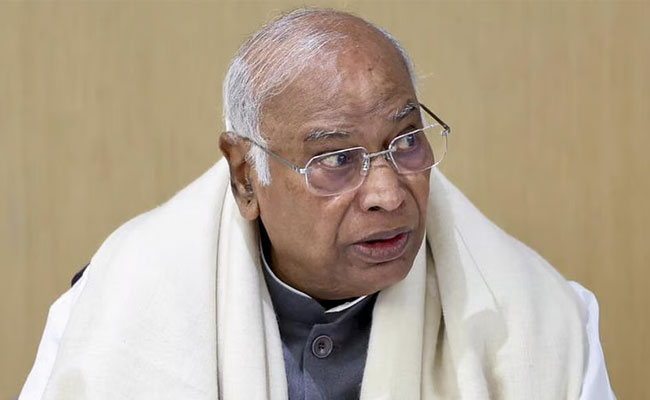
New Delhi (PTI): The Congress on Friday accused the Modi government of being "anti-worker" and demanded that the new labour code be reviewed, MGNREGA be revived as well as a national minimum wage of Rs 400 per day be established.
On International Labour Day, Congress president Mallikarjun Kharge took a swipe at the government and said unemployment in India today is a direct consequence of the 'Hum Do, Hamare Do' policies.
"Driven by the 'Hum Do, Hamare Do' policy, the Modi government implemented an anti-worker Labour Code. As a result, unrest has erupted everywhere - be it in Noida, at the IOCL facility in Panipat, Adani's factory in Raikheda, NTPC Patratu, or the Samsung factory in Sriperumbudur," Kharge said in a post in Hindi on X.
Instead of ensuring job security, this Code promotes policies such as contract labour and 'Hire & Fire' practices, Kharge said and called for a review of the new Labour Code.
The Modi government has effectively dismantled MGNREGA by forcibly pushing legislation through Parliament, he alleged.
"Mr. Modi has shifted 40% of the wage burden onto the State governments. State governments are unable to bear this financial strain and will eventually be forced to stop providing work," he claimed.
The Modi government has compelled workers into a state of unemployment and pushed them towards 'gig work', Kharge said.
Currently, 69% of the workforce is working for wages below the statutory minimum wage, he said.
The Modi government has engineered a crisis of stagnant wages, Kharge alleged.
"When adjusted for inflation, the wages of the majority of India's workers have grown by less than 1% annually over the last decade (from 2014-15 to 2022-23)," he said.
The Modi government has created a massive unemployment crisis among the educated workforce, specifically, among graduates, Kharge claimed and added that jobs have been eliminated through the sale of Public Sector Undertakings (PSUs).
"The government has refused to fill approximately 30 lakh vacant government positions. Furthermore, the government's policy blunders have led to the decimation of Micro, Small, and Medium Enterprises (MSMEs)," the Congress chief said.
The Congress reiterates its five demands for India's workers including revival of MGNREGA and its expansion to urban areas, Kharge said.
He said a national minimum wage of Rs 400 per day should be established, with MNREGA included within its scope.
Kharged demanded that a 'Right to Health' law must be enacted, providing Universal Health Coverage of up to Rs 25 lakh for laborers and workers.
"'Life Insurance and Accident Insurance' coverage must be provided for all unorganized workers. Preventing the contractualization of employment must be made a core priority of the government, and the new Labour Codes must be reviewed," Kharge asserted.