China building over 100 new silos for intercontinental ballistic missiles: Report
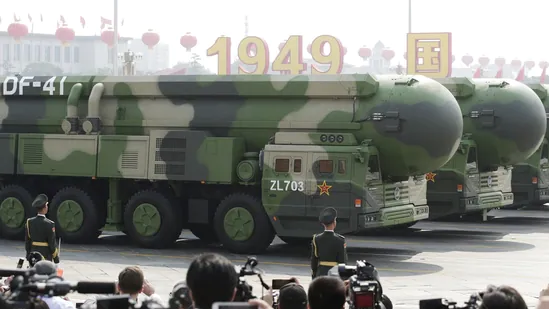
Washington, Jul 2: China has begun construction of over 100 new silos for intercontinental ballistic missiles in a desert near the country's northwestern city of Yumen, signalling a major expansion of its nuclear capabilities, a leading American daily has reported citing satellite imagery.
The silo construction project could provide China -- which celebrated its 100th anniversary on Thursday at the Tiananmen Square -- a means of concealing its nuclear weapons, The Washington Post reported on Thursday.
The 119 nearly identical construction sites, that could potentially house powerful weapons capable of reaching the American mainland, are similar to those seen at existing launch facilities for China's arsenal of nuclear-tipped ballistic missiles, the report said.
It said that commercial satellite images obtained by researchers at the James Martin Center for Nonproliferation Studies in California show work underway at scores of sites across a grid covering hundreds of square miles of arid terrain in Gansu province, some 2,100 km from Beijing.
The acquisition of over 100 new missile silos, if completed, would represent a historic shift for China, a country that is believed to possess a stockpile of 250 to 350 nuclear weapons, the report said.
The actual number of new missiles intended for those silos is unknown but could be much smaller. China has deployed decoy silos in the past.
The construction suggests a major effort to bolster the credibility of China's nuclear deterrent, said researcher Jeffrey Lewis, an expert on China's nuclear arsenal and part of a team that analysed the suspicious sites, first spotted by colleague Decker Eveleth as he scoured photos taken by commercial satellites over northwestern China.
Lewis described the scale of the building spree as incredible.
If the silos under construction at other sites across China are added to the count, the total comes to about 145 silos under construction, Lewis, director of the East Asia Nonproliferation Program at the Center for Nonproliferation Studies, part of the Middlebury Institute of International Studies, said in a summary of his findings provided to The Washington Post.
We believe China is expanding its nuclear forces in part to maintain a deterrent that can survive a US first strike in sufficient numbers to defeat US missile defences, he said.
The discovery of over 100 silos follows recent warnings by Pentagon officials about China's rapid advances in nuclear capability.
Admiral Charles Richard, who commands US nuclear forces, said during a congressional hearing in April that a breathtaking expansion was underway in China, including an expanding arsenal of Intercontinental Ballistic Missile (ICBMs) and new mobile missile launchers that can be easily hidden from satellites.
Lewis said the silos are probably intended for a Chinese ICBM known as the DF-41, which can carry multiple warheads and reach targets as far away as 9,300 miles, potentially putting the US mainland within its reach.
Major excavation work on the sites began early this year, although preparations were probably underway for months, Lewis said.
Emails and faxes seeking comment from China's Foreign Ministry in Beijing and the Chinese Embassy in Washington did not receive a response, the Washington Post said.
However, China's state-run Global Times newspaper on Friday pointed out that the US has repeatedly raised these issues based on speculative information.
"Their purpose is obvious: to exert public opinion pressure on China's nuclear deterrence building and force China to respond to their speculation.
They aim to hamper China's nuclear capacity building by making an issue of it and putting China in a passive position to defend itself," it said.
It is unknown whether The Washington Post report corresponds to the real situation, the Global Times commented.
"But generally speaking, silos are normally used for liquid-fuel intercontinental missiles. Such missiles are high-thrust and long-range, and could carry higher-yield nuclear warheads.
"Silos provide good conditions for the storage and maintenance of missiles and are able to shorten launch time under emergency situations.
However, Lewis assumed that the "silos" in Gansu are intended for DF-41 intercontinental ballistic missiles.
In reality, DF-41 is solid-fueled and is loaded on high-mobility launcher vehicles. The necessity of putting it inside a silo is questionable.
"Therefore, the latest accusations by The Washington Post and the US State Department over China cannot hold water," it commented.
Meanwhile, the Editorial Board of the Washington Post said that the report that China is building 100 or more silos for intercontinental ballistic missiles that can reach the United States marks a concerning waypoint in China's expansion and modernisation of its nuclear forces.
"If missiles are deployed in the new silos, they would represent a blossoming arms race that is a serious challenge to the Biden administration, already facing competition from Beijing across many fronts.
The new silos make more urgent the start of negotiations with China on strategic nuclear arms control," The Post said in an opinion piece.
"The signs of an accelerating competition are clear, and talks at the outset could encompass nuclear crisis management, new-generation weapons such as hypersonic gliders and anti-satellite weapons, as well as thorny older issues like missile defences and nuclear testing," it added.
Let the Truth be known. If you read VB and like VB, please be a VB Supporter and Help us deliver the Truth to one and all.
Two injuries, one DNF, a DQ as India end messy World Relays campaign

Gaborone (Botswana) (PTI): Amoj Jacob and Ragul Kumar got injured during the men's 4x400m and 4x100 races respectively as India ended their World Athletics Relays campaign in disappointment on the second day of competitions here on Sunday.
The Indian camp had high hopes of making the 2027 World Championships in the men's 4x400m relay but the team did not finish (DNF) the race as Jacob suffered cramps and pulled out of the race after taking the baton from the first leg runner Dharamveer Choudhary. Rajesh Ramesh and Vishal TK were to run in the third and fourth legs.
Those teams which could not qualify for the 2027 Beijing World Championships by reaching the final round of each of the six relay events on Saturday were given another chance in the second qualification round on Sunday.
The top two teams in each of the two heats (in all six relay events) booked the Beijing ticket on Sunday.
India will now have to try and qualify for the World Championships through the Top Lists of the World Athletics, which is a long and tedious process.
In the men's 4x100m race, third leg runner Ragul Kumar fell down the track after failing to hand over the baton inside the exchange zone to fourth leg runner Gurindervir Singh, which clearly showed the lack of coordination among the runners.
Harsh Santosh Raut and Animesh Kujur ran the first two legs.
The Indian quartet was disqualified and Kumar was seen being taken away from the Field of Play with the help of the volunteers.
It was a comedy of errors in the case of the women's 4x100m race, which saw the baton being dropped during an exchange between first leg runner Tamanna and second runner Nithya Gandhe, though the Indians finished the race in 53.09 seconds.
Gandhe started running quite a distance, but after realising that the baton was not in her hand, she turned and ran back to pick it up.
The only silver-lining for the Indian contingent was the national record time in the mixed 4x100m relay race, though the quartet of Ragul Kumar, Nithya Gandhe, Animesh Kujur and Sneha SS finished sixth in heat number two with a time of 41.35 seconds, bettering the previous national mark of 42.30 seconds set in March in Chandigarh.
The mixed 4x400m relay quartet of Theerthesh P Shetty, Kumari Saloni, Nihal William and Rashdeep Kaur ended at fifth in heat number one with a time of 3 minutes and 19.40 seconds.
On Saturday, all the five Indian relay teams had failed to make it to the respective final rounds and thus missed out on the 2027 World Championships berths.