China coronavirus: Death toll climbs to over 2,700 amidst signs of slowdown
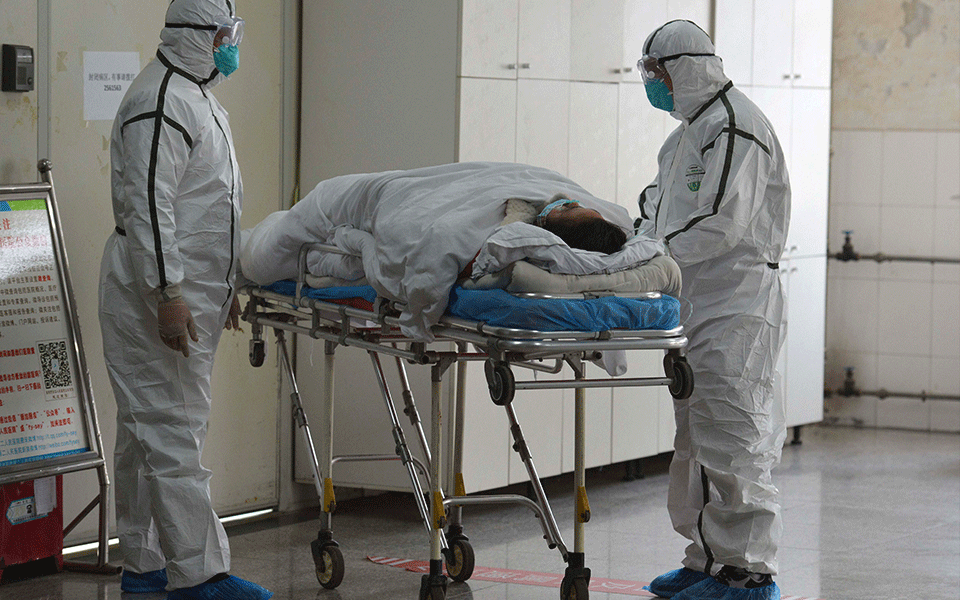
Beijing: The death toll in China's novel coronavirus epidemic on Wednesday climbed to 2,715 with 52 new fatalities while the confirmed cases rose to 78,064, amidst strong signs of COVID-19 slowing down even at its epicentre Hubei province.
The country's National Health Commission (NHC) in its daily update said it received reports of 52 deaths, all from Hubei, and 406 new confirmed cases of the novel coronavirus infection from all over the country.
The death toll has gone up to 2,715 and overall confirmed cases reached 78,064, it said. Another 439 new suspected cases were reported on Tuesday while the number of severe cases decreased by 374 to 8,752, it said.
Overall 2,491 people were still suspected of being infected with the virus. A total of 29,745 people had been discharged from hospital after recovery.
The commission said 6.47 lakh close contacts had been traced, and over 79,000 are still under medical observation.
By the end of Tuesday, 85 confirmed cases including two deaths had been reported from Hong Kong, 10 confirmed cases in Macao and 31 in Taiwan including one death.
Wuhan, the capital city of the hardest-hit province of Hubei, remains the main battlefield for prevention and control of the coronavirus epidemic in the country, the NHC said.
Resolute efforts should be made to curb the rise in confirmed cases in the periphery of Hubei and other key provincial-level regions, He Qinghua, an official of the NHC told the media.
A joint prevention and control mechanism should be initiated between Hubei and its neighbouring provinces to help prevent the spread of the epidemic to neighbouring areas and provide materials, personnel and transportation support needed in Hubei, He said.
Hubei and Wuhan together with over 50 million population continue to be under lockdown since January 23 with all public and private transportation remained suspended.
Other key areas including Beijing, Zhejiang and Guangdong should enhance coordination with Hubei in prevention work, such as information sharing, to contain further spread of the epidemic, He said.
For lower-risk regions across the country, preventive measures should be adopted at the county level to avoid relapse of the epidemic situation while advancing resumption of work and production as soon as possible, He said, stressing efforts to step up disinfection and ventilation as well as passengers' temperature and health monitoring to reduce the risk of virus transmission amidst people's return trips.
Let the Truth be known. If you read VB and like VB, please be a VB Supporter and Help us deliver the Truth to one and all.
Karnataka launches state-led Centre of Excellence for Space Technology in Bengaluru
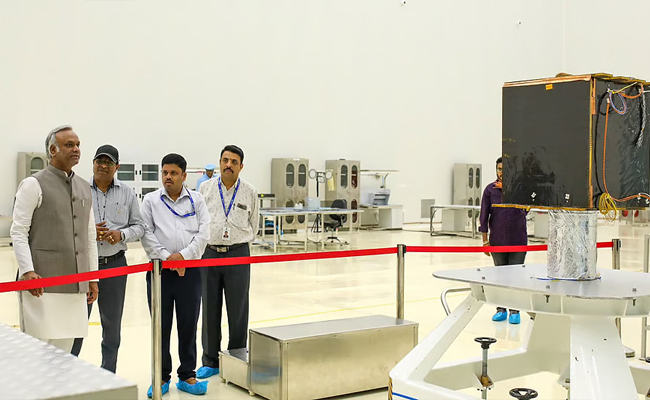
Bengaluru (PTI): In a significant boost to India’s rapidly expanding space economy, the Karnataka government on Friday launched the country’s first state-led Centre of Excellence for Space Technology here, officials said.
The initiative is aimed at strengthening India’s capabilities to translate space innovation into scalable commercial outcomes, they said.
The Centre, established by the Government of Karnataka through the Karnataka Innovation and Technology Society in collaboration with SIA (Satcom Industry Association India) -India, was inaugurated by Minister for Electronics, IT/BT, and Rural Development and Panchayat Raj, Priyank Kharge, in the presence of senior officials and industry leaders, officials said.
Speaking at the launch, Minister Kharge said that Karnataka has consistently been at the forefront of India's technology and innovation journey. With the launch of this Centre of Excellence for Space Technology, we are extending that leadership into one of the most strategic sectors of the future.
"Our focus is not just on advancing research, but on creating an ecosystem where innovation can translate into real-world applications, economic growth, and high-quality jobs. This Centre will play a critical role in positioning Karnataka as a key driver of India's space economy," he said.
According to an official statement, the CoE SpaceTech Foundation has been established under a Memorandum of Agreement between KITS and SIA-India to drive research and innovation in space technologies, industry-aligned training, startup incubation and cross-sector applications, it said.
The Centre has also formalised strategic MoUs with multiple industry and academic partners to support research in space biotech and microgravity, enable collaboration, build talent pipelines, and provide startups with training and market access, it added.