China installing QR codes on Uighur Muslim homes in mass security crackdown
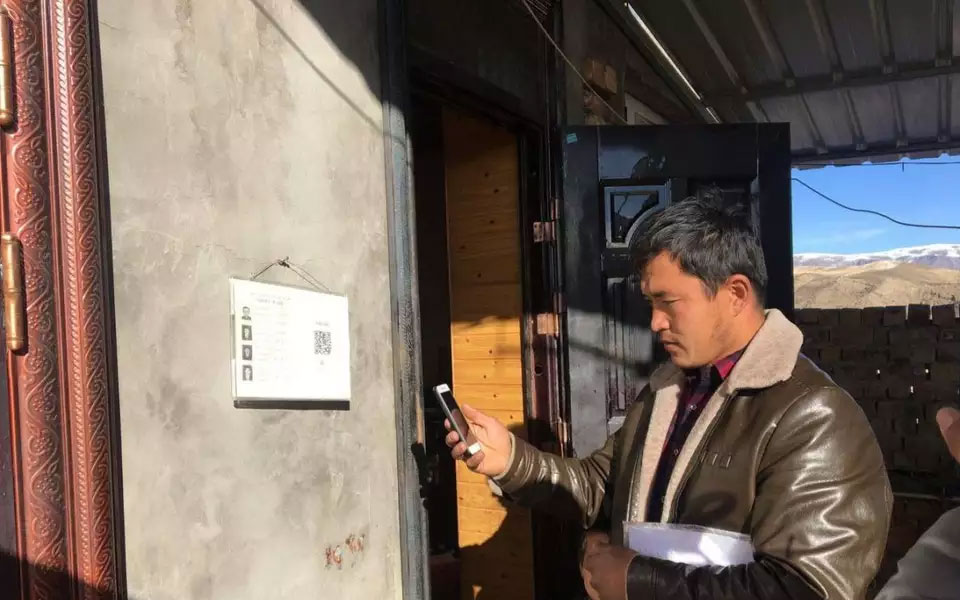
LONDON: China is installing QR codes on the homes of the Uighur Muslim community in order to get instant access to the personal details of people living there, according to a report by Human Rights Watch (HRW).
The development comes as part of a mass security crackdown on minorities in Xinjiang province, the charity said, which includes arbitrary detentions, daily restrictions on religious practice and "forced political indoctrination".
Officials reportedly scan the "smart" doorplates with mobile devices before entering homes to monitor the inhabitants.
Sophie Richardson, China director at HRW, said: "The Chinese government is committing human rights abuses in Xinjiang on a scale unseen in the country in decades. The campaign of repression in Xinjiang is a key test of whether the United Nations and concerned governments will sanction an increasingly powerful China to end this abuse."
Authorities claim the codes — which in some locales feature on every home — help with population control and delivery of services.
"Starting from spring 2017, in every home where one enters there’s a QR code," one former resident who left Xinjiang, in the far west of the country, told HRW. "Then every two days, or every day, the cadres come and scan the QR code, so they know how many people live here — and starting around then, they would ask [our] visitors, ‘Why are you here?’ In the evenings the cadres would check as well."
Former residents said authorities are also collecting biometric data, such as DNA and voice samples, when people apply for passports or ID cards, or during police interrogations.
"They did take our DNA samples and iris scans when we applied for the passports," a middle-aged woman who left Xinjiang last year said. "For those who can read, they read out from a paper but for those who cannot, they said, ‘You can sing a song or tell a story and we will record you’. You aren’t in a position to argue with them." She said people were even forced to walk back and forth at police stations so officials could record their gait.
The United Nations human rights panel in August said China is believed to be holding up to one million ethnic Uighurs in a secretive system of "internment camps" in Xinjiang, where they undergo political education.
Beijing has denied such camps are for "political education", insisting instead they are vocational training centres, part of government initiatives to bolster economic growth and social mobility in the region. China has said Xinjiang faces a serious threat from Islamist militants and separatists who plot attacks and stir up tensions between Uighurs who call the region home and the ethnic Han Chinese majority.
Uighurs and other Muslims held in the camps are forbidden from using Islamic greetings, must learn Mandarin Chinese and sing propaganda songs, according to former camp detainees interviewed by HRW. People in Xinjiang with relatives living abroad in one of 26 "sensitive countries", including Kazakhstan, Turkey and Indonesia, have reportedly been targeted by the authorities and are often held for several months, without any formal procedure.
Punishments for refusing to follow instructions in the camp could mean being denied food, being forced to stand for 24 hours or even solitary confinement, HRW said.
China’s foreign ministry spokesperson, Geng Shuang, declined to give a detailed response to the report and said HRW was a group "full of prejudice" against China. Measures in Xinjiang aim to "promote stability, development, unity and livelihoods", while also cracking down on "ethnic separatism and violent terrorist criminal activities", he said.
Security conditions in Xinjiang outside the camps have also intensified markedly and now bear "a striking resemblance to those inside", said Hong Kong-based HRW researcher Maya Wang, who has interviewed 58 former Xinjiang residents now living abroad.
Ms Wang and her team only spoke with people who had left Xinjiang due to a lack of access to the region and to avoid endangering those still living there. Monitoring of Islamic religious practices, such as asking people how often they pray and the closure of mosques, as well as regular visits by party officials to rural parts of Xinjiang, mean that practising Islam "has effectively been outlawed", Ms Wang said.
courtesy : timesofindia.indiatimes.com
Let the Truth be known. If you read VB and like VB, please be a VB Supporter and Help us deliver the Truth to one and all.
4 workers die after being buried under coal slurry in Jharkhand's Dhanbad

Dhanbad (Jharkhand) (PTI): At least four workers died after being buried under coal slurry in Jharkhand's Dhanbad district on Saturday, a police official said.
The incident took place at Moonidih coal washery in the command area of Bharat Coking Coal Limited (BCCL).
"Bodies of all four workers were dug out of debris during a rescue operation," Putki police station in-charge Waqar Hussain told PTI.
The incident took place when coal slurry was being loaded into trucks by workers, during which a large chunk of slurry fell and trapped several workers underneath, officials said.
The deceased have been identified as Manik Bauri, Dinesh Bauri, Deepak Bauri, and Hemlal Gope.
Meanwhile, the family members of the deceased and local villagers placed the bodies in front of the washery gate and began a protest.
They demanded compensation, jobs for dependents and action against those responsible for the incident.
Police and administration officials are trying to pacify the protesters, an official said.