China launches world's first 10G broadband network in Hebei, surpasses global internet speeds

Beijing: China has launched its first 10G broadband network in Sunan County, Hebei Province, on Sunday, April 20. This marks a major step forward in the country’s internet technology. The new high-speed network was developed through a partnership between Huawei and China Unicom, reported Economic Times.
The 10G broadband promises extremely fast internet speeds up to 9,834 megabits per second (Mbps) for downloads and 1,008 Mbps for uploads. It also has very low latency, around just 3 milliseconds. This means data can travel much faster and more smoothly than before.
This new network is powered by a 50G Passive Optical Network (PON) technology. It helps improve how data moves through fiber-optic cables and supports high-bandwidth activities like cloud computing, virtual and augmented reality, 8K video streaming, and connecting smart home devices.
For example, downloading a full-length 4K movie that’s around 20 GB in size usually takes 7 to 10 minutes on a 1 Gbps connection. With this 10G broadband, the same movie can be downloaded in less than 20 seconds.
With this move, China is now leading the world in broadband technology, going ahead of countries like the UAE and Qatar, which also have high-speed internet.
The new network is expected to bring improvements in many areas, including healthcare, education, and farming, by allowing faster and more dependable data connections.
Huawei, founded in 1987 and based in Shenzhen, is a global leader in telecom equipment and has helped advance optical broadband and 5G technology. China Unicom, a major state-owned telecom company in China, offers broadband, mobile, and enterprise services across the country.
Let the Truth be known. If you read VB and like VB, please be a VB Supporter and Help us deliver the Truth to one and all.
JD(U) supremo Nitish Kumar's son Nishant to start maiden political yatra on Sunday
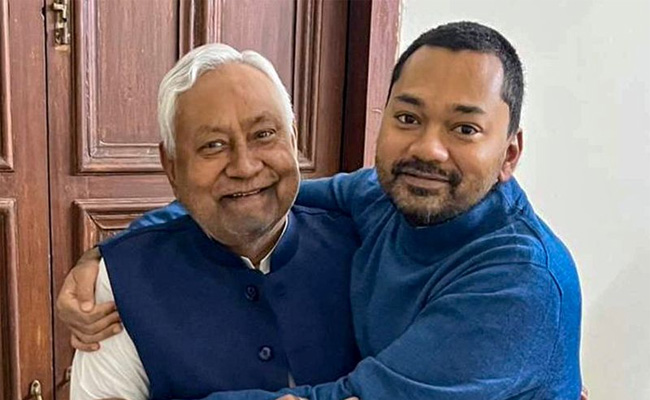
Patna (PTI): JD(U) leader Nishant Kumar, whose belated political entry has shone a ray of hope on the party rattled by his father Nitish Kumar's sudden relinquishment of power, is set to launch his first public outreach programme in Bihar on Sunday.
The 45-year-old, who joined the party only last month, is scheduled to kick off his "Sadbhav Yatra" (goodwill tour) from Valmiki Nagar in West Champaran district.
The place had been chosen multiple times by his father as the starting point for numerous "yatras" during a nearly two-decade-long tenure as the chief minister of Bihar.
The party, which is still recovering from the shock of the 75-year-old leader's sudden decision to enter the Rajya Sabha, triggering fears of a diminution in political clout, has coined a catchy slogan to announce the arrival of the heir apparent.
"Jai Nishant, tay Nishant" (victory for Nishant, his rise is inevitable) is a catchphrase that can now be seen splashed on the JD(U)'s posters as well as social media handles.
On the eve of the launch of "Sadbhav Yatra", JD(U) spokesperson and MLC Neeraj Kumar told a press conference in West Champaran's headquarters of Bettiah, that "Nishant belongs to the land where Emperor Asoka was born.
Like his father, he is starting a Yatra from the land of Sage Valmiki".
"Both Valmiki and Asoka epitomised renunciation. Our supreme leader Nitish Kumar showed the same spirit of renunciation when he decided to give up the seat of power to live by his convictions," said Neeraj Kumar.
He added that "the same dispassion for power has been demonstrated by Nishant. He could have secured a berth in the new Cabinet or the state legislature any time. But he chose to shun shortcuts and earn his spurs through the tried and tested method of mass contact".
After the JD(U) supremo stepped down as chief minister, a new government headed by BJP leader Samrat Choudhary has been formed in Bihar.
"Nitish Kumar had always followed the policy of zero tolerance for crime, corruption and communalism. The new government, too, has adopted the same as its motto. In Nishant, we have a leader who will carry forward the legacy," said Neeraj Kumar.