China 'number one' in coronavirus deaths, official toll 'unrealistic': Trump
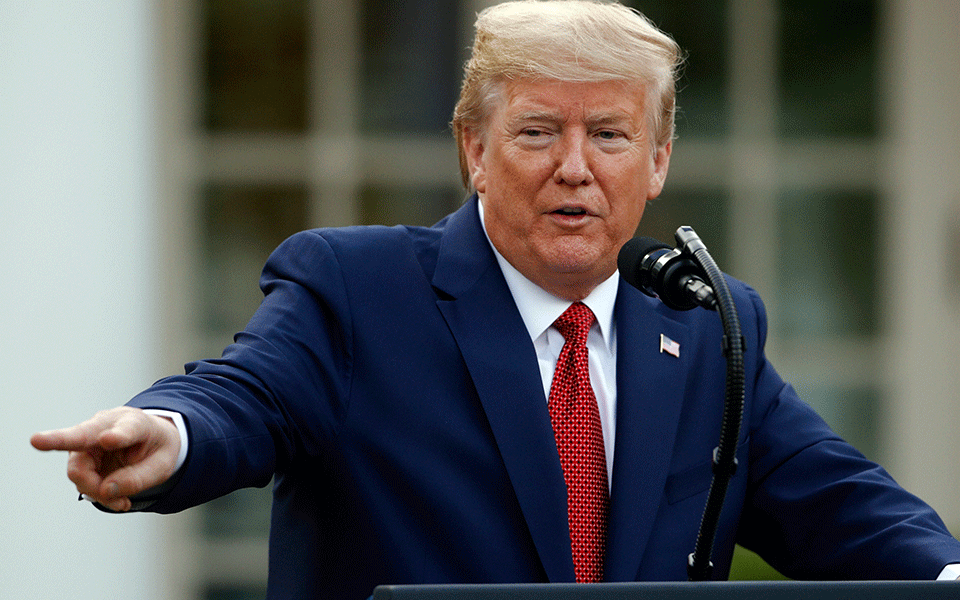
Washington: President Donald Trump has cast doubt on the accuracy of China's official coronavirus death toll, terming it "unrealistic" and claiming that the actual number was "way ahead" of the US' which is not the world's "number one" country in terms of COVID-19 fatalities.
Trump's comments have come two days after another 1,300 fatalities were added to the official count in the Chinese city of Wuhan, where the outbreak started in November last year. The revision puts China's overall death toll to more than 4,600.
"We are not number one; China is number one just so you understand," Trump told reporters at a White House news conference on Saturday. "They are way ahead of us in terms of death. It's not even close," he asserted.
According to Trump, when highly-developed healthcare systems of the UK, France, Belgium, Italy and Spain had high fatality rates, it was 0.33 in China.
The president asserted that the actual number was much more than the official Chinese death toll figures, which he said were "unrealistic".
"You know it, I know it and they know it, but you don't want to report it. Why? You will have to explain that. Someday I will explain it," he said.
He also highlighted that on a per-capita basis, the mortality rate in the US was far lower than other nations of Western Europe.
Early this month, President Trump cast doubt on the accuracy of official Chinese figures after US lawmakers, citing an intelligence report, accused Beijing of a cover up.
The number of the coronavirus cases in the US crossed 700,000 on Friday, while over 35,000 people have died from the disease, as President Trump assured his people that America was "very close" to seeing the light "shinning brightly" at the end of the tunnel.
According to data maintained by Johns Hopkins University, over 35,000 people have died in the US and the country has 734,969 infections, the highest in the world.
The death toll in China is 4,632 with no fatalities reported on Saturday, according to China's National Health Commission.
Let the Truth be known. If you read VB and like VB, please be a VB Supporter and Help us deliver the Truth to one and all.
Man arrested with Rs 2.54-crore heroin in Mumbai

Mumbai (PTI): Police have arrested a man and seized over 500 grams of heroin worth Rs 2.54 crore in the illicit market from him in Mumbai, officials said on Friday.
The police's Anti-Narcotics Cell (ANC) made the drug seizure in Santacruz in the western suburbs. The operation was conducted by the Kandivali unit of the ANC on Thursday as part of a special crackdown against drug trafficking in the area, they said.
Acting on specific inputs, an ANC team conducted a raid in Santacruz (East) and intercepted a man. During a search, the team recovered 508 grams of high-grade heroin from his possession, an official said.
The seized contraband, a highly addictive, opioid drug derived from morphine, is estimated to be worth Rs 2.54 crore in the international market, he informed.
Following the seizure, a case was registered against the man under relevant sections of the Narcotic Drugs and Psychotropic Substances (NDPS) Act, 1985, and he was formally placed under arrest in the early hours of Friday.
The police are currently investigating the source of the drug and trying to identify the intended recipients of the consignment, he said.