China opens world's longest sea bridge connecting Hong Kong to Macau, Zhuhai
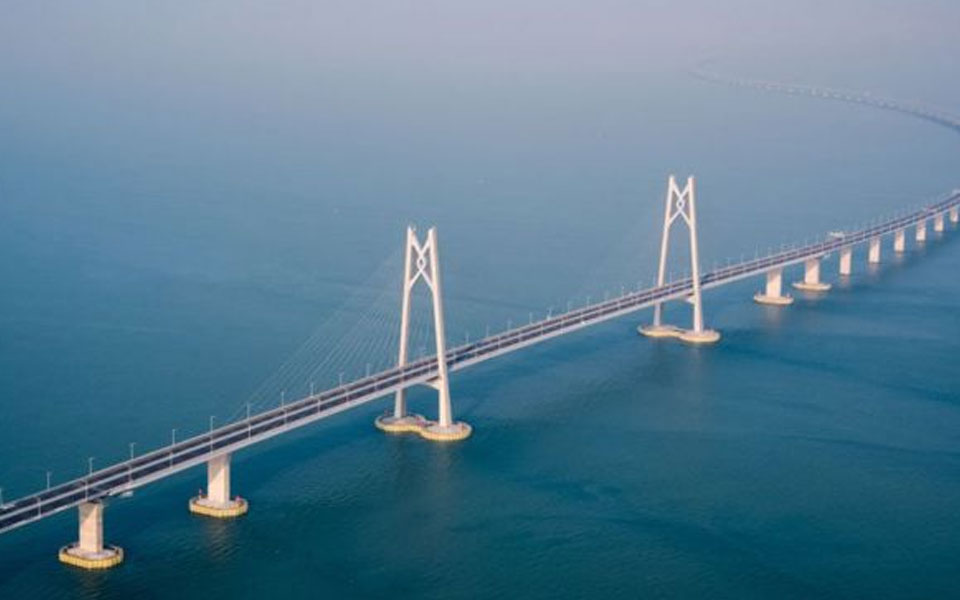
Beijing, Oct 23 : China on Tuesday officially opened the 55-km-long sea bridge, said to be the world's longest, connecting Hong Kong to Macau and the mainland Chinese city of Zhuhai.
President Xi Jinping inaugurated the USD 20 billion bridge at a special ceremony held in Zhuhai, in southern China's Guangdong Province, attended by about 700 guests, including the leaders of Hong Kong and Macau.
It was opened with a one sentence speech by Xi, the Hong Kong-based South China Morning Post reported. The construction of the bridge started in December 2009 and was to be completed in 2016.
Situated in the Lingdingyang waters of the Pearl River estuary, it will be the world's longest sea bridge, the state-run Xinhua news agency said.
China claims credit for building the world's longest bridge, the 164.8-km-long Danyang Kunshan Grand viaduct on the Beijing- Shanghai high speed railway.
The bridge, which will be opened for regular traffic from Wednesday, will slash the travel time between Hong Kong and Zhuhai from three hours to just 30 minutes, it said, adding it will further integrate the cities in the Pearl River Delta.
Chinese Vice-Premier Han Zheng said the bridge would bring Hong Kong and mainland China closer in terms of economic and trade activities.
Describing the bridge as a sign of successful cooperation between the Chinese mainland, Hong Kong and Macau he said, it is a demonstration of China's engineering capabilities.
Han, Beijing's man in-charge of regional economic integration, said that the 55-km-long bridge could facilitate the development of "one country, two systems", a framework that allows Hong Kong and Macau a certain degree of autonomy.
He said it was the first time the three sides had worked together on a major infrastructure project.
"It opens up all three places for greater exchange in trade and economics. It also enhances the competitiveness of the Pearl River Delta," the Post quoted him as saying.
The bridge would help Hong Kong and Macau be integrated to mainland China, he added.
Hong Kong Chief Executive Carrie Lam Cheng Yuet-ngor highlighted the three cross-border infrastructure projects the Guangzhou-Shenzhen-Hong Kong express rail link, the Hong Kong-Zhuhai-Macau bridge and the Liantang/Heung Yuen Wai boundary control point which will open early next year.
But, the critics have called the bridge a "white elephant" and a "blood and sweat project", noting 10 workers have died and more than 600 were injured during its construction, the Post reported.
Additional concerns surfaced earlier this year when officials revealed that estimates for the amount of traffic expected for the bridge had been cut.
A 2008 consultancy study had predicted that 33,100 vehicles and 1,71,800 passengers would cross the bridge daily by 2030.
But the estimate was lowered to 29,100 vehicles and 1,26,000 passenger trips in a 2016 study, down 12 per cent and 26 per cent respectively, the report said.
Let the Truth be known. If you read VB and like VB, please be a VB Supporter and Help us deliver the Truth to one and all.
Zubeen Garg's drowning in Singapore highlights vessel operators' responsibility: legal experts

Singapore (PTI): The drowning of Indian singer-composer Zubeen Garg has brought the spotlight on rules and regulations that concern responsibilities of vessel operators when dealing with intoxicated passengers, according to a media report that cited legal experts.
A cultural icon in India’s northeastern region, 52-year-old Garg travelled to Singapore in September 2025 to perform at a live event. A day before his performance, he went on a yacht trip with a group of people. He drowned while swimming in the sea near Lazarus Island, which is a popular diving spot.
His death shook his home state Assam, where millions came out on the streets mourning. Later, police cases were registered against the organiser of the event, his manager and some others.
Nico Lee, managing director of the Triangle Legal law firm, told The Straits Times that Singapore has Maritime and Port Authority of Singapore (Port) Regulations under which there are provisions to debar drunk passengers.
The owner, agent or captain of the vessel must not allow persons under the influence of alcohol or drugs onboard if they are intoxicated to a point where they endanger safety of the vessel, its crew or any person in it.
“In terms of civil liability, it could be argued that a yacht captain is negligent, as he owes a prima facie duty of care to guests on board under general negligence principles,” Lee was quoted as saying by the newspaper.
The singer and his entourage of about 15 individuals were partying on a chartered vessel, which they had boarded at Marina at Keppel Bay.
A death certificate issued by the Singapore General Hospital listed his cause of death as drowning.
An autopsy report suggested that Garg had 333 mg of alcohol per 100 ml of blood in his system, which was four times the legal limit for driving in Singapore and is likely to have impacted his coordination.
Citing Garg’s case, Lee said the circumstances were serious, as the controller of the vessel knew that the guest was intoxicated. Also, he may not have understood or processed a safety briefing for all passengers.
“That combination makes reliance on an ordinary briefing inadequate. If intoxication reaches a level that endangers the safety of the vessel or persons on board, the person in charge should not permit boarding at all,” he said.
According to Lee, the vessel’s operators could also have assigned a crew member to directly supervise him or ensure that he received a one-to-one explanation when he was capable of understanding.
Part of the responsibility could be attributed to the guest if he chose to enter the water and ignore instructions or behave dangerously despite the yacht owner or charterer’s best efforts, Lee said.
Vanessa Sandhu from Clifford Law LLP told The Straits Times that a key question is whether the yacht captain or operator owed a “duty of care” to the passenger and, if so, whether a breach of that duty caused the death.
“A yacht captain and operator generally owe passengers a duty to take reasonable care for their safety while on board, including swimming or water activities. This may include providing safety equipment and issuing appropriate safety instructions,” the daily quoted Sandhu as saying.
“However, the standard of care is an objective one, based on what a reasonable captain or operator would have done in the circumstances. It is not an absolute obligation to prevent all harm,” she said.
During the coroner’s inquiry, the operators of the vessel had said that no one had forced the singer to consume alcohol or enter the water, and that the entire entourage was informed on the yacht about the necessity of wearing life jackets before going for a swim.
A coroner’s inquiry on March 25 ruled Garg’s death as accidental drowning. On April 1, the police said that investigations into the singer's death had concluded, with no evidence of foul play.
However, in Assam, where seven persons were arrested in connection with Garg’s case, and some of them charged with murder, the matter is being heard in the court. All the suspects have denied any wrongdoing.