China rejects the Dalai Lama's succession plan, insists his heir requires its approval
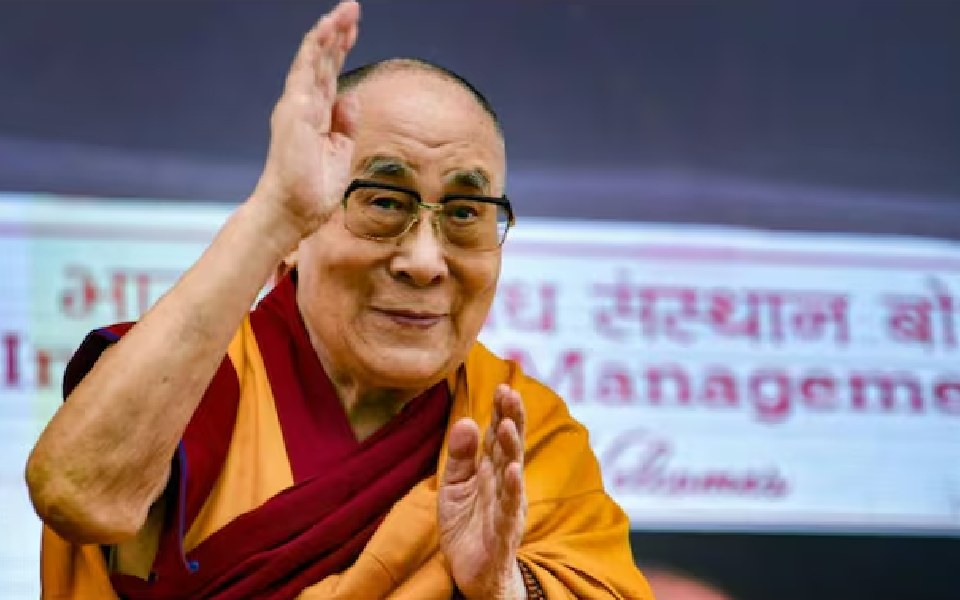
Beijing, Jul 2 (PTI): China on Wednesday rejected the Dalai Lama's succession plan, insisting that any future heir must receive its seal of approval, adding a new chapter to Tibetan Buddhism's decades-long struggle with the Chinese ruling Communist Party.
The Tibetan spiritual leader on Wednesday said the institution of the Dalai Lama will continue and only the Gaden Phodrang Trust - founded by his office in 2015 - will have the authority to recognise the future reincarnation, ending speculation whether he will have a successor or not after his death.
His announcement ahead of his 90th birthday on Sunday is set to intensify tensions with Beijing.
"The Dalai Lama's reincarnation must follow the principles of domestic recognition, the ‘Golden Urn’ process, and approval by the central government, in line with religious traditions and laws,” Chinese Foreign Ministry spokeswoman Mao Ning told a media briefing while responding to the Dalai Lama's announcement.
The Dalai Lama caught the attention of the world following his high-profile defection to India in 1959 with a large group of Tibetans after the Chinese military under the command of Communist Party founder Mao Zedong took over Tibet.
Since then, he made Dharamsala his "adopted" home, which drew the ire of Beijing and his presence there continued to be a bone of contention between China and India, and the struggle for Tibetan autonomy may have to be continued by his successor.
His successor issue is also expected to flare up fresh tensions between Beijing and Washington as China's policy comes in conflict with the US Tibetan Policy and Support Act of 2020, which reaffirmed America's steadfast support for the Dalai Lama and Tibetan Buddhism. The Dalai Lama is revered by Tibetan Buddhists as a living manifestation of Chenrezig, the Buddhist god of compassion.
The reincarnation of the Dalai Lama and Panchen Lama, the second-high priest of Tibetan Buddhism, has to go through the centuries-old tradition of the Golden Urn law procedure started by the 18th century Qing dynasty, Mao said.
The current 14th Dalai Lama himself was recognised after his predecessor's death following traditional rituals, but his recognition was granted directly by the then-central government, exempting him from the Golden Urn process, Mao said.
She also spoke about how the traditional ceremony was incorporated in 2007 into China’s official regulations, along with a clause explicitly banning interference by overseas individuals and parties.
Significantly, the question and Mao's reply related to the Dalai Lama’s succession plan was conspicuously missing from the official transcript of the media briefing posted on the Chinese Foreign Ministry website on Wednesday.
Mao also defended the “sinicisation” of Tibetan Buddhism and other religions under the guidelines issued by Chinese President Xi Jinping.
“I believe that sinicisation of religion is not about restricting religious practice; rather, all religions must adapt to the social, cultural and historical context of the country. Tibetan Buddhism in China is a prime example of a religion that has integrated Chinese characteristics, exemplifying the process of sinicisation,” Mao said.
A commentary on the Dalai Lama’s succession carried by state-run Xinhua news agency Tuesday ruled out official recognition without proper rituals.
Any so-called "reincarnation" that bypasses traditional religious rituals, whether conducted within or outside the Chinese territory, lacks religious legitimacy and will by no means be recognised by Tibetan Buddhist followers, it said.
Notably ahead of the much-expected announcement by the Dalai Lama, China-appointed Panchen Lama, the second most important Buddhist monk in Tibet after the Dalai Lama, met President Xi here on June 6 and swore his loyalty to the ruling Communist Party.
Meeting the Panchen Lama, Xi asked him to make greater contributions to promoting ethnic unity and religious harmony, as well as the stability, development and progress in the Tibet Autonomous Region.
Xi also asked him to make continued efforts to promote the "sinicisation of religion".
Since he came to power in 2012, Xi has been calling for the “sinicisation” of all religions in the country, including Buddhism and Islam, to re-orient them to function under the guidance of the CPC, which ideologically remained atheist.
The 35-year-old Panchen Lama was appointed by China at the age of five in 1995, ousting the Gedhun Choekyi Nyima, who was chosen as the 11th Panchen Lama by the Dalai Lama.
Beijing has in the past accused the Dalai Lama of indulging in "separatist" activities and trying to split Tibet and considers him as a divisive figure.
However, the Nobel Peace Prize-winning spiritual head of Tibetan Buddhism has insisted that he is not seeking independence but "genuine autonomy for all Tibetans living in the three traditional provinces of Tibet" under the "Middle-Way approach".
The Chinese government held nine rounds of talks with the Dalai Lama’s representatives from 2002 to 2010, without any concrete outcome. No talks were held on record after Xi took over power in 2012.
In the talks, the Tibetan side pitched for genuine autonomy for the Tibetan people in line with the Dalai Lama's middle-way policy.
However, China consistently rejected his autonomy plan, stating that it covered vast stretches of the Himalayan region beyond the current Tibet Autonomous Region.
Let the Truth be known. If you read VB and like VB, please be a VB Supporter and Help us deliver the Truth to one and all.
Two injuries, one DNF, a DQ as India end messy World Relays campaign
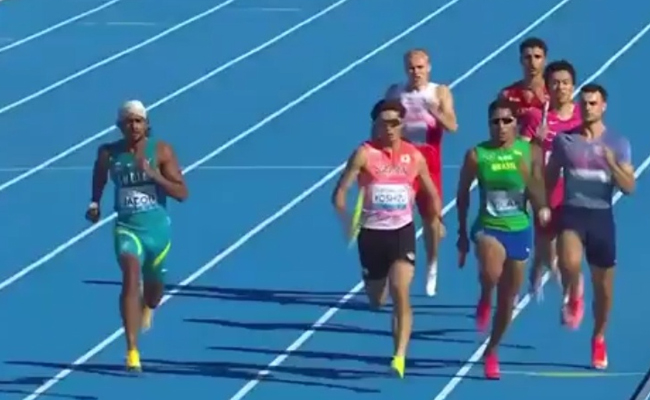
Gaborone (Botswana) (PTI): Amoj Jacob and Ragul Kumar got injured during the men's 4x400m and 4x100 races respectively as India ended their World Athletics Relays campaign in disappointment on the second day of competitions here on Sunday.
The Indian camp had high hopes of making the 2027 World Championships in the men's 4x400m relay but the team did not finish (DNF) the race as Jacob suffered cramps and pulled out of the race after taking the baton from the first leg runner Dharamveer Choudhary. Rajesh Ramesh and Vishal TK were to run in the third and fourth legs.
Those teams which could not qualify for the 2027 Beijing World Championships by reaching the final round of each of the six relay events on Saturday were given another chance in the second qualification round on Sunday.
The top two teams in each of the two heats (in all six relay events) booked the Beijing ticket on Sunday.
India will now have to try and qualify for the World Championships through the Top Lists of the World Athletics, which is a long and tedious process.
In the men's 4x100m race, third leg runner Ragul Kumar fell down the track after failing to hand over the baton inside the exchange zone to fourth leg runner Gurindervir Singh, which clearly showed the lack of coordination among the runners.
Harsh Santosh Raut and Animesh Kujur ran the first two legs.
The Indian quartet was disqualified and Kumar was seen being taken away from the Field of Play with the help of the volunteers.
It was a comedy of errors in the case of the women's 4x100m race, which saw the baton being dropped during an exchange between first leg runner Tamanna and second runner Nithya Gandhe, though the Indians finished the race in 53.09 seconds.
Gandhe started running quite a distance, but after realising that the baton was not in her hand, she turned and ran back to pick it up.
The only silver-lining for the Indian contingent was the national record time in the mixed 4x100m relay race, though the quartet of Ragul Kumar, Nithya Gandhe, Animesh Kujur and Sneha SS finished sixth in heat number two with a time of 41.35 seconds, bettering the previous national mark of 42.30 seconds set in March in Chandigarh.
The mixed 4x400m relay quartet of Theerthesh P Shetty, Kumari Saloni, Nihal William and Rashdeep Kaur ended at fifth in heat number one with a time of 3 minutes and 19.40 seconds.
On Saturday, all the five Indian relay teams had failed to make it to the respective final rounds and thus missed out on the 2027 World Championships berths.