China starts new drills in Taiwan Strait against ‘separatist forces’
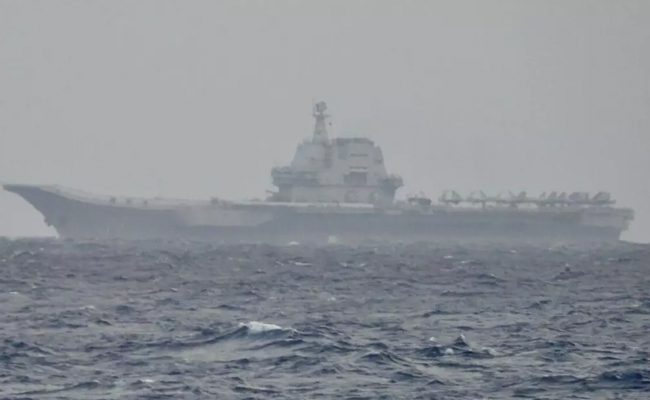
Beijing (PTI): China on Monday launched massive military drills in the middle areas of the Taiwan Strait as a “punitive and deterrent” action against Taiwan’s separatist forces, days after the US announced a record USD 11.1 billion arms sales to Taipei.
The two drills, in which a host of advanced fighter jets, long-range rockets and naval ships are involved, came amid rising diplomatic tensions with Japan over Taiwan that Beijing claims as its territory.
"The Chinese People's Liberation Army (PLA) Eastern Theatre Command is employing fighters, bombers and unmanned aerial vehicles in coordination with long-range rocket fires to conduct drills in the waters and airspace in the middle areas of the Taiwan Strait on Monday," a Chinese military announcement said.
China has been conducting high-intensity military exercises around Taiwan since 2022, following then US House Speaker Nancy Pelosi's visit to Taipei.
ALSO READ: Russia says 90 Ukrainian drones tried to attack Putin's country residence
This is the sixth such drill. These exercises are widely interpreted as rehearsals for military action against the self-governing island which Beijing claims as part of its mainland.
The drills are a punitive and deterrent action against separatist forces who seek “Taiwan independence” through military build-up, and a necessary move to safeguard China’s national sovereignty and territorial integrity, Chinese Foreign Ministry spokesperson Lin Jian told a media briefing here.
Nothing will deter China from defending national sovereignty, security and territorial integrity. Anyone who crosses the line or makes provocations on the question will be met with China’s firm response. All attempts to hold back China’s reunification will invariably fail, he said.
Asked whether the drills were in retaliation to the US record arms sales to Taiwan, Lin said, “Anyone who crosses the line or makes provocations on the question will be met with China’s firm response”.
Taiwan condemned China's military drills, saying Beijing is using military intimidation to threaten neighbouring countries.
In its reaction to the drills Taiwan's Defence Ministry said in a post on X that rapid response exercises were underway, with forces on high alert to defend the island
In a separate statement, the ministry said it had deployed appropriate forces in response, conducting combat readiness drills.
Spokesperson for the Taiwanese president's office, Karen Kuo was quoted as saying that the drills undermined the stability and security of the Taiwan Strait and Indo-Pacific region and openly challenged international law and order.
A PLA statement said the drills focussed on striking mobile ground targets and intended to test the troops' capabilities of precision strikes on key targets.
The drills in which fighters, bombers, long range rockets and unmanned aerial vehicles will be used comes in the backdrop of the US approval of a record USD 11.1 billion arms package to Taipei which China sharply criticised and diplomatic tensions with Japan over Taiwan.
US President Donald Trump approved an arms package worth USD 11.1 billion for Taiwan, which, if cleared by the US Congress, would mark Washington's largest-ever arms sale to the island.
The arms sale aids Taiwan's independence forces' plans to turn the island into a powder keg, Chinese Foreign Ministry spokesperson Guo Jiakun told a media briefing here on December 18, reacting to Trump's approval to the arms sale.
"China will take resolute and strong measures to defend its national sovereignty, security and territorial integrity," he said.
The arms sales to Taiwan comes in the backdrop of rising China-Japan tensions over Japanese Prime Minister Sanae Takaichi's remarks in parliament on November 7 that a Taiwan contingency could be a "survival-threatening situation" for Japan that may lead to action from the country's defence forces in support of the US.
Her remarks angered China, which demanded Takaichi to retract her statement.
ALSO READ: Hamas confirms death of Abu Obeida, introduces new military spokesman
China has also criticised Japan's move to develop the easternmost island of Okinawa for the deployment of a mobile surveillance radar unit to monitor Chinese aircraft carriers and airplanes.
The Japanese side kept strengthening targeted military deployment near Taiwan region and even claimed it will deploy mid-range missiles, he said.
This time, it went even further by deploying a radar unit and troops to secretly monitor its neighbour," Guo said.
"Given the erroneous and dangerous remarks made by Prime Minister Sanae Takaichi on Taiwan, we must question: Is the Japanese side making trouble and provocations at one's doorstep to find a pretext for its military build-up and missions overseas," he said.
Let the Truth be known. If you read VB and like VB, please be a VB Supporter and Help us deliver the Truth to one and all.
India should create strategic buffers to navigate 'most difficult' energy shock: CEA Nageswaran
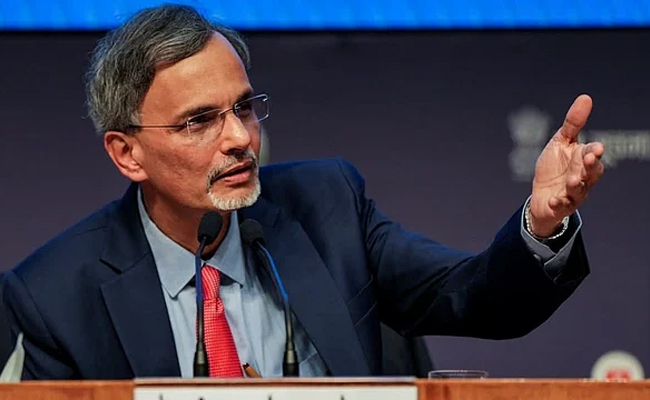
New Delhi (PTI): Chief Economic Advisor V Anantha Nageswaran on Saturday said India needs to create strategic buffers in the face of the "most difficult" energy shock that the country is facing amid the West Asia crisis.
Nageswaran also said the rising prices of fertiliser and petroleum products globally due to the crisis will make it challenging to achieve the 4.3 per cent fiscal deficit target for the current fiscal, while below normal monsoon and pass-through of higher energy prices could lead to "potential inflation spike".
He also said India has employment challenge emanating from AI, and there is a need to ensure that IT sector becomes more competitive and not lose jobs to AI, and instead create jobs that use AI within the IT sector or in other services.
Speaking at the ICPP Growth Conference organised by the Ashoka University, Nageswaran said the current account deficit (CAD) in the current fiscal could rise to over 2 per cent of GDP, from less than 1 per cent in FY'26.
"The ... priority for us is to create strategic buffers. This energy shock is the most difficult one compared to any other previous energy shock in terms of energy lost as a percentage of total global energy supply, not just oil, including gas.
"And we also need to use this occasion to think about other areas where we are vulnerable in terms of import dependence, nickel, tin, and copper. We need to build strategic buffers if we have to make a shot at manufacturing and becoming indispensable," Nageswaran said.
Since the beginning of the war in West Asia on February 28, crude oil prices soared to a four-year high of USD 126 per barrel on Thursday, from about USD 73 level before the war.
Stating that geopolitics will compel policymakers to be nimble and flexible and shed old model of thinking, Nageswaran said India is better prepared than many other countries to deal with the crisis because of the fiscal leeway that the country has due to lowering of fiscal deficit ratio to 4.4 per cent of GDP in FY'26.
Nageswaran said the West Asia conflict is more of a price shock than supply shock for India as the government is managing the supply side deftly.
"This particular conflict, which is going to be on a low simmer or a high flame situation, whatever it is, it is going to be there with us in some form or the other because the military conflict may be over, but the strategic conflict is well and truly alive. It will be so for some time," Nageswaran said.
He said the conflict has four channels of shock: price and supply shock, trade impact, sticky logistics costs and remittance shock.
India imports 60 per cent of its LPG usage and of that, 90 per cent flows through the now closed Strait of Hormuz.
Nageswaran said the pass-through of high global energy prices would have to be a "balancing act". He said some pass-through is already happening in commercial LPG, and the levy of export duty on diesel and ATF.
The government has cut excise duty on petrol and diesel to shield customers from the impact of the rise in petroleum prices. "We are coming around to arriving at a certain modus vivendi with respect to burden-sharing between the fiscal policy side, inflation, households and the oil marketing companies. So it has to be a balancing act," Nageswaran said.