China threatens 'countermeasures' after Trump signs bills supporting Hong Kong protesters
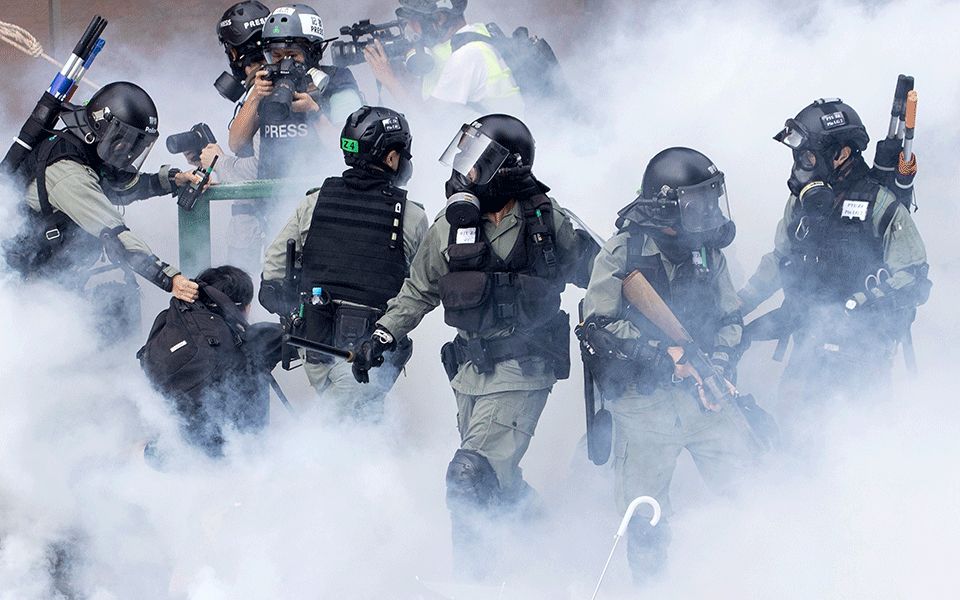
Beijing: China on Thursday accused the US of harbouring "sinister intentions" and warned of "countermeasures" after President Donald Trump signed a bill supporting pro-democracy protesters in Hong Kong.
The Chinese Foreign Ministry's statements came just hours after Trump signed the Hong Kong Human Rights and Democracy Act of 2019 into law.
The bill would require the State Department to certify once a year that Hong Kong is sufficiently autonomous to retain its special US trading consideration a status that helps its economy.
Reacting to Trump's move, the Chinese Foreign Ministry said: "This is a severe interference in Hong Kong's affairs, which are China's internal affairs".
"It is also in serious violation of international law and basic norms governing international relations. The Chinese government and people firmly oppose such stark hegemonic acts," the statement said.
"The nature of this is extremely abominable, and harbours absolutely sinister intentions," the statement said.
"This act will only further expose the malicious and hegemonic nature of US intentions to the Chinese people, including our Hong Kong compatriots. And the Chinese people will only stand in greater solidarity. The US attempts are bound to fail," it said.
But at the same time, it sought to reassure that China would implement the 'one country two system' formula under which Hong Kong was handed over to China by Britain in 1997.
Hong Kong is a semi-autonomous territory which operates under the 'one country, two systems' principle a structure that grants the city's citizens some degree of financial and legal independence from the mainland.
Hong Kong has been shaken by massive, sometimes violent, protests initially organised to oppose a now-suspended bill that would have allowed extraditions to mainland China. These protests have now turned into a wider movement for democratic reforms.
"The Chinese government is determined in opposing foreign interference in Hong Kong's affairs," the statement said.
"We are determined in implementing the 'one country, two systems' principle and safeguarding national sovereignty, security and development interests. We urge the US not to continue going down the wrong path, or China will take countermeasures, and the US must bear all consequences," it said.
The legislation came at a time when China and the US reached an advanced stage of negotiations to sign phase one agreement to end a trade war between the two world's largest economies.
Let the Truth be known. If you read VB and like VB, please be a VB Supporter and Help us deliver the Truth to one and all.
AIITA welcomes Karnataka’s ban on obscene songs in school events
Bhatkal: The Karnataka unit of the All India Ideal Teachers Association (AIITA) has welcomed the Karnataka government’s decision to strictly ban school children from dancing to obscene songs during educational and cultural programmes in government, aided, and private schools across the state.
AIITA Karnataka State President M. R. Manvi congratulated the government for taking what he termed an important step to preserve the sanctity of education.
“Such decisions to safeguard the dignity of school children and uphold the values of education are the need of the hour. This rule should not be limited to government schools alone but must be strictly implemented in all private educational institutions as well,” he said.
He further urged the government to address other concerns within school programmes.
“The government should not only prohibit obscene dances in the name of school anniversaries, but also ensure that plays and dialogues that incite religious hatred are avoided. Schools should be centres of harmony, not platforms for spreading hatred,” he added.
According to a recent circular issued by the Department of School Education and Literacy, obscene dances are adversely affecting the mental health and moral values of students.
In this regard, schools have been advised to use songs that promote nationalism, positive thinking, the greatness of Kannada culture, and value-based traditions instead of inappropriate content during programmes.
The circular also emphasises that students should be dressed in decent attire.
AIITA also backed the department’s warning that disciplinary action would be taken against head teachers if such guidelines are violated. The association has further demanded that district Deputy Directors of Public Instruction strictly monitor the implementation of these rules.