China to begin construction of Ya'an-Linzhi section of Sichuan-Tibet Railway close to India's border

Beijing: China is all set to begin the construction of the strategic Sichuan-Tibet Railway between Ya'an in southwest Sichuan province and Linzhi in Tibet, close to the Indian border in Arunachal Pradesh, the official media reported.
China Railway announced on Saturday the bidding results for the construction of two tunnels and one bridge, as well as the power supply project for the Ya'an-Linzhi section of the Sichuan-Tibet Railway, indicating that construction of the project is about to begin.
The Sichuan-Tibet Railway is the second such project in Tibet after the Qinghai-Tibet Railway. It will go through the southeast of the Qinghai-Tibet Plateau, one of the world's most geologically active areas, a report by the state-run China News reported.
The Sichuan-Tibet Railway starts from Chengdu, the capital of Sichuan province, and travels through Ya'an and enters Tibet via Qamdo, shortening the journey from Chengdu to Lhasa from 48 hours to 13 hours, the report said.
Linzhi, which is also known as Nyingchi, is located close to the Arunachal Pradesh border.
China claims Arunachal Pradesh as part of southern Tibet while India contests it.
Linzhi also has an airport, one of the five built by China in the Himalayan region.
The newly-built Ya'an-Linzhi section runs 1,011 kilometers and includes 26 stations. Trains are expected to run at speeds between 120 and 200 km per hour, a staffer in charge of the project said.
The total cost of the entire Sichuan-Tibet Railway project is around 319.8 billion yuan (USD 47.8 billion), Global Times reported.
The Sichuan-Tibet railway is also of great significance in safeguarding national unity and maintaining border stability, the daily quoted Chinese experts as saying.
After the Sichuan-Tibet railway starts operation, Tibet will have more exchanges with other parts of the Chinese mainland. Strategically, China's Tibetan region will have much stronger capabilities in material transportation and logistical supplies," Lin Minwang, deputy director at the Center for South Asian Studies at Fudan University, said.
Qian Feng, director of the research department at the National Strategy Institute at Tsinghua University told the daily If a scenario of a crisis happens at the China-India border, the railway will provide a great convenience for China's delivery of strategic materials."
The Sichuan-Tibet Railway will not only accelerate and enhance the overall economic development of the Tibet region but will play an important role in safeguarding border stability, the daily's report said.
The construction of the Sichuan-Tibet Railway is of strategic importance that benefits the overall development of Tibet, Xiong Kunxin, an ethnic studies professor at the Tibet University in Lhasa, said.
As a major infrastructure project, the railway is set to improve transport that has hindered exchanges between the Tibet region and the rest of China, and could help transport advanced equipment and technologies from other places to Tibet, and bring local products out, Xiong said.
Observers said the new railway line will put Tibet on a fast track to catch up with other more developed regions of China, the reports said.
Both Sichuan and Tibet are rich in resources with their unique natural landscapes, huge mineral reserves, and a wide variety of medicinal herbs.
After the completion of the Sichuan-Tibet Railway, it is expected to greatly boost local tourism all along the line, it said.
It will also enhance person-to-person exchanges between different regions and ethnic groups, promote understanding and cultural integration, Xiong said.
Let the Truth be known. If you read VB and like VB, please be a VB Supporter and Help us deliver the Truth to one and all.
4 workers die after being buried under coal slurry in Jharkhand's Dhanbad
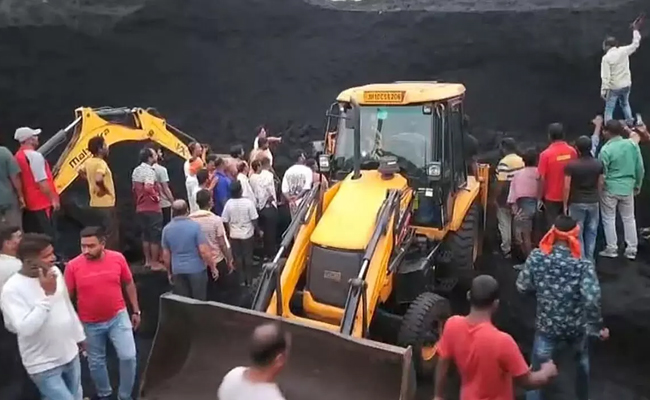
Dhanbad (Jharkhand) (PTI): At least four workers died after being buried under coal slurry in Jharkhand's Dhanbad district on Saturday, a police official said.
The incident took place at Moonidih coal washery in the command area of Bharat Coking Coal Limited (BCCL).
"Bodies of all four workers were dug out of debris during a rescue operation," Putki police station in-charge Waqar Hussain told PTI.
The incident took place when coal slurry was being loaded into trucks by workers, during which a large chunk of slurry fell and trapped several workers underneath, officials said.
The deceased have been identified as Manik Bauri, Dinesh Bauri, Deepak Bauri, and Hemlal Gope.
Meanwhile, the family members of the deceased and local villagers placed the bodies in front of the washery gate and began a protest.
They demanded compensation, jobs for dependents and action against those responsible for the incident.
Police and administration officials are trying to pacify the protesters, an official said.